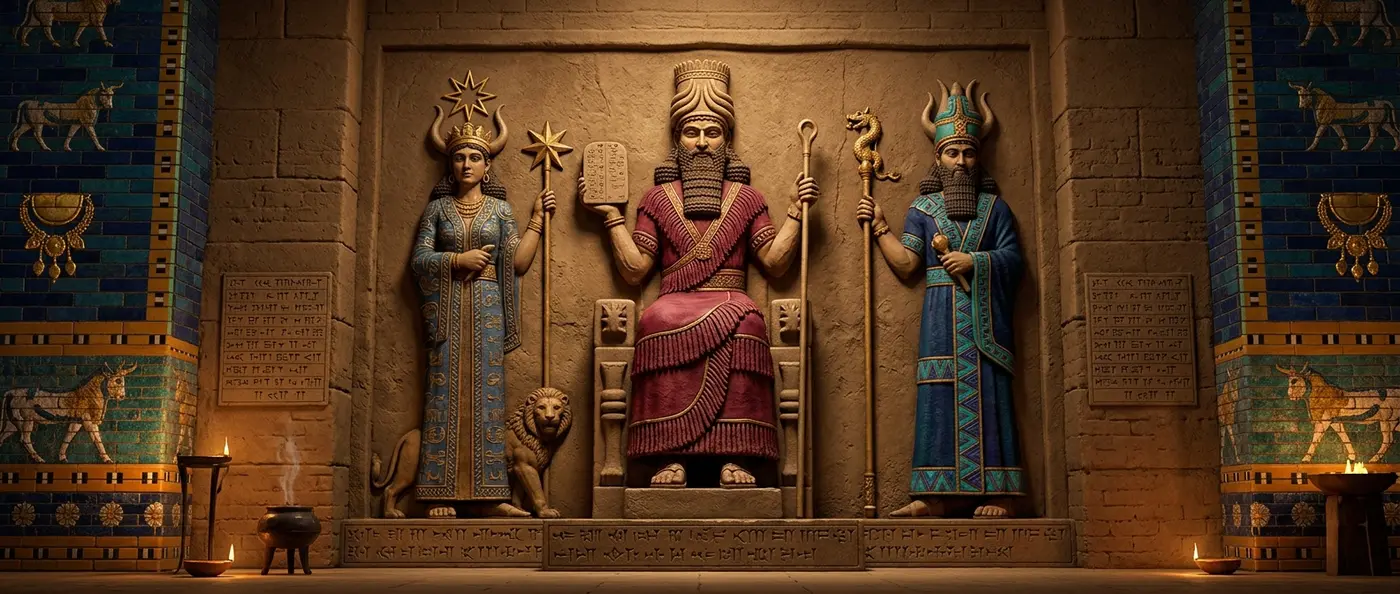
Clay tablets crack under desert heat, revealing prayers carved 4,000 years ago. Priests once scratched desperate pleas to gods who ruled with passion and power. Enlil. Marduk. Ishtar. Three names that echoed through temple halls from Babylon to Ur, shaping the fate of kings and commoners alike.
🌩️ Enlil: Lord of Wind and Destiny
Enlil held second place in Mesopotamia's divine hierarchy, ranking just below An, the sky god. As master of wind and storms, his power could create or destroy with equal fury. In Nippur, his cult center, worshippers honored him with annual festivals that brought the year's first harvest to his temple doors.
Ancient texts credit Enlil with separating heaven from earth at the world's beginning. His authority stretched beyond weather patterns — he decided the fate of kingdoms and crowned kings. No monarch could rule without his divine approval stamped in cuneiform.
Art depicts him with horns, symbols of divine power, while his scepter represented absolute dominion over the earth. Sumerians called him "Father of the Gods," recognizing his central role in creating and maintaining cosmic order. When Enlil spoke, mountains trembled and rivers changed course.
🔱 Marduk: From Local God to King of Gods
Marduk's rise to supreme deity mirrors Babylon's political ascent. Originally a local city god, he gradually absorbed the powers of older deities until he ruled all Mesopotamia. The creation epic "Enuma Elish" tells how he defeated primordial chaos — the dragon Tiamat — and forged the world from her corpse.
Every New Year, Babylonians celebrated Akitu, a twelve-day festival reenacting Marduk's victory over chaos. The king played a central role in these ceremonies, renewing his divine mandate to rule. Without this annual endorsement, his reign was considered illegitimate by both gods and subjects.
Marduk's temple, Esagila, and the Tower of Babel (Etemenanki) formed ancient Mesopotamia's religious heart. His statue resided there, believed to contain the god's actual essence. When enemies captured this statue, it spelled national disaster — the god himself had been kidnapped.
💘 Ishtar: The Goddess of Contradictions
No Mesopotamian deity embodied more paradoxes than Ishtar. Goddess of love and war, fertility and destruction, she combined forces that seem impossible to reconcile. The Akkadian Ishtar merged with Sumerian Inanna, inheriting a complex mythological legacy that spanned millennia.
As an astral deity, Ishtar connected to the planet Venus. Her symbol — an eight-pointed star within a circle — appears on countless seals and reliefs. With Shamash (sun god) and Sin (moon god), she formed a secondary astral triad that influenced human destiny from the heavens.
Her worship likely included sacred prostitution, a practice that shocked later observers. As protector of prostitutes and tavern keepers, Ishtar represented physical pleasure without shame. Yet as war goddess, she led armies into battle with the same intensity she inspired erotic passion.
Astral Deity
Connected to planet Venus and worshipped as both morning and evening star across the ancient world.
Love Goddess
Protected lovers and physical pleasure, with temples that functioned as centers of sacred prostitution.
War Goddess
Led warriors into battle and was often depicted with lions, symbols of her fierce, untamed power.
🏛️ Worship and Rituals
Mesopotamian temples weren't just worship buildings. They functioned as economic powerhouses, controlling vast estates and employing thousands. Priests managed enormous wealth and wielded deep political influence. Each day, the god's statue "awakened," "ate," and was "dressed" through elaborate ceremonies.
Major festivals like Babylon's Akitu mobilized entire cities. Processions carrying divine statues wound through streets while crowds joined feasts and sacrifices. These ceremonies reinforced social bonds and confirmed the cosmic order that kept chaos at bay.
Communication with gods happened through dreams, omens, and divination. Priests interpreted signs in sacrificed animals' livers or birds' flight patterns. Every decision — from war to marriage — required divine approval obtained through these ancient methods.
💡 Did You Know?
The name "Ishtar" survived into modern English through the Germanic goddess Eostre, from whom we get "Easter." The connection between Easter and fertility/renewal traces back to ancient Mesopotamian worship practices.
📜 Myths and Epics: The Gods' Stories
Mesopotamian epics preserved divine stories across millennia. "Enuma Elish" describes world creation through Marduk's battle against primordial chaos forces. "The Descent of Inanna/Ishtar to the Underworld" narrates the goddess's journey to the realm of the dead and her return that brings spring.
These myths weren't mere entertainment. They explained natural phenomena, justified social structures, and provided moral lessons. Annual reenactments of divine death and resurrection connected the human world to cosmic cycles that governed all existence.
Divine relationships mirrored human ones — love, jealousy, anger, forgiveness. Enlil punished humanity with floods but saved Utnapishtim. Ishtar loved passionately but destroyed her lovers. These contradictions brought the gods within reach of ordinary people struggling with their own flawed hearts.
🌍 Influence on Later Civilizations
Mesopotamian gods' legacy extends far beyond the Tigris and Euphrates. Jews during the Babylonian Captivity incorporated elements of these myths into their own tradition. The biblical flood bears striking similarities to the Epic of Gilgamesh's deluge narrative.
Greeks and Romans recognized Ishtar in Aphrodite and Venus. The Phoenicians' Astarte was essentially the same goddess with a different name. Through trade and conquest, Mesopotamian deities traveled throughout the Mediterranean world, adapting to local cultures.
Even today, their influence remains visible. The seven-day week, twelve-month year, and sixty-minute hour all trace back to Mesopotamian astronomy and religion. The gods may have fallen silent, but their legacy lives on in our daily rhythms.
⚔️ Comparing the Three Deities
🔬 Modern Archaeological Discoveries
Mesopotamian excavations continue revealing new details about these gods' worship. Tablets with unknown hymns, temples lost for millennia, statues still bearing traces of ancient paint. Each discovery deepens our understanding of how these gods shaped daily life in ancient cities.
Technology enables new approaches. Digital analysis of cuneiform texts reveals hidden meanings. Satellite archaeology locates buried temples. DNA from ancient bones traces worshippers' migrations. Mesopotamian gods come alive again through science.
Interest in these ancient deities isn't purely academic. In an age searching for identity and meaning, the myths of Enlil, Marduk, and Ishtar still speak to the human soul. Their struggles with chaos, the search for order, the tension between love and death — these are timeless themes that resonate today.