Picture this: a massive bull charges at full speed. A young athlete grabs its horns, somersaults over its back, and lands behind the beast. No weapons. No safety nets. Just split-second timing between human and animal that meant the difference between glory and death. This wasn't mythology — it was the most dangerous sport in the ancient world, practiced by the Minoans of Crete 3,500 years ago.
📖 Read more: Minoan Civilization: Crete Before the Greeks
🏺 The Discovery That Rewrote History
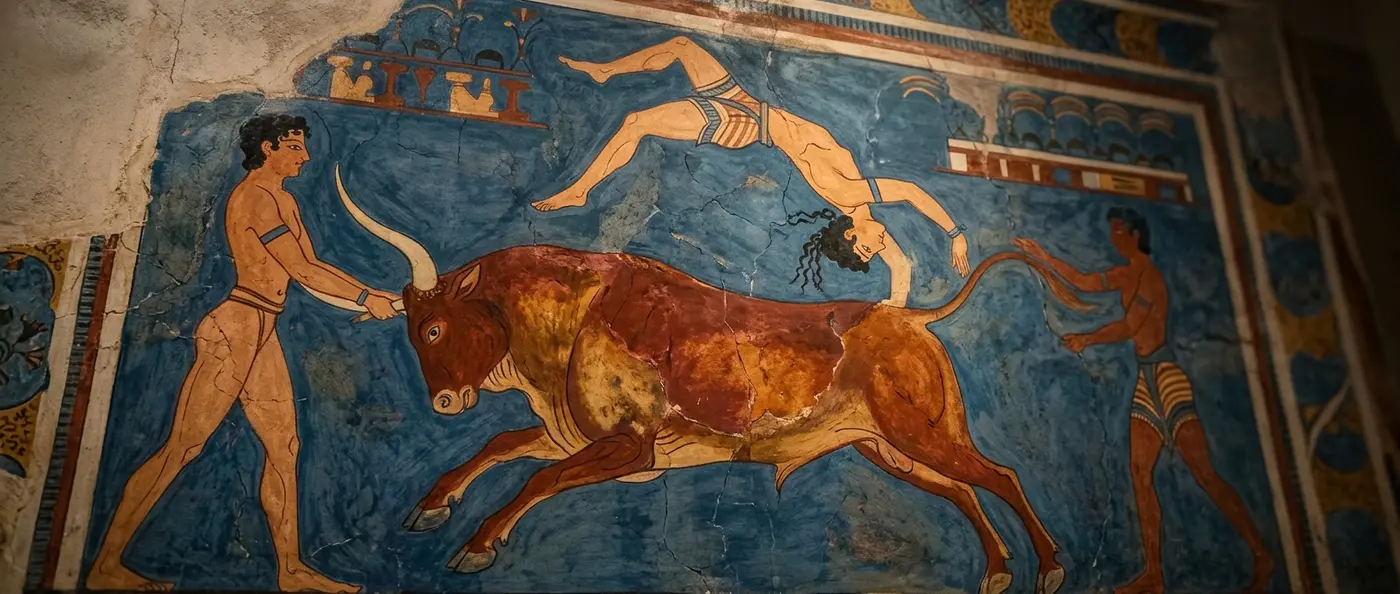
Arthur Evans expected pottery when he started digging at Knossos in 1900. What he found buried under Cretan soil was an entire lost civilization. Among the stunning frescoes that emerged from the rubble, scenes of bull-leaping caused the biggest sensation. The most famous, known as the "Toreador Fresco" and dating to 1450-1400 BCE, shows three figures caught in different phases of the deadly leap.
The fresco, now housed in Heraklion Archaeological Museum, depicts a galloping bull with three human figures. The central figure — painted with dark skin following Minoan conventions for men — is captured mid-vault over the animal's back. Two other figures with light skin, indicating women, stand at the front and rear of the bull.
What makes this discovery electrifying is that similar scenes appeared everywhere across Crete. Not just frescoes, but seals, pottery, jewelry. The repetition screams one thing: this wasn't artistic fantasy. Bull-leaping was real, and it mattered deeply to Minoan society.
⚔️ The Physics of Death
Minoan bull-leaping bore zero resemblance to modern bullfighting. No swords. No killing. Just pure acrobatics that demanded superhuman reflexes. According to the frescoes, the athlete would grab the charging bull's horns, execute a backflip over its spine, and stick the landing behind the animal.
Skeptics initially dismissed this as impossible. But experiments with trained acrobats and docile bulls proved otherwise. The maneuver is doable — barely. Success hinged on perfect synchronization between human and beast. One mistimed move meant trampling, goring, or worse.
The bull couldn't be just any bull, either. Size mattered. Too small, and the athlete couldn't clear the back. Too large, and the horns became unreachable. The perfect bull-leaping animal likely stood around 4.5 feet at the shoulder — powerful enough to be dangerous, manageable enough for the vault.
🔱 Sacred Bulls and Divine Power
Bulls dominated Minoan religion like nothing else. Horns of consecration crowned palace rooftops. Bull-head rhytons held sacred wine. The animal embodied strength, fertility, and divine presence rolled into one massive package. Bull-leaping wasn't entertainment — it was communion with the gods.
Many scholars link the practice to worship of the Great Goddess, the supreme deity of Minoan religion. Leaping over the bull might have symbolized humanity's triumph over nature's wild forces, or the union of mortal and divine through an act of supreme courage. The ritual likely coincided with religious festivals, perhaps to ensure good harvests or protection from natural disasters.
The timing wasn't random. Bulls represented the untamed power of earthquakes, volcanic eruptions, and storms that constantly threatened Crete. By mastering the bull, the Minoans symbolically mastered the chaotic forces that could destroy their world.
Sacred Ritual
Bull-leaping likely occurred during religious festivals, possibly to secure divine favor for good harvests or protection from the natural disasters that plagued Crete.
Royal Ceremony
Evidence from palace contexts suggests bull-leaping may have been connected to coming-of-age rites or ceremonies validating royal authority and divine approval.
Public Spectacle
The great courtyards of Minoan palaces, especially at Knossos, may have served as arenas where the ritual unfolded before crowds of spectators.
🏛️ The Arenas of Death
Knossos holds the smoking gun. The palace's central courtyard — roughly 165 by 82 feet of flat, paved stone — screams "arena." Surrounding buildings with balconies and windows would have given hundreds of spectators perfect sightlines to the action below.
Similar courtyards existed at every major Minoan palace: Phaistos, Malia, Zakros. The architectural consistency suggests bull-leaping wasn't a Knossos quirk but a civilization-wide practice. Even smaller centers like Agia Triada featured bull-leaping imagery, indicating the ritual's widespread importance.
Here's the kicker: archaeologists have found no specialized facilities for breeding or training bulls. This suggests the Minoans used wild bulls captured from the countryside, making the ritual exponentially more dangerous. A domesticated bull might cooperate. A wild one? Pure chaos.
📖 Read more: Phaistos Disc: Crete's Greatest Archaeological Mystery
🗿 The Minotaur Connection
The parallels are impossible to ignore. Greek mythology tells of King Minos hiding a bull-headed monster in Knossos's labyrinth, fed with young Athenians as tribute. Sound familiar?
Many researchers believe the Minotaur myth preserves a distorted memory of bull-leaping. The young "sacrifices" from Athens might have been athletes participating in the deadly ritual, where death was always possible. The "labyrinth" could be Knossos itself — a sprawling palace complex with endless corridors that would seem maze-like to outsiders.
The myth's emphasis on youth fits perfectly. Bull-leaping demanded peak physical condition, lightning reflexes, and the fearlessness that comes with inexperience. Older, wiser athletes probably knew better than to grab a charging bull by the horns.
💡 The Mystery of Disappearance
Bull-leaping vanished abruptly around 1450 BCE, the same time Minoan palaces burned. The volcanic eruption at Thera and possible Mycenaean conquest ended a civilization and its unique traditions. The ritual that had symbolized Minoan courage and faith for centuries survived only in frescoes — silent witnesses to a lost world.
📜 Art Meets Athletics
Minoan artists followed strict conventions when depicting bull-leaping. Bulls always appeared at full gallop, legs extended, radiating speed and power. Human figures showed the characteristic Minoan style — elongated bodies, impossibly narrow waists, and fluid motion that made stone seem to dance.
The attention to detail was obsessive. Every muscle in the bull's legs. The strain on athletes' faces. Even the veins in the animal's neck. Colors blazed — red, blue, yellow — creating scenes crackling with energy and movement.
Beyond frescoes, bull-leaping appeared on precious stone seals, gold rings, and tiny figurines. The variety of media proves this wasn't elite entertainment but something that resonated across all social classes. Rich or poor, everyone knew about bull-leaping.
Modern archaeological techniques continue revealing new details. 3D analysis of frescoes shows elements invisible to the naked eye. Biomechanical studies examine whether the depicted movements are anatomically possible. The answer? Barely, but yes.
Ethnographic research in modern societies where bull-related traditions survive offers valuable parallels. In southern France and Spain, traditional "games" with bulls include acrobatics reminiscent of Minoan depictions. The human urge to test courage against dangerous animals apparently transcends time and culture.
⚔️ Minoan Bull-Leaping vs Modern Bullfighting
🌅 Legacy of a Lost Art
Minoan bull-leaping leaves more questions than answers. Sport or sacred ritual? How many young athletes died attempting the deadly vault? Why did an entire civilization devote such energy and artistry to this practice?
We may never know all the answers. But the images the Minoans left behind speak of a people unafraid of danger, who honored men and women equally, and who saw something sacred in the relationship between human and animal. In a world where violence against animals was commonplace, the Minoans chose a different path — a dance with death that demanded respect from both sides.
Today, as we admire the frescoes in Heraklion Museum or walk through Knossos's courtyards, we can almost hear the crowd's roar, the thunder of hooves on stone, the athlete's breath in the moment before the leap. Bull-leaping may be lost to time, but its spirit — courage, grace, the pursuit of the impossible — survives in the art bequeathed by one of humanity's most mysterious civilizations.
The Minoans understood something we've forgotten: that the greatest achievements come not from conquering nature, but from learning to dance with it. Their bull-leapers didn't defeat the bull — they joined it in a moment of perfect, terrifying harmony. In our age of safety nets and risk management, there's something both alien and inspiring about people who would grab death by the horns and vault over its back, trusting nothing but skill, courage, and the favor of the gods.