🏛️ Europe's First Complex Civilization
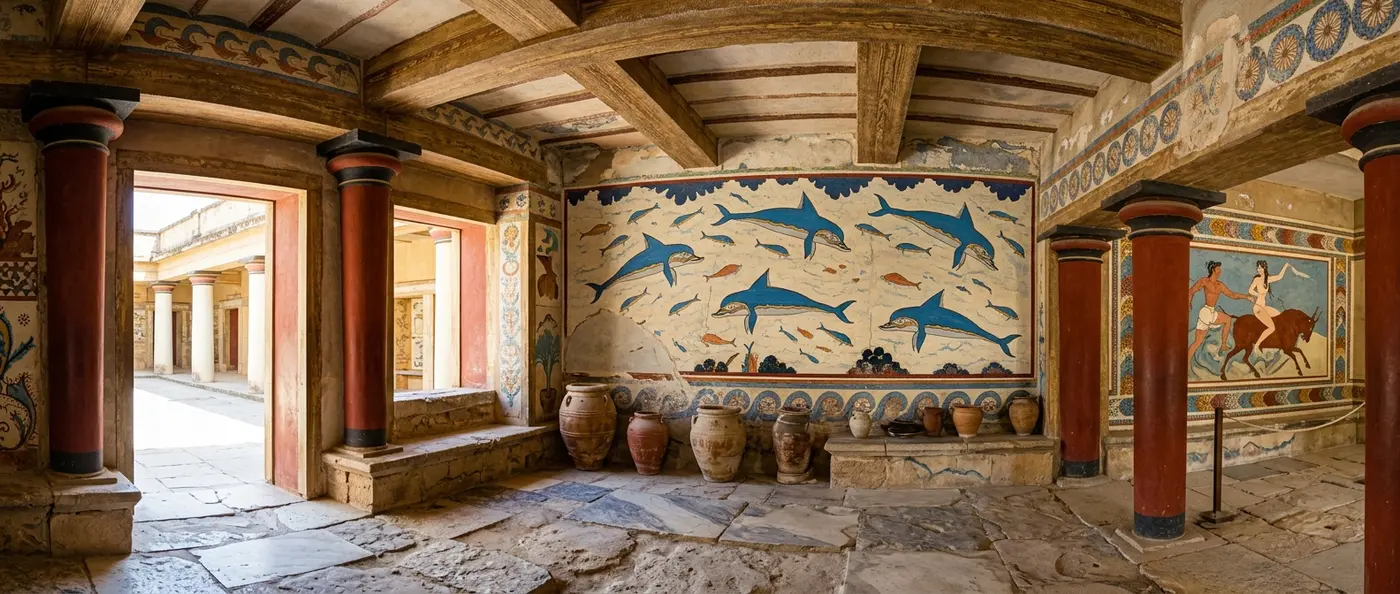
The Minoans built Europe's first sophisticated society from 3000 to 1100 BCE, creating one of the Bronze Age's most advanced cultures. They constructed massive palaces, developed complex administrative systems, and produced vibrant frescoes of dolphins, bull-leaping athletes, and snake goddesses.
Their name comes from the mythical King Minos, though they never called themselves that. British archaeologist Sir Arthur Evans coined the term in the early 20th century when he excavated the palace at Knossos. After their civilization collapsed, the Minoans were almost forgotten for millennia until archaeological excavations brought them back to light.
Their written language, Linear A, remains undeciphered today, keeping many of their secrets locked away. What we know comes mainly from their architecture, art, and artifacts — pottery, figurines, jewelry, and frescoes depicting a society deeply connected to the sea and nature.
🗿 The Kastelli Discovery
In June 2024, during construction work to install radar surveillance systems for the new airport, archaeologists uncovered a structure unlike anything from the Minoan period. The circular building, 48 meters in diameter, consists of eight concentric stone rings with small walls crossing between them, creating rooms in a labyrinthine layout.
The Greek Ministry of Culture dates the structure between 2000 and 1700 BCE, during the middle Minoan period. The building appears to have had two main zones: a circular structure 15 meters in diameter at the center and an area created by walls radiating outward.
The discovery is particularly significant because circular designs are extremely rare in Minoan architecture. While known palaces like Knossos are organized in square or rectangular layouts with central courtyards and room wings, this structure follows a completely different logic. Circular shapes are usually found only in Minoan tombs, raising questions about the building's purpose.
⚔️ Ritual Practices and Community Feasts
Finds from the excavation suggest the building wasn't used as a residence. The presence of numerous animal bones among other artifacts indicates periodic use for community ritual feasts involving food, wine, and other offerings. Minoan religion centered on elaborate ceremonies and offerings to the gods.
The Minoans had a complex religious life centered around the Great Goddess, often depicted with snakes or holding double axes. Their rituals included bull-leaping — the dangerous sport where young men and women vaulted over bulls — as well as offerings in sacred caves and mountaintops.
The labyrinthine layout of the Kastelli building inevitably recalls the mythical labyrinth of the Minotaur. Though the myth was recorded much later by the ancient Greeks, many researchers believe it may preserve memories from the Minoan era. The complexity of Minoan palaces with their endless corridors and rooms may have inspired these myths.
Bull-Leaping
The most famous Minoan sport, where athletes vaulted over bulls in religious ceremonies. Depicted in many frescoes of the period.
Snake Goddess
Central deity of the Minoans, depicted holding snakes and symbolizing fertility and nature's renewal.
Peak Sanctuaries
Minoans worshipped their gods on mountaintops, where numerous votive offerings and ritual traces have been found.
🏺 Palace Organization
Minoan palaces weren't just royal residences but centers of administration, religion, and economy. Knossos, Phaistos, Malia, and Zakros formed the cores of a sophisticated system that controlled production, storage, and distribution of goods.
The palaces contained massive storage areas with pithoi — giant clay vessels for oil, wine, and grain. Pottery, textile, and metalworking workshops operated under palatial supervision. Scribes recorded every transaction on Linear A tablets, creating one of history's first bureaucratic systems.
The sea played a central role in Minoan life. Their fleet dominated the Aegean and reached Egypt and Syria. They traded oil, wine, pottery, and textiles, bringing back copper from Cyprus, gold from Egypt, and precious stones from the East. This thalassocracy allowed them to develop a civilization without fortification walls — unique for the period.
💡 The Linear A Mystery
Despite decades of attempts, Linear A remains undeciphered. It contains about 90 syllabic signs and over 100 ideograms. Though it resembles Linear B (which was deciphered and proved to write an early form of Greek), the language recorded by Linear A is not Greek and probably doesn't even belong to the Indo-European language family.
🎨 Art and Daily Life
Minoan art stands out for its vibrancy and naturalism. Frescoes depict leaping dolphins, monkeys gathering saffron, and elegant women in elaborate dresses. Unlike art from other ancient civilizations, Minoans rarely depicted warfare scenes, preferring themes from nature and religious life.
Women appear to have held significant positions in Minoan society. They're depicted in positions of power as priestesses and perhaps even rulers. They wore skillfully tailored dresses that left the chest uncovered, elaborate jewelry, and had complex hairstyles. Men are usually depicted with loincloths and bare torsos, often in athletic activities.
Their diet was based on the Mediterranean triad of wheat, oil, and wine, supplemented with legumes, fruits, vegetables, and seafood. They also ate meat from sheep, goats, and cattle, while honey was the main sweetener. Symposiums and community feasts were an important part of social life, as indicated by the numerous cups and kraters found.
🌋 Destruction and End
Around 1450 BCE, most Minoan centers were destroyed. The cause remains a subject of intense scholarly debate. The Santorini volcanic eruption, one of the largest in human history, certainly caused tsunamis and ash fall over large areas. But the eruption's dating (around 1600 BCE) doesn't exactly match the destructions.
The Mycenaeans from mainland Greece likely exploited Minoan weakness and conquered Crete. After 1450 BCE, Linear B replaces Linear A, showing that Greek-speaking Mycenaeans now had control. Knossos continued operating under Mycenaean administration until about 1350 BCE, when it too was finally destroyed.
Minoan civilization didn't disappear entirely. Elements survived in the religion, art, and myths of later Greeks. Zeus was worshipped in Cretan caves where the Minoan goddess was once revered. Stories of Minos, the Labyrinth, and the Minotaur preserved memories of a civilization that dominated the Mediterranean for centuries.
📊 Minoans vs Mycenaeans
🔬 Modern Discoveries and Research
Archaeological research in Crete continues at an unrelenting pace. Each year new discoveries add pieces to the Minoan civilization puzzle. The circular building at Kastelli is just the latest in a series of significant finds that are changing our understanding of this ancient culture.
Modern technologies like LiDAR, satellite imaging, and DNA analysis are opening new research avenues. Recent genetic studies showed that Minoans had their roots in Neolithic farmers from Anatolia, with some admixture from Caucasian populations. They weren't Indo-Europeans like the later Greeks, which explains why their language remains undeciphered.
Collaboration between the Greek Ministry of Culture and international institutions continues to bring new evidence to light. Work at Kastelli will continue in cooperation with the Civil Aviation Service, aiming for complete excavation and protection of this unique monument. As archaeologists continue their research, each new find brings us closer to understanding a civilization that laid the foundations of European history.