📖 Read more: Samnite Children Found Buried with Bronze Warrior Belts
🏺 The Civilization That Worshipped War
From 100 to 800 CE, the Moche ruled what is now northern Peru. They weren't just another pre-Columbian culture — they were artists of violence, architects of massive pyramids, and creators of a religious system where blood was the most sacred liquid.
Two colossal pyramids dominating the Moche Valley reveal the scale of their power. The Huaca del Sol (Temple of the Sun) and Huaca de la Luna (Temple of the Moon) weren't simple religious centers. They were stages where the bloody drama of power played out, starring warrior-priests who turned death into art.
Here's the kicker: the Moche had no writing system as we know it. Instead of texts, they left thousands of ceramic vessels that tell stories. Every pot is a chapter in an illustrated encyclopedia of violence, power, and supernatural force.
Their ceramic library contains more narrative information than most ancient civilizations left in stone tablets. Each vessel was hand-crafted by master artists who understood that clay could carry messages across millennia. They were right — we're still reading their stories 1,200 years later.
⚔️ Ritual Combat and Sacred Sacrifice
The Moche didn't fight for territory or wealth. They fought for blood. Ritual battles were carefully choreographed spectacles where young warriors faced each other in single combat. The goal wasn't death on the battlefield — it was capture.
Prisoners were led to temples for the final chapter of their lives. There, before thousands of spectators, they were sacrificed in ways depicted with chilling detail on the ceramics. Their blood was collected in special cups and offered to gods or drunk by warrior-priests in ceremonies that enhanced their divine power.
The pottery shows every stage of this process. We see warriors in intricately painted armor, captives with bound hands, priests in animal masks, and the moment of sacrifice. It's like watching an ancient documentary, painted in clay.
But these weren't random acts of brutality. The Moche ritual combat system was as sophisticated as any religious practice. Warriors wore specific regalia that identified their rank and role. The battles followed strict rules. Even the sacrifice had precise protocols that had to be followed for the ritual to work.
🎨 Pottery That Shocks
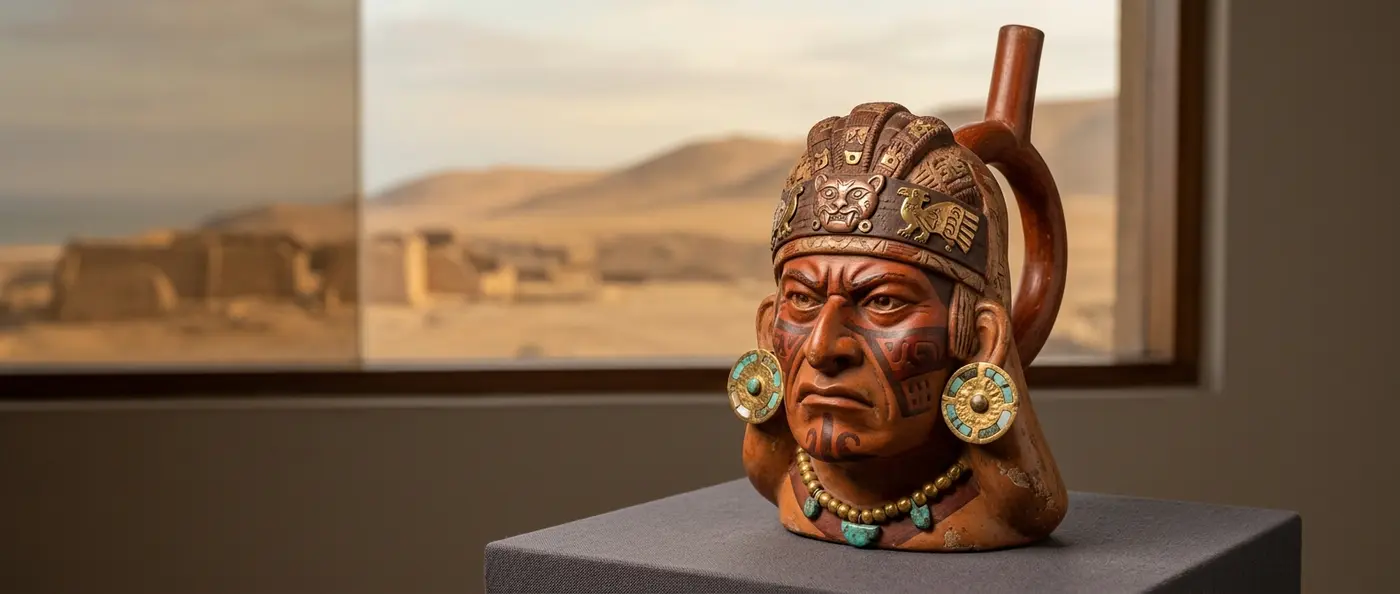
Moche ceramics weren't just functional objects. They were three-dimensional narratives, sculptures that spoke. Craftsmen created portraits so realistic we can see wrinkles, scars, and facial expressions. Each vessel was unique, made with techniques that far surpassed other contemporary civilizations.
The subjects? Beyond violence scenes, we find depictions of daily life, erotic scenes with stunning frankness, mythical creatures, and deities. The Moche weren't ashamed of anything — they portrayed everything with the same artistic skill, from a harvest scene to a decapitation.
Most impressive is their use of color. With a limited palette of red, white, and black, they managed to create scenes so vivid they seem to move. Their techniques influenced the region's ceramic art for centuries after their disappearance.
The pottery reveals a society obsessed with detail and narrative. Every vessel tells a story, but more than that — it preserves a moment in time. Facial expressions capture individual personalities. Clothing shows social status. Even the way someone holds a weapon reveals their training and experience.
📖 Read more: Spartan Education: How Ancient Greece Forged Warriors
Portrait Vessels
Realistic depictions of faces with unique features, scars, and expressions that reveal the identity of the portrayed individual.
Narrative Art
Every vessel tells a story — from mythological scenes to daily activities and ritual acts captured in stunning detail.
Sacrifice Scenes
Detailed depictions of ritual sacrifices and battles that reveal the significance of blood in their religious practices.
🏛️ Architecture of Giants
The Huaca del Sol isn't just big — it's massive. Built with millions of mud bricks, it was one of the largest structures in pre-Columbian America. Spanish conquistadors tried to destroy it by diverting the Moche River to wash away the structure and find treasures. They managed to destroy two-thirds, but what remains still impresses.
The Huaca de la Luna, smaller but better preserved, reveals breathtaking murals. Polychrome depictions of deities, mythical creatures, and ritual scenes cover the walls. Each level of the temple — built in phases, one on top of another — tells a different story.
Between the two temples stretched the city. Ceramic workshops, craftsmen's homes, markets, and administrative buildings. The Moche weren't just warriors and artists — they were an organized society with complex hierarchy and specialized professions.
The construction techniques were remarkable. Each brick was marked with the maker's symbol, allowing archaeologists to trace work gangs and construction phases. The pyramids weren't built by slaves but by organized labor forces that took pride in their work. You can still see the maker's marks today.
💡 The Mystery of Collapse
Around 800 CE, Moche civilization vanished abruptly. Archaeologists believe a series of catastrophic El Niño events caused floods and droughts that destroyed their economy. The religious elite lost credibility when sacrifices didn't bring rain, and society collapsed.
🗿 Legacy in Clay and Blood
The Moche left no written texts, but their legacy is equally eloquent. Their ceramics, now displayed in museums like the Brüning Museum in Lambayeque, continue teaching us about a civilization that saw art, violence, and religion as inseparable elements of human experience.
Each new vessel surfaces from the sand with another scene painted in clay. Recent excavations have revealed intact tombs filled with gold jewelry, weapons, and ceramics. The Lords of Sipán tombs, discovered in the 1980s, showed that Moche leaders were buried with the same wealth and ritual complexity depicted in their art.
Today, as archaeologists continue excavations in northern Peru's valleys, each new find confirms what the ceramics have been telling us for centuries. The Moche were a civilization that embraced violence not as necessary evil, but as sacred art. Through that art, they managed to speak to us, thousands of years after their disappearance.
Their influence extended far beyond their borders. Later civilizations like the Sicán and Chimú adopted Moche artistic techniques and religious practices. Even the Inca, centuries later, admired and imitated elements of Moche art. The pottery tradition continues today among descendants who still live in the same valleys.
📖 Read more: Ancient Greek Medicine: How Hippocrates and Galen Changed History
🔬 Modern Discoveries and Technology
Moche studies have entered a new era thanks to modern technology. Archaeologists now use 3D scanning to analyze ceramics and reveal details invisible to the naked eye. DNA analysis from human remains reveals relationships between sacrifice victims and the elite.
The bones tell a startling story: many sacrifice victims weren't foreign captives but members of the Moche community itself. This radically changes our understanding of ritual sacrifice. They weren't simply acts of conquest, but complex religious ceremonies where the community offered its best members to the gods.
Isotope studies of bones reveal diet and origin of individuals. Chemical analyses of ceramics show that certain vessels contained psychotropic substances used in ceremonies. These findings reveal a civilization where ritual sacrifice followed stricter protocols than we ever suspected.
Ground-penetrating radar has revealed entire neighborhoods buried under centuries of sand. Satellite imagery helps archaeologists identify new sites across the vast desert landscape. The Moche world was much larger than anyone suspected, with trade networks extending from Ecuador to Bolivia.
⚔️ Moche vs Other Civilizations
🌅 The End and Rebirth
The Moche collapse wasn't the end of their story. Their art and techniques influenced later civilizations in the region, like the Sicán and Chimú. Even the Inca, centuries later, admired and imitated elements of Moche art.
Today, Moche descendants still live in northern Peru's valleys. Many are craftsmen who continue the ceramic tradition, creating replicas of ancient vessels using techniques passed down through generations. It's a living connection to the past, proof that art can survive even when civilizations die.
The Moche pottery speaks in a language of painted clay — each vessel a page in their unwritten history. Through their ceramics, they still speak, telling their stories to anyone willing to listen. And we, millennia later, still decode their clay messages — stories of a people who painted their gods with human blood.
Their pottery workshops have become archaeological sites where modern artisans learn ancient techniques. Museums worldwide display Moche ceramics as masterpieces of world art. The warrior-priests who drank blood from ceremonial cups have become symbols of humanity's complex relationship with violence, beauty, and the sacred.