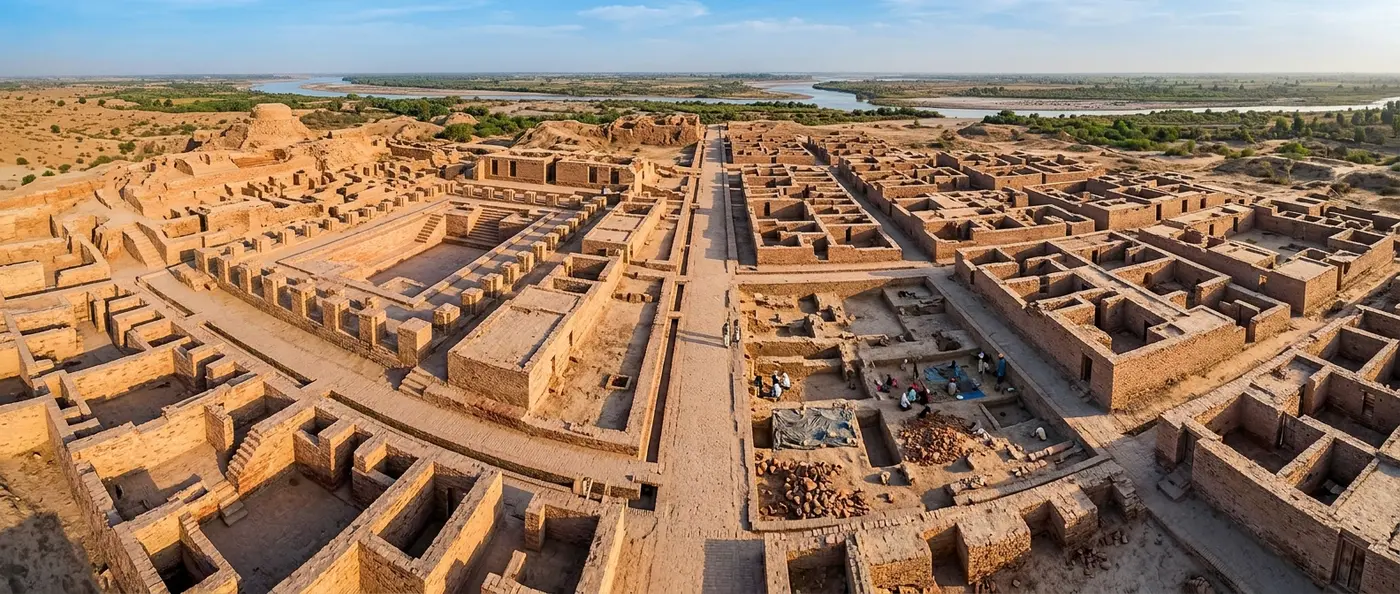
Mohenjo-daro—"the mound of the dead" in the Sindhi language—ranks among archaeology's greatest puzzles. Built around 2500 BCE, the same era as Egypt's pyramids, it was the largest city of the Indus Valley Civilization. Unlike other ancient civilizations, though, archaeologists found zero evidence of monarchy or central authority.
📖 Read more: Ancient Warrior Belts Found on Children in Italy
The Indus Valley Civilization stayed completely unknown until 1921, when excavations revealed the cities of Harappa and Mohenjo-daro. This mysterious civilization emerged 4,500 years ago and flourished for a millennium, exploiting the fertile plains of the Indus River and trading with neighboring Mesopotamia.
🏛️ A City Without Palaces
Walk through Mohenjo-daro's ruins and the absences scream louder than any monument. No ostentatious palaces. No grand temples or monuments. No obvious seat of government or hint of kings or queens. As Indus specialist Gregory Possehl from the University of Pennsylvania puts it: "It's quite an impersonal city."
Instead of monuments to power, the city boasted something far more practical and impressive: advanced urban planning. Streets ran in perfect grids, with main arteries up to 33 feet wide intersecting at right angles. Every house had access to a well with clean water and featured a private bathroom with drainage.
💧 The Great Bath: Temple of Water
Water ruled Mohenjo-daro like no pharaoh ever ruled Egypt. The city's most iconic structure is the Great Bath, a watertight tank measuring 39 by 23 feet and 8 feet deep. Built atop an artificial mound with walls of fired brick, it's the closest thing to a temple the city possessed.
The Great Bath wasn't just a pool. Its construction required advanced waterproofing techniques, with layers of bitumen between the bricks. Rooms and galleries surrounded it, suggesting a space of ritual significance. Possehl argues it represents an ideology based on cleanliness.
Cleanliness wasn't just valued—it was engineered into every corner. Wells appeared everywhere, and nearly every house contained a bathing area and sewage system. Drains from houses connected to central sewers running beneath the streets, a system that wouldn't reappear on such a scale for thousands of years.
🏺 Standardization and Trade
Beyond its grid of streets, Mohenjo-daro controlled trade routes stretching from Afghanistan to Gujarat. Finds include beads of ivory, lapis lazuli, carnelian, and gold, materials from distant regions. Yet the real revelation lies in the uniformity: every brick, every weight, every seal followed identical standards.
Pottery and tools made from copper and stone were standardized across the entire Indus civilization. Seals and weights indicate a system of strictly controlled trade. Bricks followed a specific 4:2:1 ratio (length:width:height) in all cities of the civilization, from Harappa to Dholavira.
Steatite Seals
Thousands of seals with mysterious symbols and animals were found in the city. The Indus script remains undeciphered to this day.
Weight System
Standardized stone weights followed a binary system. The smallest weight was 0.856 grams.
Maritime Trade
Indus seals were found in Mesopotamia, proving trade relationships extending to the Persian Gulf.
🗿 The Enigmatic Statues
Among the most famous finds is the tiny bronze figurine of a nude woman, known as the "Dancing Girl," discovered in 1926. Just 4.1 inches tall, it depicts a young woman in a pose suggesting movement, with one hand on her hip.
📖 Read more: Bronze Age Burial Mounds: Secrets of Ancient Monuments
Even more intriguing are the few stone sculptures of seated male figures. The most famous is the so-called "Priest-King," an intricately carved and painted statue. The name is misleading—there's no evidence he was a priest or king. All these sculptures were found broken, which archaeologist Jonathan Mark Kenoyer interprets as evidence of deliberate destruction.
💡 The Script Mystery
Despite thousands of seals with symbols found, the Indus Valley script remains undeciphered. The inscriptions are too short (averaging 5 symbols), making decipherment nearly impossible without some "Rosetta Stone."
🏘️ The City of Mounds
Mohenjo-daro sprawled across roughly 250 acres atop a series of artificial mounds. According to Kenoyer, the mounds developed organically over centuries as people continued building platforms and walls for their houses. Each new generation built on top of the previous one's ruins.
The Great Bath and a connected large building occupied the highest mound, but there was no clear hierarchy in space allocation. Houses of the rich and poor sat side by side, differing only in size, not in construction quality or access to amenities.
Without evidence of kings or queens, Mohenjo-daro was probably governed as a city-state. Perhaps by elected officials or elites from each of the mounds. The absence of fortifications and weapons suggests a peaceful society, at least for most of its history.
🌅 The End of a Civilization
What exactly ended the Indus civilization—and Mohenjo-daro—remains a mystery. Around 1900 BCE, the city began declining. Kenoyer suggests the Indus River changed course, which would have devastated the local agricultural economy and the city's importance as a trading center.
However, there's no evidence that floods destroyed the city. Nor was it completely abandoned. The final occupation layers show a poorer, less organized community that continued living in the ruins of former greatness.
📊 Comparison with Contemporary Civilizations
🔍 Legacy and Lessons
Mohenjo-daro teaches us that cultural evolution doesn't always follow the same pattern. While other ancient civilizations built pyramids and palaces, the Indus Valley people invested in infrastructure that improved everyone's daily life. The emphasis on hygiene, standardization, and urban planning created one of the most advanced cities of its time.
Today, Mohenjo-daro is a UNESCO World Heritage Site, but faces serious threats. Erosion from the Indus River, rising groundwater levels, and soil salinity threaten the ancient bricks. Conservation efforts continue as archaeologists race to preserve evidence that humans once built differently—and perhaps better.
Perhaps Mohenjo-daro's greatest mystery isn't how it fell, but how it functioned so well for so long without the usual power structures. In a world where inequality and hierarchy seem inevitable, the city without kings challenges us to rethink our assumptions about human organization.