Picture this: 3,500 years ago, warriors in bronze armor thundered across Greek hillsides in horse-drawn chariots. They spoke Greek. They built palaces that would make pharaohs jealous. They kept meticulous records on clay tablets. And then they vanished so completely that when Homer sang their stories centuries later, people thought he was making it all up.
🏰 Rise of the Bronze Age Greeks
Around 1600 BC, something extraordinary happened in mainland Greece. The Mycenaeans — named after their most famous city, Mycenae — didn't just appear overnight. They evolved from local Middle Bronze Age populations who absorbed and transformed Minoan influences from Crete into something entirely new.
The change reshaped the landscape. Simple farming villages became fortified palace complexes. Local chieftains became kings who commanded fleets and armies. The Mycenaeans took Minoan writing, art, and religious practices, then fused them with their own warrior culture and administrative genius. The result? Europe's first literate civilization.
Seven major kingdoms emerged across Greece — Mycenae, Tiryns, Pylos, Thebes, Orchomenos, Athens, and others. Each had its own king, the "wanax," ruling from a heavily fortified palace. They weren't united under one ruler, but they shared language, religion, and culture that set them apart from everyone else in the Bronze Age Mediterranean.
⚔️ Warriors and Weapons
If one thing defined the Mycenaeans above all else, it was their warrior culture. Homer's descriptions in the Iliad, written centuries later, preserve memories of their impressive armor and battle tactics.
A typical Mycenaean warrior wore bronze armor that included helmet, breastplate, and greaves. The most distinctive piece was the boar's tusk helmet — a genuine work of art requiring dozens of tusks to construct. Weapons included long spears with bronze points, various types of swords, and the famous "figure-eight shield" — a massive shield shaped like an 8 that covered almost the entire body.
Elite warriors fought from chariots — light, two-wheeled vehicles pulled by two horses. Unlike in Egypt or Mesopotamia, chariots weren't used for mass charges but mainly to transport aristocratic warriors to the battlefield, where they dismounted to fight on foot.
🏛️ Architecture and Engineering
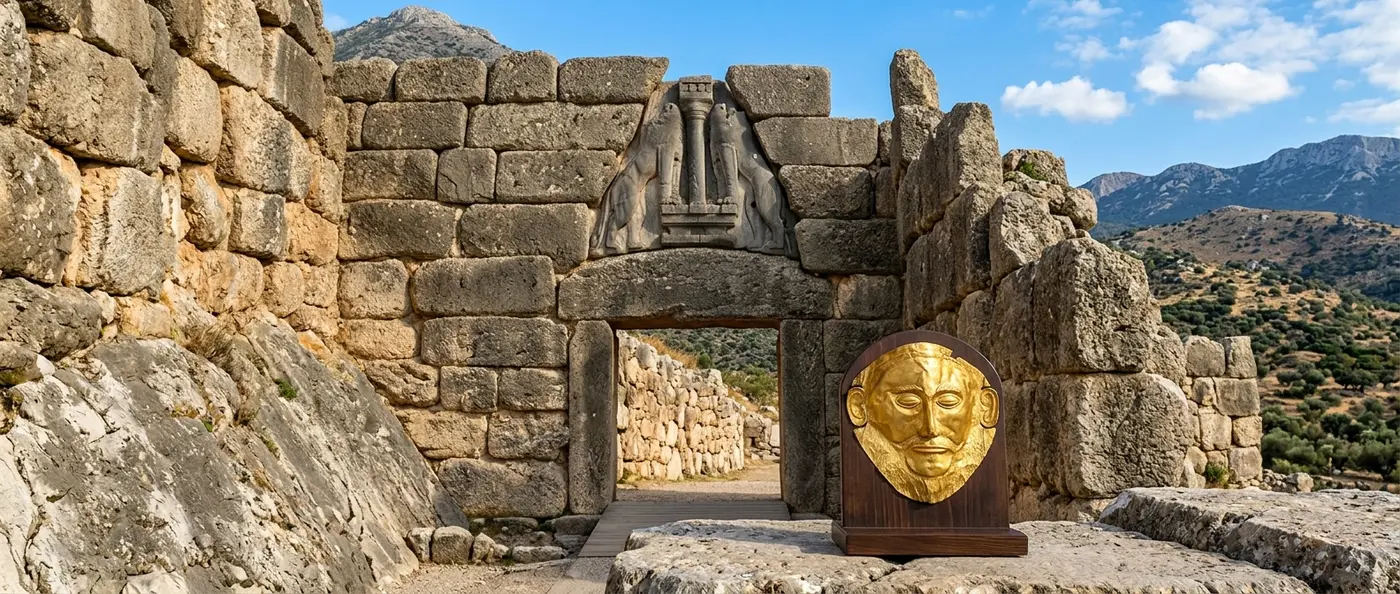
Mycenaean palaces were engineering marvels for their time. Built on strategic hilltops controlling roads and valleys, they were surrounded by massive walls that later Greeks called "Cyclopean," believing only the mythical Cyclopes could have lifted such enormous stones.
The Lion Gate at Mycenae remains the most iconic example of Mycenaean architecture. Built around 1250 BC, it consists of four massive stones — two vertical, one horizontal, and the famous relief with two lions. The triangular relieving space above the lintel, an innovative technique for distributing weight, shows the advanced engineering understanding the Mycenaeans possessed.
Inside the palaces, the central hall was the megaron — a large rectangular room with a central hearth and four columns supporting the roof. Here the king received visitors, held banquets, and conducted administration. Walls were decorated with colorful frescoes depicting hunting scenes, warfare, and religious ceremonies.
Cyclopean Walls
Walls up to 8 meters thick, built with massive stones without mortar. Perfect fitting of stones created impenetrable defenses.
Hydraulic Works
Underground cisterns and tunnels ensured water supply during sieges. The fountain at Tiryns is an excellent example.
Road Networks
Stone roads connected palaces with harbors and other centers. Bridges and ramps facilitated transportation.
📜 Linear B and Administration
The decipherment of Linear B by Michael Ventris in 1952 revealed the inner workings of Mycenaean administration. The tablets, written in an early form of Greek, revealed an extraordinarily organized bureaucratic machine.
The palace was the center of a centralized economy. Scribes recorded everything: from the number of sheep and wool production to quantities of olive oil and wine stored in warehouses. They documented taxes each village had to pay, offerings to gods, even food rations given to workers.
The tablets also reveal a complex social hierarchy. At the top was the wanax (wa-na-ka in Linear B), followed by the lawagetas (ra-wa-ke-ta), probably the military commander. There were also local officials, priests, craftsmen of various specialties, and at the bottom of the pyramid, slaves.
💡 The Linear B Mystery
For decades, Linear B remained unreadable. Many believed it was an unknown language. Ventris, an architect with a passion for ancient scripts, proved it was Greek — 700 years older than Homer!
🌊 Trade and International Relations
The Mycenaeans weren't isolated in their fortresses. They were traders and sailors who traveled throughout the Mediterranean. Mycenaean pottery has been found from Sicily to Cyprus, from Egypt to Syria. In Ugarit, Syria, the Mycenaeans had a permanent trading presence.
Trade wasn't limited to goods. The Mycenaeans imported raw materials like copper from Cyprus, tin from distant regions, ivory and gold. They exported olive oil, wine, perfumed oils in characteristic stirrup jar vessels, and their famous textiles.
Diplomatic relations with other powers of the era are evident. Hittite archives mention the land of Ahhiyawa, which many researchers identify with the Achaeans — the Mycenaeans. References speak of diplomatic contacts, trade agreements, and conflicts over control of the Asia Minor coasts.
🗺️ Mycenaean Trade Network
🔱 Religion and Mythology
Mycenaean religion was the precursor to ancient Greek religion. In Linear B tablets we encounter names of gods we recognize: Zeus (di-wo), Hera (e-ra), Poseidon (po-se-da-o), Artemis (a-te-mi-to), Dionysus (di-wo-nu-so). This shows that the Greek pantheon was already largely formed.
However, there were differences. Potnia, the "Lady," seems to have held a central position in worship, possibly as the Great Goddess of fertility. Poseidon wasn't just god of the sea but also of earthquakes and horses. There were also deities that later disappeared or were absorbed by others.
Religious ceremonies included animal sacrifices, offerings of agricultural products, and probably ritual banquets. Burial practices were particularly significant. Elite dead were buried with rich grave goods: gold jewelry, weapons, vessels, even chariots. Tholos tombs, like the so-called "Treasury of Atreus" at Mycenae, are architectural masterpieces showing the importance of afterlife in Mycenaean thought.
💀 Collapse and End
Around 1200 BC, the Mycenaean world collapsed. Within a few decades, the great palaces were destroyed or abandoned. Linear B disappeared. Long-distance trade stopped. Greece entered a period we call the "Dark Ages."
What caused this catastrophe? There's no simple answer. Tablets from Pylos speak of "watchers supervising the coasts," suggesting threats from the sea. Perhaps the mysterious "Sea Peoples" mentioned in Egyptian texts. Earthquakes have been recorded at many sites. Internal conflicts, economic collapse, climate change — all may have contributed.
Whatever the cause, the end was definitive. Survivors abandoned the great centers and scattered to small settlements. The art of writing was lost. Pottery became simpler. The memory of the Mycenaeans survived only in myths and epics preserved orally for centuries.
🏛️ The Mycenaean Legacy
Despite their collapse, the Mycenaeans left an indelible mark on Greek civilization. When Homer composed his epics centuries later, his heroes were Mycenaeans: Agamemnon "lord of men" from "golden Mycenae," Menelaus from Sparta, Nestor from "sandy Pylos." The Troy they besieged was a real city, and the war, though mythologized, may reflect actual Late Bronze Age conflicts.
Many elements of Mycenaean civilization survived and reemerged in Archaic and Classical Greece. The language, of course, but also religious practices, mythological traditions, even political institutions. The "basileus" of the classical period is a descendant of the Mycenaean "qa-si-re-u," though with much more limited powers.
Today, archaeological excavations continue to bring new evidence to light. Every year new tombs, settlements, even palaces are discovered. DNA studies from Mycenaean burials confirm genetic continuity with modern Greeks. The Mycenaeans weren't just an ancient civilization — they were our ancestors, the first page in the book of Greek history.
Genetic Continuity
DNA studies show that modern Greeks descend largely from the Mycenaeans, with small admixtures from later populations.
Linguistic Heritage
Greek has a continuous presence of 3,500 years, from Linear B to today — a unique phenomenon in Europe.
Mythological Tradition
Myths about Mycenaean heroes became the foundation of Greek literature, from Homer to the tragic poets.
🔬 Modern Discoveries
Mycenaean archaeology is a living field of research. In 2015, the "Griffin Warrior" tomb at Pylos revealed an intact burial with over 3,500 objects — the richest intact tomb found in Greece in 65 years. Among the finds, a seal stone with a battle scene so detailed it required a microscope to study fully.
New technologies open new research avenues. Isotope analysis reveals diet and human origins. Spectroscopy tells us where metals came from. 3D imaging allows digital reconstruction of destroyed objects.
Most Mycenaean sites remain untouched. It's estimated that less than 10% of known Mycenaean sites have been excavated. Each new dig can bring to light treasures of knowledge about our ancestors.
🗿 Mycenaean Civilization by the Numbers
Over 400 Mycenaean sites have been identified throughout Greece. Of these, only 30-40 have been systematically excavated. Linear B tablets found exceed 5,000, but represent only a tiny fraction of the archives that once existed.
The Mycenaeans weren't just the first Greeks. They were a civilization that combined power with art, trade with war, tradition with innovation. Their story is one of success and tragedy, rise and fall. But above all, it's the story of the people who laid the foundations for everything that followed — the language we speak, the myths we tell, the identity we carry.
As archaeologists continue their work, each new find adds a piece to the puzzle. The Mycenaeans, our Bronze Age ancestors, still have much to teach us. Their story is our story — and it's a story still being written.