📖 Read more: Sumerians: The Civilization That Invented the Wheel
🏛️ The Akkadian Empire
The Akkadian Empire, founded around 2334 BCE by Sargon the Great, was humanity's first multinational empire. It stretched from the Persian Gulf to the Mediterranean Sea, uniting for the first time the Sumerians of the south with the Semitic peoples of the north under one central authority. No one had ever built anything like it.
The capital city of Akkad — whose exact location remains unknown to this day — became the center of a massive trade network. Akkadian merchants traveled to the Indus Valley and Anatolia, bringing back precious metals, timber, and exotic goods. The Akkadian language became the diplomatic tongue of the age, used throughout the Near East for the next thousand years.
Under Sargon and his immediate successors, the empire thrived. New irrigation techniques boosted agricultural output. Standardized weights and measures facilitated trade. Art flourished — Akkadian sculptors created masterpieces like the famous bronze head believed to depict Sargon himself, its eyes gouged out by ancient enemies but its regal bearing still intact.
👑 Naram-Sin: The God-King
Naram-Sin, Sargon's grandson, ascended to the throne around 2254 BCE and ruled for 36 years. His reign marked both the peak of Akkadian power and the beginning of the end. He was the first Mesopotamian ruler to declare himself a god, adding the divine determinative to his name and depicting himself with the horns of divinity in official representations.
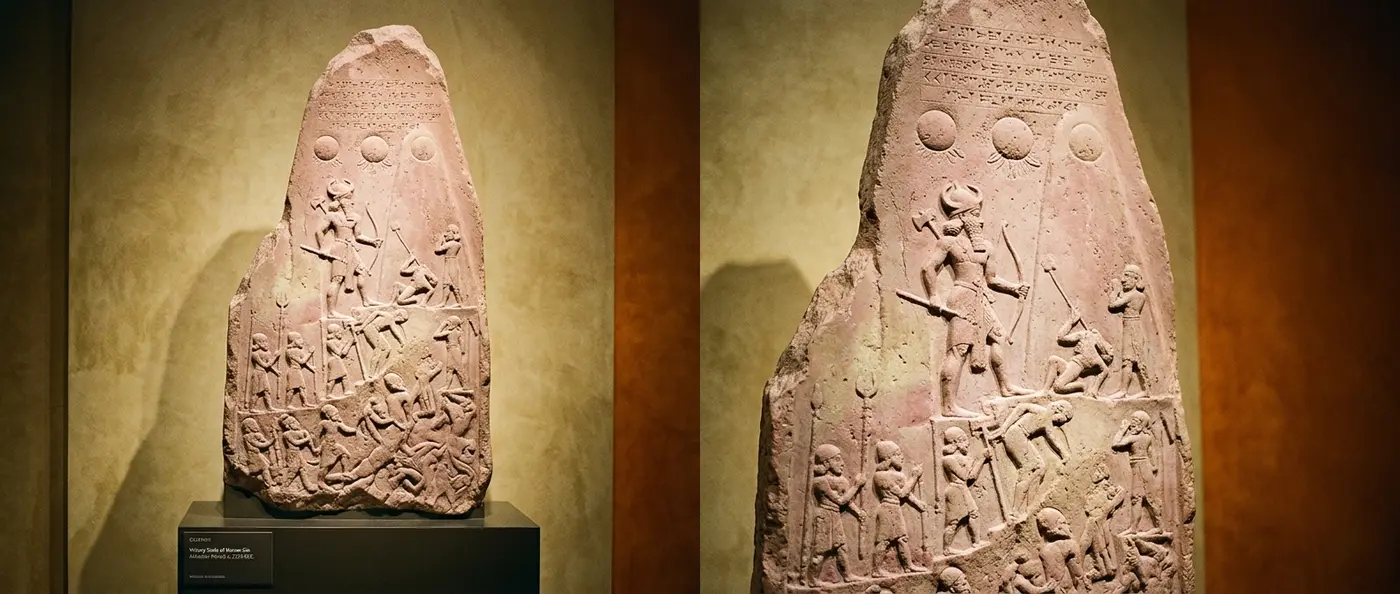
His military campaigns extended the empire in all directions. He defeated the Lullubi in the Zagros Mountains, subjugated the city-states of northern Syria, and reached the Mediterranean. His famous Victory Stele, now in the Louvre, shows him climbing a mountain while trampling his enemies, his divine crown gleaming under the stars of the gods.
But Naram-Sin's hubris didn't stop at self-deification. According to ancient texts, when the gods refused to give him favorable omens for a campaign, he decided to act without divine approval. Worse still, in a moment of rage, he ordered the destruction of the Ekur, the sacred temple of Enlil in Nippur — an act of sacrilege that would cost his empire dearly.
⚡ The Sacrilege and Divine Wrath
The "Curse of Akkad" text describes the consequences of this sacrilege in dramatic terms. Enlil, king of the gods, enraged by the destruction of his temple, summoned the Gutians — a barbarous mountain people — to invade Mesopotamia. The Gutians are described in the text as "people with the faces of monkeys, with the intelligence of dogs and the form of apes," who descended from the mountains like a flood.
The Gutian invasion was catastrophic. Cities were looted, irrigation canals destroyed, and fields left barren. The text describes how "grain no longer sprouted, water no longer rose in the canals, gardens bore no fruit." Famine spread across the land, and people were forced to eat their children to survive.
But the punishment didn't stop there. The other gods, following Enlil's example, abandoned their temples and left Mesopotamia without divine protection. The goddess Inanna/Ishtar abandoned Akkad, taking with her the city's prosperity and glory. Without divine favor, the great empire collapsed within a few years.
📜 Excerpt from the "Curse of Akkad"
"Enlil, because his temple was destroyed, what did he do? He brought down from the mountains those who know no cities, the Gutians who obey no one... Like small birds abandoning their nest, people abandoned their cities."
🔬 Historical Reality and Myth
Modern archaeological research has shed new light on the events described in the "Curse of Akkad." Indeed, around 2150 BCE, the Akkadian Empire collapsed abruptly. Archaeological evidence from various sites shows signs of abandonment, destruction, and dramatic population decline during this period.
The actual causes of the collapse were more varied than the religious text suggests. Paleoclimatological studies have revealed that the period around 2200-2100 BCE was characterized by severe drought throughout the Near East. Reduced rainfall and falling water levels in the Tigris and Euphrates would have had catastrophic consequences for agriculture and the economy.
The empire's overextension had also created serious administrative and military problems. Continuous revolts in remote provinces required enormous resources to suppress. The economy, which relied heavily on loot from conquests, began to collapse when there were no more wealthy regions to conquer.
Climate Change
Paleoclimatological data shows severe drought in the region around 2200 BCE, with rainfall reduced by 30% for about 300 years.
📖 Read more: Sargon of Akkad: The World's First Emperor
Economic Crisis
Imperial overextension and dependence on military loot created an unsustainable economic model that eventually collapsed.
Internal Revolts
Continuous rebellions in Sumeria, Elam, and other regions exhausted the empire's military resources.
🗿 The Legacy of the Curse
The "Curse of Akkad" isn't just a historical text — it's one of the earliest examples of political propaganda in human history. Written probably during the Third Dynasty of Ur (2112-2004 BCE), about a century after Akkad's fall, the text served specific political purposes.
The kings of Ur, who claimed succession to the Akkadian Empire, needed to explain why the gods had allowed their predecessors' destruction. The story of Naram-Sin's sacrilege provided the perfect explanation: the empire collapsed because of its leader's hubris, not because of any inherent weakness in the system.
At the same time, the text functioned as a warning to contemporary and future rulers. The message was clear: royal power comes from the gods and must be exercised with respect for divine order. Violation of this order, especially through sacrilege, would inevitably lead to destruction.
📚 Lessons for the Modern Age
The story of Naram-Sin and the curse of Akkad offers timeless lessons. Great empires collapse from external enemies, internal contradictions, and environmental crises. Excessive concentration of power, contempt for traditions, and inability to adapt to changing conditions proved fatal.
The text demonstrates how narrative shapes historical memory. The image of Naram-Sin as an arrogant king who caused his empire's destruction persisted for millennia, regardless of its historical accuracy. Later Mesopotamian kings learned from his story and tried to avoid his mistakes.
Today, as we face our own environmental and political crises, the story of Akkad gains new relevance. Even the most powerful empires crumble when they ignore environmental constraints and abandon their people. Collapse can come quickly and unexpectedly, turning glory into ruins within a generation.
⚖️ Naram-Sin vs Sargon the Great
🔍 Ongoing Research
The search for the city of Akkad continues to this day. Despite intensive archaeological research, the location of the world's first empire's capital remains one of the greatest mysteries of Mesopotamian archaeology. Some researchers believe it lies somewhere near modern Baghdad, while others argue it may have been completely destroyed by changes in the Tigris riverbed.
Satellite archaeology and ancient DNA analysis are revealing fresh details about this critical period. Recent studies have identified genetic changes in Mesopotamian populations during the collapse period, suggesting massive population movements.
The story of Naram-Sin and the curse of Akkad remains alive not only as an archaeological mystery but also as a timeless lesson about the limits of human power. Climate change, political instability, economic crises — the parallels to Akkad's collapse are unmistakable. The question remains whether we can avoid repeating Akkad's fatal mistakes.