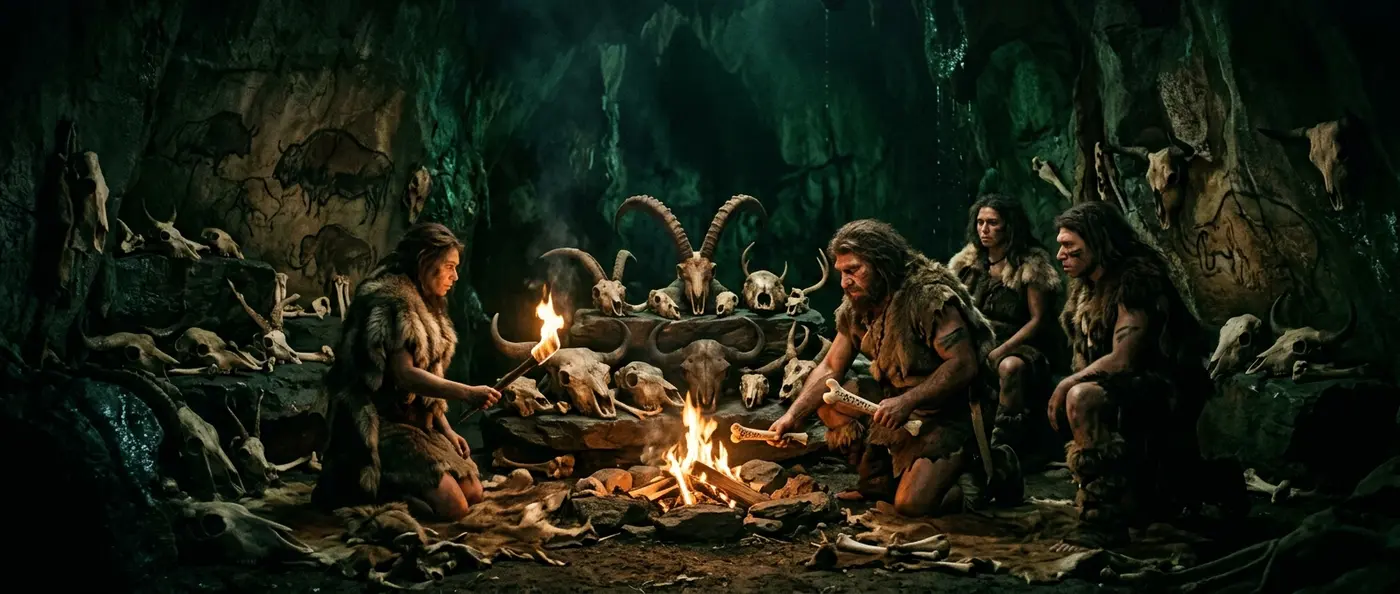
Inside a cave in central Spain, Neanderthals returned again and again across centuries to place skulls of large mammals — steppe bison, aurochs, rhinoceros, red deer — in specific spots throughout the cavern. They didn't live there. They didn't eat there. They just collected, arranged, and left. This behavior, spanning multiple generations over 43,000 years ago, challenges our understanding of Neanderthal cognition — and poses a question nobody can answer: why?
📖 Read more: Did Preeclampsia Kill Off the Neanderthals?
🦴 The Discovery: Des-Cubierta Cave
Des-Cubierta cave in the Lozoya valley of central Spain was first discovered in 2009 during systematic archaeological surveys of the broader region. Archaeologists quickly realized they had something unusual: within a single layer, they found 35 skulls of large mammals, most from horned or antlered animals. Among them were skulls of steppe bison, aurochs, rhinoceros, and red deer. Alongside these, over 1,400 stone tools of Mousterian technology — a toolmaking tradition exclusively linked to Neanderthals. Almost all skulls had their jaws removed, leaving only the upper cranium with horns or antlers — as if the head and horns were what truly interested the Neanderthals, not the meat.
Initially, the accumulation appeared chaotic. "At first glance, the deposit looks chaotic," explained Lucía Villaescusa Fernández, a researcher at the University of Alcalá. "What initially appeared to be a disorganized accumulation of materials turned out to preserve a clear record of both geological processes and human activity." The research team mapped the position of every archaeological find and compared the distribution of rock falls — the cave suffered multiple collapses in the millennia after its use — with that of bones and tools. The conclusion was definitive: the skulls had been deliberately placed in specific locations within the cave.
🔬 The Proof: Nature or Intent?
The critical challenge for archaeologists was proving that the skull accumulation wasn't the result of natural phenomena — floods, roof collapses, water flows, or animals dying naturally inside the cave over millennia. "This distinction is absolutely fundamental in archaeology," stated Villaescusa Fernández, "because understanding human behavior from the past requires first recognizing which parts of the archaeological record were created by humans and which were shaped exclusively by natural processes." The study was published in January 2026 in the journal Archaeological and Anthropological Sciences, adding crucial new data to the debate over Neanderthal cognitive abilities.
The research team applied methodical spatial analysis: they mapped the position of every archaeological object within the cave, compared the geographic distribution of rock fragments from roof collapses with that of bones and tools, and proved that the materials had completely different origins. "These materials had different sources and were not introduced into the cave by the same processes," the researcher explained. The skulls didn't follow rock-fall patterns — they were placed in locations that couldn't be explained by gravity or water.
The analysis also revealed that skulls had been placed in specific areas of the cave repeatedly, over an extended time period during particularly cold climatic phases between 135,000 and 43,000 years ago. This means the practice wasn't an isolated incident by one group — it was likely transmitted from generation to generation, as a cultural tradition unconnected to immediate economic or survival needs. The precise duration of each phase can't be measured directly, but the repetition shows consistent practice across many centuries. Neanderthals didn't hunt there and didn't inhabit the cave — they used it exclusively for this mysterious collecting activity.
The selectivity is key: Neanderthals didn't collect just any skull. They chose almost exclusively horned and antlered animals — steppe bison, aurochs, rhinoceros, red deer. Horns and antlers in many human cultures worldwide are chronically associated with power, fertility, or spiritual connection to the natural world. The removal of jaws shows they were interested in the skull's form with horns, not food. This clearly selective treatment rules out the hypothesis that these were simply meal remnants.
📖 Read more: Ancient Egyptian Medicine: Surgeons 4,000 Years Ago