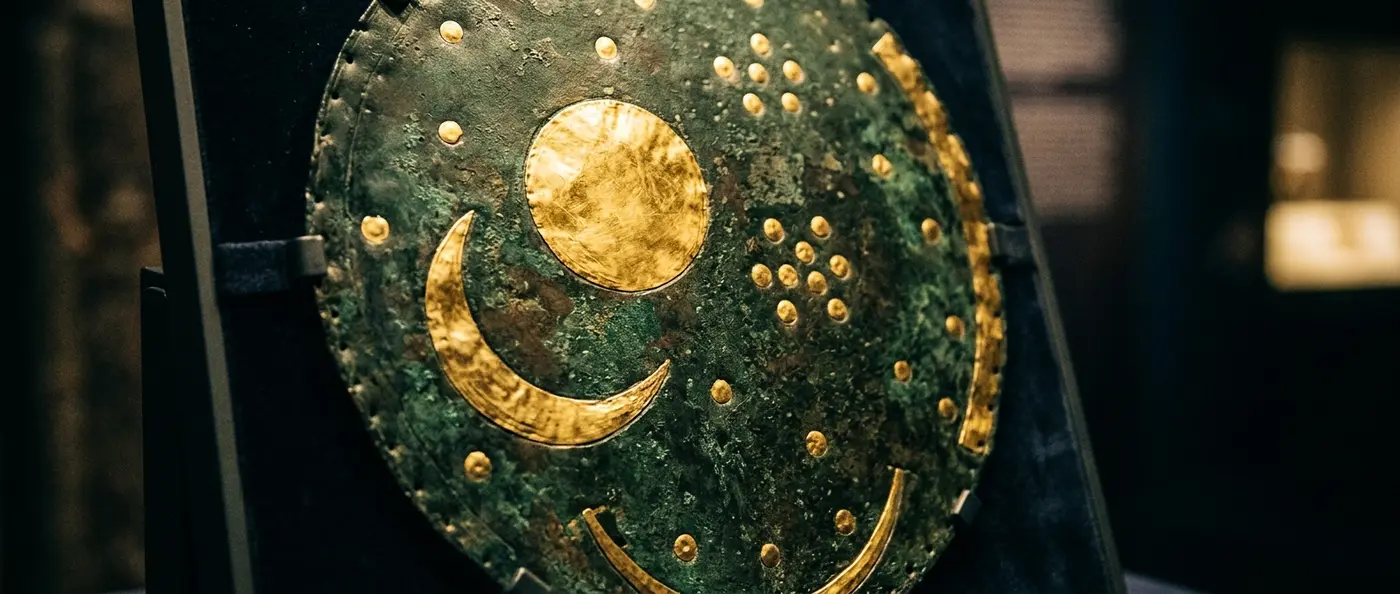
Picture holding a 3,600-year-old map of the heavens. Bronze and gold in your hands. The Nebra Sky Disk, unearthed in 1999 near the German town of Nebra, isn't just another archaeological find — it's the oldest known depiction of the cosmos ever discovered, showing prehistoric Europeans tracked celestial movements with the same precision as astronomers in Mesopotamia and Egypt.
🌙 The Discovery That Shattered Assumptions
Two treasure hunters with metal detectors made the find of a lifetime in 1999. On Mittelberg hill near Nebra in Saxony-Anhalt, they struck something that would rock the archaeological world. A mysterious bronze disk alongside two swords, two axes, a chisel, and two spiral bracelets. They had no idea they'd just uncovered humanity's oldest known astronomical instrument.
The disk measures roughly 32 centimeters across and weighs 2.2 kilograms. Bronze forms the base. Gold appliqués dance across its surface — depicting the sun or full moon, a crescent, and 32 stars. Seven stars cluster together, almost certainly representing the Pleiades. Dating to around 1600 BCE places it squarely in the Bronze Age, a period we thought lacked such sophisticated astronomical understanding in Europe.
After adventures involving illegal sales and the eventual arrest of antiquities dealers in 2002, the disk landed at the State Museum of Prehistory in Halle. There, scientists from around the globe began deciphering its secrets.
⭐ Cracking the Celestial Code
Analysis revealed this wasn't decorative art. The gold appliqués sit with stunning precision. Two 82-degree arcs at the disk's edges match exactly the angle between sunrise and sunset positions during summer and winter solstices at Nebra's latitude.
The disk functioned as an astronomical calendar. Ancient users could determine the season by observing the sun's position relative to the arcs. Even more impressive — the Pleiades depicted alongside the moon indicates knowledge of the lunar year and the need to harmonize it with the solar year. Every ancient civilization grappled with this problem.
A third golden arc at the bottom has been interpreted as a "solar barge," a mythological symbol common across ancient cultures. This suggests the disk served not just practical purposes but religious ones too, bridging scientific observation with mythology.
🔬 Technology and Craftsmanship
Metallurgical analysis revealed the scope of Bronze Age technology. The copper came from Austria. The gold from the Carpathian Mountains. This shows extensive trade networks connecting different regions of central Europe.
The disk's construction happened in at least four phases. First, they placed the sun/full moon, crescent, and stars. Next came the two horizon arcs. Later they added the "solar barge" at the bottom. Finally, they punched 39 holes around the perimeter, probably to mount it on a support or carry it as a ceremonial object.
Metallurgical Mastery
Combining Austrian copper with Carpathian gold demonstrates advanced metalworking techniques and extensive trade networks spanning hundreds of miles.
Multi-Phase Construction
Creation in four distinct phases suggests the disk evolved over time, adding new elements as astronomical knowledge increased.
Measurement Precision
The 82-degree arcs correspond exactly to solstice positions, showing remarkable astronomical accuracy for the period.
🌍 Comparing Ancient Astronomical Achievements
The Nebra Sky Disk isn't the only ancient astronomical object discovered, but it's unique in combining science and art. Compared to other ancient astronomical monuments and objects, it stands out for its portability and complexity.
Stonehenge in England, dating roughly the same period, is a monumental astronomical observatory but obviously couldn't be moved. The ancient Egyptians developed sophisticated astronomical systems, but most of their objects were either monumental or written texts. The Antikythera Mechanism, though far more complex, is 1,500 years younger.
🗿 Ancient Astronomical Objects
🏛️ The Únětice Culture
The disk belongs to the Únětice culture, an Early Bronze Age civilization that flourished in central Europe between 2300 and 1600 BCE. This culture is known for advanced metallurgy and rich burial customs.
Únětice people were traders and craftsmen who maintained contacts with distant regions. They controlled important trade routes and had access to precious metals. Their ability to create such a complex astronomical instrument shows they possessed not only technical skills but deep understanding of celestial phenomena.
Excavations of period graves have revealed rich burial goods, including gold jewelry, bronze weapons, and ceramics. But nothing compares to the uniqueness and significance of the Nebra Sky Disk. Its existence suggests there was an elite of priest-astronomers who possessed specialized knowledge and had the power to commission such precious objects.
💫 Mythology and Symbolism
Beyond its practical use as an astronomical tool, the disk brims with symbolism connected to the religious beliefs of the era. The "solar barge" at the bottom is a motif found across many ancient cultures, from Egypt to Scandinavia.
According to these mythologies, the sun travels each night through the underworld in a boat to be reborn at dawn. The presence of this symbol on the disk suggests its creators shared similar cosmological concepts with other ancient civilizations.
The Pleiades, depicted as a cluster of seven stars, held special significance for agricultural civilizations. Their appearance and disappearance in the sky marked important seasons for sowing and harvesting. In many mythologies, the Pleiades connect to stories of transformation and divine intervention.
🌟 The Pleiades in Ancient Cultures
From ancient Greece where they were Atlas's seven daughters, to Australian Aborigines who saw them as seven sisters hunted by Orion, the Pleiades were among the most important star clusters for all ancient civilizations. Their depiction on the Nebra Sky Disk shows that prehistoric Europeans also recognized their significance.
🔍 Modern Significance and Legacy
The Nebra Sky Disk's discovery radically changed our understanding of prehistoric European knowledge and capabilities. It proves that 3,600 years ago, central European inhabitants had developed sophisticated astronomical knowledge comparable to the great civilizations of Mesopotamia and Egypt.
Today, the disk is displayed at the State Museum of Prehistory in Halle and has become a symbol of the Saxony-Anhalt region. In 2013, it was inscribed in UNESCO's Memory of the World Register, recognizing its global significance as a document of human cultural heritage.
The disk continues inspiring scientists and artists. Archaeoastronomers study it to better understand Bronze Age astronomical knowledge. Archaeologists search for similar objects that might shed more light on the culture that created it. Artists draw inspiration from its aesthetics and deep symbolism.
Perhaps the most important lesson the Nebra Sky Disk teaches us is that human curiosity about the sky and the desire to understand our place in the universe is as old as civilization itself. Our prehistoric ancestors looked at the same stars we see today and tried to find meaning in their patterns. The disk is proof they succeeded.