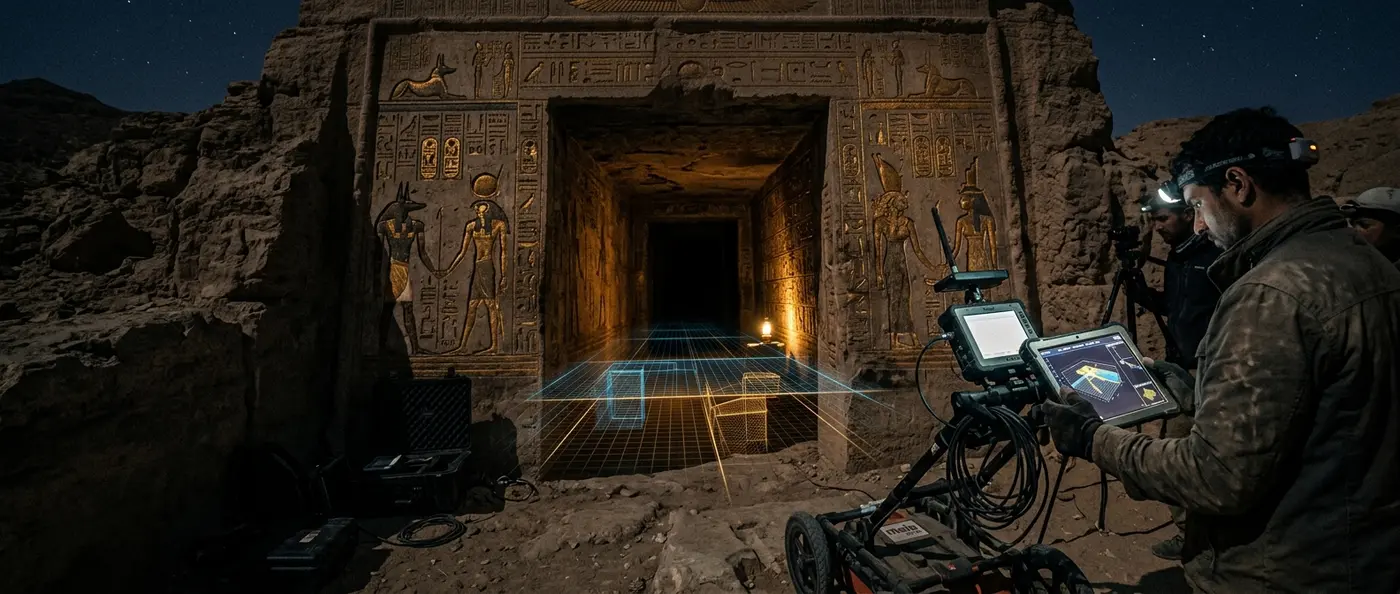
Ground-penetrating radar pulses through limestone bedrock. Thermal cameras map temperature variations across ancient walls. Muon detectors track cosmic particles as they pierce through solid rock. This is how archaeologists hunt for Nefertiti in 2026 — and they've never been closer to finding her.
🔍 The 3,300-Year Cold Case
Nefertiti vanished from history around 1336 BCE. One day she was co-ruling Egypt alongside Akhenaten, smashing enemies with a mace in royal reliefs. The next? Gone. No tomb. No mummy. No trace of where the "Beautiful One Who Has Come" went for her final rest.
This isn't your typical missing pharaoh case. Nefertiti wielded unprecedented power for a queen. She performed religious ceremonies reserved for pharaohs. She led armies. Some scholars think she ruled Egypt as pharaoh under the name Smenkhkare after Akhenaten died. A woman this powerful would have commanded a tomb to match — filled with gold, jewels, and secrets that could rewrite Egyptian history.
Egyptologists have proposed three main scenarios. Did plague kill her during the Amarna period? Was she murdered in a palace coup? Did she die in exile after the religious revolution collapsed? Each hypothesis leads back to the same question: where is she buried?
👑 The Queen Who Broke Every Rule
Forget the pretty face on that famous Berlin bust. The real Nefertiti was a revolutionary who helped tear down 2,000 years of Egyptian religion. Alongside Akhenaten, she abandoned the traditional pantheon of gods and established worship of the Aten — the sun disk. This wasn't just changing churches. This was dynamiting the entire power structure of ancient Egypt.
The art from Amarna tells the story. Nefertiti appears in scenes traditionally reserved for pharaohs: offering to gods, striking down enemies, driving war chariots. In one relief, she grabs a captive by the hair while raising a mace to crush his skull. Egyptian queens didn't do that. Pharaohs did.
She bore Akhenaten six daughters but no sons. When the king died around 1336 BCE, the succession became murky. Some evidence suggests Nefertiti ruled briefly as pharaoh before the boy-king Tutankhamun took power. If true, she would be one of the few women to hold absolute power in ancient Egypt — making her tomb even more significant.
🗿 The Face That Launched a Thousand Theories
Ludwig Borchardt's team uncovered the limestone bust in 1912 when his team uncovered Nefertiti's limestone bust in sculptor Thutmose's workshop at Amarna. The piece — now Berlin's most famous Egyptian artifact — shows a woman of striking beauty wearing the distinctive blue cylindrical crown. But there's something odd about it.
The left eye was never painted. Scholars debate whether this was intentional or the piece was simply unfinished. Some think it was a master model used to create other portraits. Others believe it held ritual significance — the missing eye representing death or the underworld.
The bust sparked international fascination with Nefertiti, but it also raised more questions. If this was found in a sculptor's workshop, where are the other portraits? Where are the statues that would have filled her tomb? The absence of such artifacts suggests her burial goods remain hidden somewhere, waiting to be discovered.
💡 Did You Know?
The famous Nefertiti bust has only one painted eye. The left eye was never completed, sparking theories about whether this was intentional or if the sculpture was simply unfinished when the workshop was abandoned.
🔬 High-Tech Tomb Hunting
Modern archaeology looks nothing like Indiana Jones. Today's tomb hunters wield laptops, not whips. Ground-penetrating radar sends electromagnetic pulses through bedrock, mapping cavities and structures up to 30 meters deep. Thermal imaging detects temperature variations that might indicate hollow spaces behind walls. Muon tomography uses cosmic ray particles to peer through solid rock.
These technologies have already revealed hidden chambers in the Great Pyramid and suspicious voids in Valley of the Kings tombs. The same tools are now focused on finding Nefertiti. Every wall in every tomb gets scanned. Every anomaly gets investigated. Every temperature variation gets mapped.
The breakthrough came from combining multiple technologies. Radar might show a void. Thermal imaging confirms unusual heat patterns. Muon detectors provide 3D maps of what's behind the rock. Together, they create a detailed picture of hidden spaces that would be impossible to detect with traditional methods.
Ground-Penetrating Radar
Detects voids and structures underground using electromagnetic waves. Can penetrate up to 30 meters deep under ideal conditions, mapping hidden chambers without excavation.
Thermal Imaging
Records temperature differences that may indicate hidden spaces. Particularly effective in areas with large temperature fluctuations between day and night.
Muon Technology
Uses cosmic particles to "see" through solid materials. Has already revealed unknown chambers in the Great Pyramid of Giza without any physical intrusion.
⚔️ The Prime Suspects
British Egyptologist Nicholas Reeves proposed in 2015: Nefertiti's tomb lies behind a wall in Tutankhamun's burial chamber. His hypothesis? KV62 was originally built for Nefertiti. When Tut died unexpectedly, they hastily walled off her burial chamber and squeezed the boy-king into the antechamber.
High-resolution scans of KV62's walls show intriguing anomalies. The northern and western walls display density variations that could indicate sealed doorways. If Reeves is right, we're looking at the archaeological discovery of the century. Nefertiti's intact burial chamber would dwarf even Tutankhamun's treasures.
Other candidates include the area around KV55, where a mummy possibly belonging to Akhenaten was found. Burying the royal couple near each other would follow Egyptian tradition. There's also speculation about undiscovered tombs at Amarna itself, the city Nefertiti helped establish.
Each location offers tantalizing clues. KV55 contained gold foil inscribed with Nefertiti's name. Amarna has yielded fragments of royal burial equipment. The Valley of the Kings continues to reveal new tombs — 63 have been found so far, with more suspected.
🏺 Potential Treasure Comparison
An intact Nefertiti tomb would contain treasures beyond imagination. As Great Royal Wife and possible co-ruler, she would have been buried with extraordinary wealth. Gold jewelry, ceremonial weapons, furniture inlaid with precious stones, and religious artifacts would accompany her to the afterlife. The artistic style would reflect the revolutionary Amarna period — more naturalistic and expressive than traditional Egyptian art.
🌅 2026: The Year of Discovery?
Multiple factors align to make 2026 a pivotal year. Egyptian authorities have approved new high-tech surveys in the Valley of the Kings. International teams are collaborating with unprecedented access to advanced scanning equipment. The technology has matured to the point where hidden chambers can be mapped with remarkable precision.
Recent discoveries have built momentum. New tombs continue to emerge in the Valley of the Kings. Each find provides more data about burial patterns and construction techniques. The accumulated knowledge from decades of research is finally reaching critical mass.
Whether Nefertiti's tomb is found in 2026 or later, the search continues to captivate the world. Every new scan brings us closer to solving this ancient mystery. When her tomb is finally discovered, it will be a moment that transforms our understanding of ancient Egypt forever.
The "Beautiful One Who Has Come" has been hiding for 3,360 years. But with cosmic particles, thermal cameras, and ground-penetrating radar closing in, her secrets may not stay buried much longer. In three months, muon detectors will complete their scan of KV62's western wall.