🔮 The Bones That Spoke to Gods
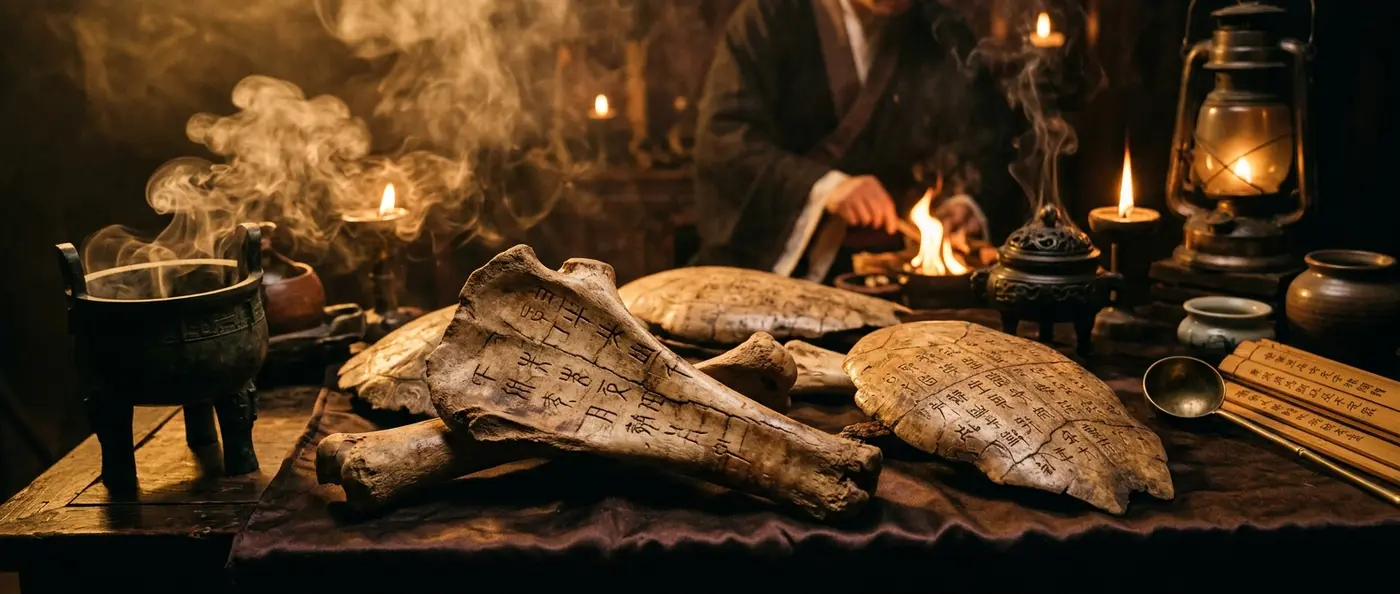
Oracle bones, known as jiaguwen (甲骨文), represent the earliest known examples of Chinese writing. Dating from the Shang Dynasty, approximately 1250-1050 BCE, they were discovered primarily in the ancient capital of Anyang in Henan Province. These are ox scapulae and turtle shells used for divination by the royal court.
The process was specific and ritualistic. A diviner would carve a question into the bone with a sharp tool. Heat was then applied until cracks formed on the surface. These cracks were "read" as answers from gods and ancestors. After the divination, the result was recorded next to the original question.
The questions covered every aspect of royal life: from military campaigns and agricultural harvests to illnesses and dream interpretations. A typical question might be: "Will we have a good harvest this year?" or "Is today favorable for attacking the enemy?" Each bone could be used multiple times until it was filled with inscriptions.
📜 The Birth of Chinese Writing
Oracle bones reveal an already mature writing system. By 1400 BCE, the system included 2,500 to 3,000 characters, many of which can still be read today. This suggests that Chinese writing had begun developing much earlier, possibly in the early 2nd millennium BCE.
The earliest characters were pictographic — schematic representations of objects. The character for "person" resembled an upright figure, while "woman" depicted a kneeling form. According to legend, Cangjie, the mythical inventor of Chinese writing, was inspired by animal tracks and bird claw marks in the sand.
As the language evolved, ways were needed to express abstract concepts. The solution was ingenious: combinations of simple images created new meanings. Two "deer" characters side by side meant "beautiful," while three deer in irregular arrangement meant "wild" or "rough." Arrangement and combination determined meaning.
🏺 From Bones to Bronze
After the oracle bone period, writing evolved into jinwen (金文) or "metal script," found on ritual bronze vessels. These vessels were used for ancestral offerings and bore inscriptions ranging from a few words to hundreds of characters. The writing had to harmonize with the decorative patterns of the vessels, leading to more artistic forms.
Turtle Shells
Preferred for important royal divinations due to their flat surface and the turtle's symbolic connection to longevity.
Pyromancy Technique
Heated metal tools were applied to predetermined points, creating cracks that were interpreted according to their direction and shape.
Royal Monopoly
Only the Shang royal court had access to this divinatory practice, making writing a tool of power and religious legitimization.
🗿 The Discovery That Changed History
For centuries, farmers near Anyang found these peculiar bones with carved symbols. They called them "dragon bones" and sold them to traditional pharmacies, where they were ground into medicines. Thousands of priceless archaeological finds were destroyed this way.
In 1899, scholar Wang Yirong, ill with malaria, bought "dragon bones" for treatment. Examining them, he recognized ancient characters. His discovery caused a sensation in academic circles. Soon, antiquities dealers began systematically searching for these bones, and their value skyrocketed.
Systematic excavations at Anyang beginning in 1928 revealed enormous quantities of oracle bones. They were found in storage pits, carefully catalogued — the archives of the Shang Dynasty. Through these, archaeologists reconstructed the genealogy of Shang kings, confirming historical records once thought mythical.
💡 The Oldest Find
In 2003, archaeologists claimed to have found "Neolithic oracle bones" 8,600 years old. If confirmed, this would overturn writing history by thousands of years. However, many experts dispute the findings, arguing it's unlikely that Shang characters were used 5,000 years earlier.
⚡ Standardization and Evolution
China's unification under the first emperor Qin Shihuangdi in 221 BCE brought writing standardization. Prime Minister Li Si undertook creating a unified system, the xiaozhuan (小篆) or "small seal script." Each character had to fit within an imaginary square, with lines of equal thickness and many curves.
But this elegant style was slow to write. Thus developed lishu (隶书) or "clerical script," allegedly invented by Cheng Miao while imprisoned. The new style, with straight lines and minimal curves, allowed faster writing and opened the path to calligraphy.
🎭 Divination and Power
Oracle bones weren't simply prediction tools — they were mechanisms for legitimizing royal power. The Shang king was the sole mediator between heaven and earth. Through divination, he communicated with ancestors and gods, receiving their approval for every important decision.
📊 Divination Question Topics
The process was strictly ritualistic. First, the diviner cleaned the bone and prepared the surface. Then carved the question in specific format: date, diviner's name, the question, and space for the answer. Heat application used special tools at predetermined points. The resulting cracks were "read" according to complex rules.
🔍 Decipherment and Legacy
Oracle bone decipherment began in the early 20th century. Scholars like Luo Zhenyu and Wang Guowei pioneered their study. Today, approximately 1,500 of the 5,000 known characters have been fully deciphered. Many remain mysteries.
Oracle bones provide unique insights into ancient Chinese society. We learn about climate (references to droughts and floods), geography (river and region names that have changed), diseases (symptom descriptions), even a solar eclipse in 1302 BCE confirmed by modern astronomical calculations.
This ancient writing system's influence extends far beyond China. It influenced writing systems throughout East Asia — Japan, Korea, Vietnam. Until the 18th century, more than half the world's books were written in Chinese characters. Even today, 1.34 billion people use variations of this system.
"Every character on oracle bones is a window into our ancestors' minds. We see their fears, hopes, daily lives — it's like hearing their voices after 3,000 years of silence."
🌟 Modern Discoveries and Mysteries
In 1992, archaeologists at Dinggongcun in Shandong Province unearthed a pottery fragment bearing symbols that looked suspiciously familiar. If the markings date to the Neolithic Longshan culture (2600-2000 BCE), they would push Chinese writing back another thousand years.
Modern technologies like 3D scanning and artificial intelligence help decipher illegible characters. Databases with digitized bones allow researchers worldwide to collaborate. Each year, new characters are deciphered, revealing more about this ancient civilization.
Oracle bones remind us that the human need for communication, recording, and seeking meaning is timeless. From ancient diviners interpreting cracks in bones to modern scientists deciphering ancient symbols, the quest for knowledge continues. Each revealed character is another piece of humanity's historical puzzle.