📖 Read more: Delphi Oracle: Where Ancient Greeks Decided Fate
🏛️ Greece's Oldest Oracle Predates Delphi by Centuries
Dodona holds a unique place in ancient Greek sacred history. According to Herodotus, it was Greece's most ancient oracle, with roots stretching deep into prehistory. Archaeological research places the sanctuary's founding around 2000 BCE, making it significantly older than Delphi.
The sanctuary sat in a valley surrounded by mountains, roughly 22 kilometers southwest of modern Ioannina. Its isolated location, far from major urban centers, made approaching the oracle feel like a journey into the unknown.
Dodona's age was only part of its power. It was the unique way Zeus communicated with his faithful. Here, the father of the gods didn't speak through a Pythia like at Delphi, but through the rustling of leaves on a sacred oak and the sound of bronze cauldrons surrounding the tree.
💡 Did You Know?
Homer references Dodona in the Iliad as "harsh-wintered Dodona," where Zeus's priests, the Selloi, slept on the ground with unwashed feet to maintain contact with the earth and receive oracles.
⚡ The Sacred Oak and Zeus's Prophecies
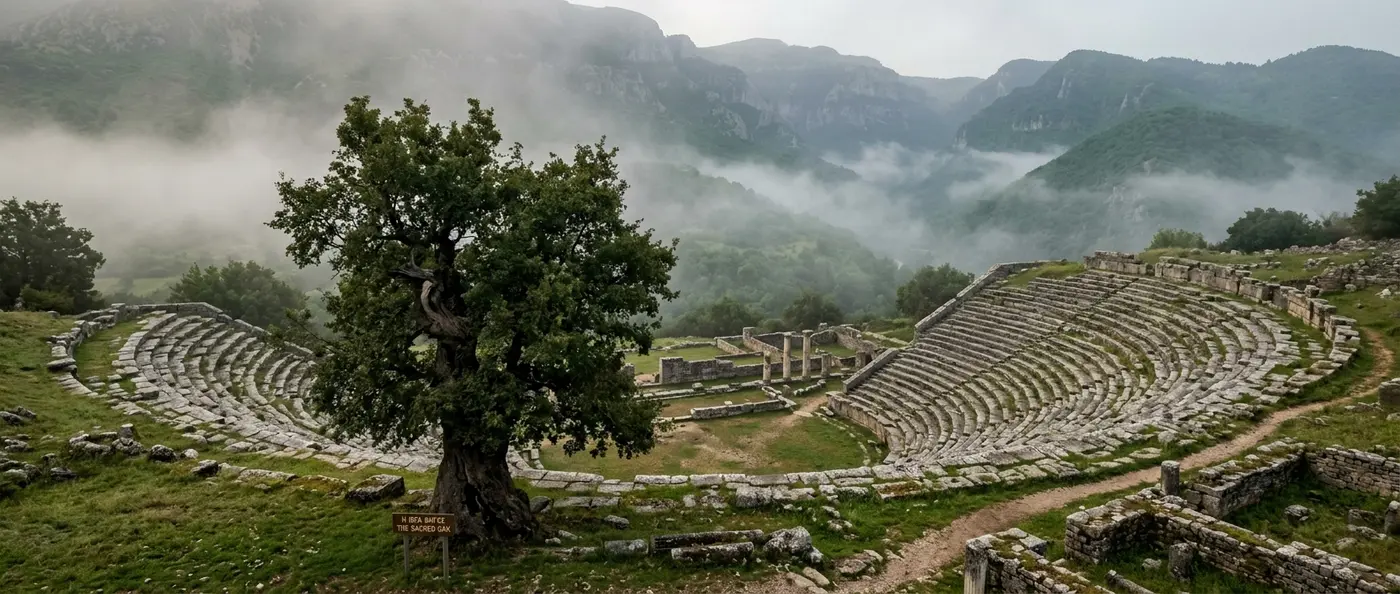
At the sanctuary's heart stood the legendary oak, Zeus's sacred tree. This wasn't merely a symbol — the ancients believed it possessed the power to transmit the god's will through the sound of its leaves. Bronze tripods and cauldrons surrounded the oak, creating a low humming sound when struck by wind that priests interpreted as Zeus's messages.
The Selloi and later the Peleiades (priestesses called "doves") were responsible for interpreting these divine signs. The process of prophecy was completely different from other oracles. Pilgrims wrote their questions on lead tablets, many of which have been found during excavations and reveal the private fears of ordinary Greeks.
The questions covered the full spectrum of human experience: practical matters like "Should I marry Theodora?" to existential anguish and political decisions. One tablet contains a man's blunt question: is the child his wife carries actually his?
Over centuries, Dodona grew from a simple clearing into an architectural complex. Initially, it was a simple open-air space around the sacred oak. Over the centuries, various buildings and structures were added that transformed the oracle into an impressive architectural complex.
In the 4th century BCE, under King Pyrrhus of Epirus, the sanctuary reached its greatest glory. Pyrrhus built a magnificent theater with a capacity of 17,000 spectators, one of the largest in ancient Greece. This theater wasn't used only for dramatic performances but also for the Naia, games honoring Zeus Naios held every four years.
The Theater
With 17,000 seats, it was among antiquity's largest. Its acoustics were so perfect they still impress visitors today.
The Bouleuterion
A rectangular building where the Council of the Epirote League met, showing the sanctuary's importance as a political center.
The Prytaneion
The seat of the sanctuary's magistrates, where the sacred flame was kept and official banquets held.
📖 Read more: Greek Mythology: 10 Creatures You've Never Heard Of
🗿 The Mystery of the Bronze Cauldrons
The bronze cauldrons surrounding the sacred oak created an otherworldly soundscape. surrounding the sacred oak. According to ancient sources, these cauldrons were arranged in a circle and connected by chains. When wind blew, the chains struck the cauldrons creating a continuous, metallic sound.
Strabo mentions a bronze figurine of a child holding a whip that the wind made continuously strike one of the cauldrons. This gave rise to the expression "bronze of Dodona" that the ancients used to describe someone who talked incessantly.
How exactly the priests interpreted these sounds is still debated. Some scholars believe the sounds produced helped priests enter a state of ecstasy to receive oracles. Others argue that different tones and rhythms were interpreted as specific messages from the god.
📜 Prophecies on Lead Tablets
One of the most significant discoveries at Dodona is the thousands of lead tablets with questions to the oracle. These tablets, dating mainly from the 6th to 3rd centuries BCE, offer us a unique window into daily life and the concerns of ancient Greeks.
Questions were usually brief and specific. Many concerned commercial transactions ("Will I profit from the journey to Sicily?"), marriages ("Is it advantageous to marry Alexander's daughter?"), health ("Will I recover from illness?") and fertility ("Will I have a son?").
Questions about political decisions are particularly interesting. City-states sent envoys to ask about alliances, wars and founding colonies. One tablet from Corfu asks: "To which god or hero should we sacrifice to have peace with the Corinthians?"
Dodona wasn't simply an oracle but a major religious center where Zeus was worshipped with the epithet "Naios" (he who dwells) and his consort Dione. The worship of Dione at Dodona is particularly interesting, since elsewhere in Greece Zeus's wife was Hera.
Ceremonies at the sanctuary included animal sacrifices, mainly cattle and sheep, votive offerings, and participation in sacred games. The Naia, held every four years, included athletic, musical and dramatic competitions. Winners from all over Greece participated, making Dodona a Panhellenic center.
A special aspect of worship was the role of the Selloi, priests who lived an ascetic life. According to Homer, they slept on the ground and didn't wash their feet, thus maintaining constant contact with the earth from which they drew their prophetic power. Later, their role was taken by the Peleiades, female priestesses whom tradition said had come from Egypt in the form of doves.
⚖️ Dodona vs Delphi: The Two Great Oracles
⚔️ Historical Adventures and Destruction
Like many ancient sanctuaries, Dodona survived wars, invasions, and religious upheaval. The oracle reached its greatest fame during the Hellenistic period, especially under the protection of Epirus's kings. Pyrrhus, the famous general who fought the Romans, was a great benefactor of the sanctuary.
In 219 BCE the sanctuary suffered devastating pillage by the Aetolians under Dorimachus. The invaders burned the sacred buildings and looted the treasures. Despite the destruction, the oracle was rebuilt and continued operating.
Roman conquest brought new challenges. In 167 BCE, Roman general Aemilius Paullus destroyed 70 Epirote cities and enslaved 150,000 inhabitants. Nevertheless, the oracle survived and even gained fame in the Roman world. Octavian Augustus himself visited Dodona before the Battle of Actium.
📖 Read more: Temple of Poseidon at Sounion: Ancient Ruins Above the Sea
The end came with Christianity's triumph. In 391 CE, by decree of Theodosius I, all pagan practices were banned. The sacred oak was cut down, the cauldrons destroyed, and the oracle ceased functioning after nearly 2,400 years of continuous operation.
🔬 Modern Excavations and Discoveries
Systematic excavations at Dodona began in 1875 by Constantine Karapanos and continue today. Research has brought to light impressive finds that illuminate the oracle's function and daily life at the sanctuary.
Besides the thousands of lead tablets with questions, numerous votive offerings have been found: bronze figurines, weapons, jewelry, coins from throughout the Greek world. Bronze tripods and cauldrons are particularly impressive, confirming ancient descriptions of the prophetic system.
Recent geophysical surveys have revealed the existence of even more buildings underground. Archaeologists believe only a small part of the ancient sanctuary has been excavated so far. Every summer dig uncovers more buildings, more tablets, more evidence of how Greeks sought divine guidance.
🏛️ The Oracle Today
Dodona's archaeological site is open to visitors and is one of Greece's most impressive. The ancient theater has been restored and hosts summer performances, continuing a 2,300-year tradition. A new tree has been planted where the sacred oak stood, symbolizing the site's continuity.
🌟 Dodona's Legacy
Dodona's influence on the ancient world was enormous. The oracle is mentioned in works by great writers, from Homer and Hesiod to Herodotus and Pausanias. The myth of the doves that founded the oracle connected Dodona with the great sanctuaries of Egypt and Libya, giving it Panhellenic and international dimensions.
In modern times, Dodona continues to fascinate. Archaeologists, historians and visitors from around the world come to admire the ruins and imagine life at the ancient sanctuary. The lead tablets with human questions remind us that, despite the centuries separating us, people's basic concerns remain the same.
Dodona wasn't simply an oracle. It was a place where human anguish met divine wisdom, where nature spoke with the voice of the gods, where thousands of people sought answers to life's great and small questions. Today, as we stand among the ruins and hear the wind in the leaves of the new oak, we can still feel something of the awe that ancient pilgrims experienced.