📖 Read more: Triremes: Ancient Greece's Naval Superweapon Ruled Seas
🗿 The Discovery That Rewrites Arctic History
Archaeologists working on Isbjørne island just uncovered 15 prehistoric dwellings — the largest cluster ever found in the region. Matthew Walls from the University of Calgary, who led the research published in Antiquity, calls it one of the biggest concentrations of tent rings in a single location. This wasn't random camping. This was systematic, repeated occupation of one of the most isolated spots on Earth.
The dwellings show up as circular stone arrangements that once anchored skin tents, each with a central hearth. One animal bone found inside these rings dates between 4,000 and 4,475 years old, confirming the ancient Paleo-Inuit presence. The numbers tell a different story: the sheer number of structures suggests entire communities made this death-defying crossing, not just solo hunters on quick raids.
These people didn't stumble onto the islands by accident. The tent ring patterns show careful site selection and repeated use over generations. Multiple generations of Paleo-Inuit families loaded their boats and crossed waters that would challenge modern vessels, all to harvest the islands' rich marine resources during the brief Arctic summer.
⚓ Death-Defying Voyage Across the Arctic
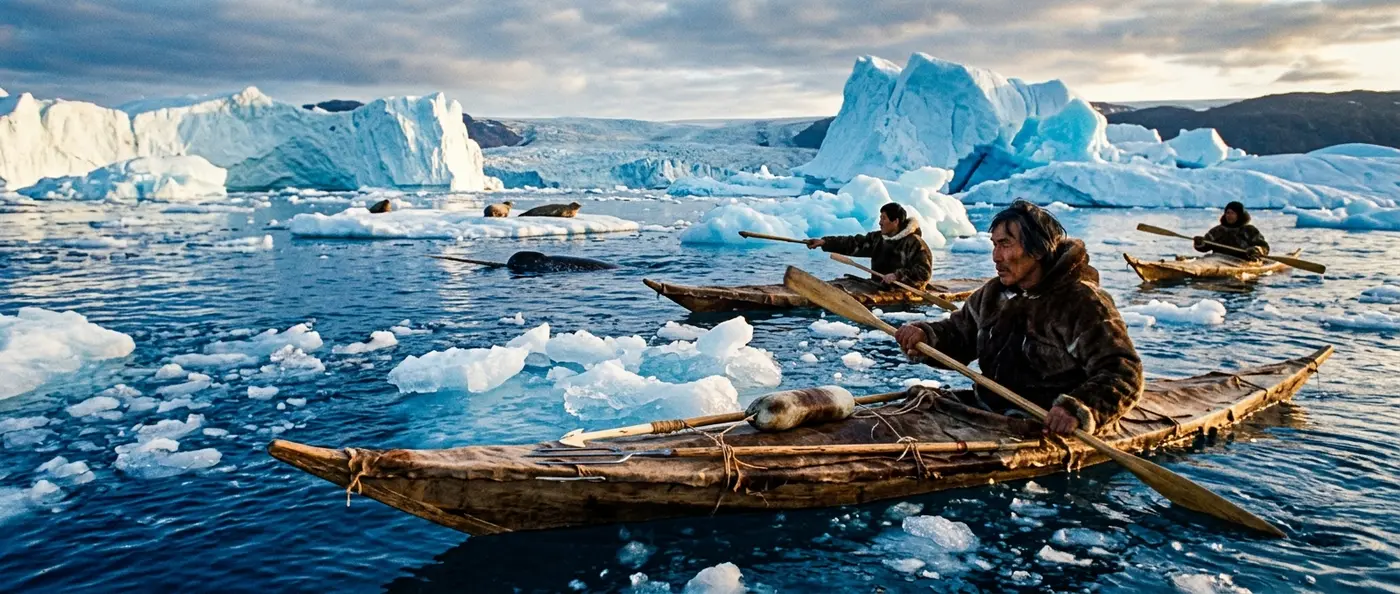
The route from mainland Greenland to Kitsissut wasn't a casual paddle. At minimum 33 miles from the nearest land, these waters throw everything at you: erratic winds, thick fog, powerful currents, and temperatures that can kill within minutes if you capsize. The 12-hour journey required boats made from wooden frames wrapped in animal skins — think primitive kayaks, but carrying entire families and their gear.
Walls emphasizes these crossings happened during the warm season, which doesn't last long in the Arctic. The Paleo-Inuit had maybe three months when the seas were navigable enough to attempt the crossing. Miss that window, and you're trapped until next summer. Or dead.
The navigation skills required boggle the mind. No GPS. No compass. Just intimate knowledge of currents, wind patterns, and celestial navigation passed down through generations. One wrong turn in Arctic fog, and your family disappears forever into the ice. Yet they kept making the journey, year after year, generation after generation.
🦅 The Seabird Gold Rush
Why risk everything for these remote rocks? The answer flies overhead every summer. Kitsissut sits in the heart of a polynya — a semi-permanent area of open water within sea ice — that attracts thousands of seabirds. Thick-billed murres (Uria lomvia) nest by the thousands on the islands' cliff faces, creating a protein bonanza that drew Paleo-Inuit hunters across deadly waters.
Archaeologists found murre bones scattered around the tent rings, while the dwelling locations sit directly below the nesting cliffs. The camp placement was deliberate. The Paleo-Inuit positioned their camps for maximum hunting efficiency, turning the islands into a prehistoric seabird processing center.
The timing was everything. Murres arrive to breed during the brief Arctic summer, exactly when sea conditions allow the dangerous crossing. The Paleo-Inuit synchronized their expeditions with this natural calendar, harvesting not just adult birds but also their protein-rich eggs during the peak nesting season.
Seabirds
Thousands of thick-billed murres nested on cliff faces, providing nutrient-rich meat for Arctic hunters during the brief summer season.
Eggs
Seabird eggs offered concentrated protein and fat essential for surviving the harsh Arctic environment and long return journey.
Polynya
The open water zone attracted fish and marine mammals, creating a rich ecosystem that supported massive seabird colonies.
🏺 Stone Age Maritime Technology
The Kitsissut discovery showcases sophisticated Paleo-Inuit technology. Their boats — wooden frames covered in marine mammal skins — were light enough to portage yet tough enough to handle Arctic seas. These vessels, ancestors of modern kayaks, let hunters move fast and silent through the water, perfect for stalking seals and birds.
Building these boats required specialized knowledge passed down through generations. The frame construction, skin preparation, and waterproofing techniques had to be perfect. One leak in Arctic waters meant death. The Paleo-Inuit developed quality control standards that would impress modern manufacturers.
Beyond boats, they'd mastered Arctic survival technology. Stone and bone tools, hunting techniques, and knowledge of seasonal animal migrations let them thrive in one of Earth's most hostile environments. Their gear list for the Kitsissut expeditions would have included harpoons, fishing gear, food processing tools, and emergency supplies for the long journey home.
💡 Did You Know?
Traditional Inuit kayaks could reach speeds of 10 knots and were so watertight that hunters could perform complete 360-degree rolls without taking on water — a technique called the Eskimo roll.
📖 Read more: 5,000-Year-Old Whale Hunters Found in Brazil
🗺️ Kitsissut as Innovation Hub
This discovery flips our understanding of northwest Greenland. Archaeologists previously saw the region as mainly a migration corridor between Canada and Greenland. The Kitsissut findings reveal something far more complex — a center of maritime innovation where extreme challenges drove technological advancement.
Walls argues that Kitsissut and its polynya should be considered a place of innovation. The need to cross dangerous seas to reach the islands pushed Paleo-Inuit maritime technology to new levels. Their success shows organizational and technical capabilities that exceed previous estimates of their abilities.
The concentration of dwellings also suggests Kitsissut served as a social gathering point. Different Paleo-Inuit groups likely met there during summer months, trading goods, sharing knowledge, and possibly arranging marriages. The islands became a prehistoric conference center where Arctic cultures cross-pollinated.
🌍 Rewriting Arctic Settlement History
The Kitsissut discovery has massive implications for understanding early Arctic settlement. These findings show Paleo-Inuit weren't just nomads following land-based prey — they'd developed a complex maritime civilization thousands of years before anyone expected.
Their ability to reach and exploit such remote resources demonstrates deep environmental knowledge. They knew when and where to travel, how to predict weather and currents, and how to survive emergencies. This wasn't luck or desperation — this was systematic exploitation of Arctic marine resources using sophisticated planning and technology.
⚔️ Ancient Maritime Civilizations Timeline
🔬 Future Research and Unanswered Questions
The tent rings raise as many questions as they answer. Archaeologists plan further excavations to uncover more details about Paleo-Inuit life on Kitsissut. They're particularly interested in finding tools, weapons, and artifacts that could illuminate daily life and cultural practices.
Researchers also hope to determine the frequency and duration of visits with greater precision. Were these seasonal migrations or more permanent settlements? How many people participated in each crossing? What was the social organization of groups making the journey?
DNA analysis from organic remains could reveal information about Paleo-Inuit genetic connections to modern Arctic populations. This would help understand migration patterns and the evolution of Arctic cultures over millennia.
🌊 Legacy of the Arctic's First Mariners
The Paleo-Inuit story at Kitsissut is one of courage, innovation, and adaptation. These Arctic pioneers weren't just survivors in a harsh environment — they were trailblazers who opened new frontiers and created technologies that allowed their descendants to thrive in the Arctic for millennia.
Their discovery reminds us that human ingenuity and courage know no bounds. In an era when climate change threatens Arctic ice, the Paleo-Inuit story gains new relevance. It shows how humans can adapt to extreme environmental conditions and create sustainable lifestyles even in the most remote corners of the planet.
As archaeologists continue research at Kitsissut and other Arctic sites, more secrets of these remarkable early mariners will emerge. Each new discovery adds another piece to the puzzle of human history and helps us better understand our species' journey from Africa to every corner of Earth.