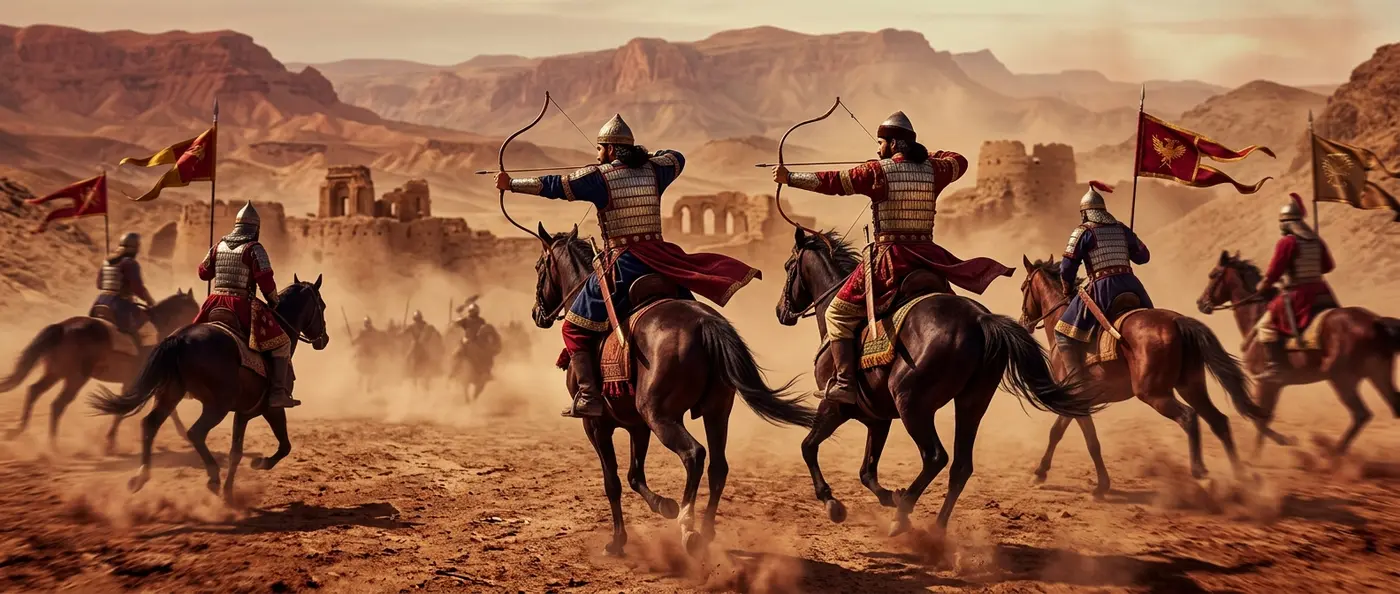
Seven Roman legions marched into the Mesopotamian desert in 53 BC. Only half came back. Marcus Licinius Crassus, one of Rome's richest men and a member of the First Triumvirate alongside Julius Caesar and Pompey, had led 40,000 soldiers into what became one of the most catastrophic defeats in Roman military history. The enemy? The Parthian Empire — a sprawling power that stretched from modern-day Iran to Syria, and the only force that repeatedly stopped Rome's eastward expansion dead in its tracks.
🏹 Rise of the Horse Lords
The Parthian Empire erupted from the wreckage of the Seleucid Empire around 247 BC, when Arsaces I led a rebellion of nomadic tribes in Parthia. What started as a local uprising in the northeastern provinces of Iran transformed into an empire that would dominate the Middle East for nearly five centuries.
These weren't just conquerors. The Parthians absorbed and adapted elements from every civilization they encountered — Hellenistic culture from the Seleucids, Persian traditions from the Achaemenids, even nomadic customs from Central Asian tribes. This cultural mixing made their empire more adaptable than Rome or the Han Chinese.
Their capital, Ctesiphon, on the banks of the Tigris River, became one of the largest urban centers in the ancient world. Chinese merchants, Roman diplomats, and Indian philosophers converged there, making the city a hub of international trade and cultural exchange that rivaled Alexandria or Rome itself.
⚔️ The Carrhae Catastrophe
53 BC marked one of the darkest moments in Roman military history. Crassus, desperate for military glory to match his partners' conquests, decided to invade the Parthian Empire. His ambition for battlefield fame that could rival Caesar's Gallic Wars or Pompey's eastern campaigns led him to a catastrophic decision.
With seven legions — roughly 40,000 men — Crassus crossed the Euphrates and pushed deep into Parthian territory. Near the city of Carrhae (modern Harran in Turkey), he encountered the Parthian army under General Surena. The result was annihilation.
The Parthians deployed tactics the Romans had never faced. Their mounted archers, equipped with powerful composite bows, unleashed a relentless barrage of arrows against the Roman lines. When the legions tried to advance, the Parthian cavalry retreated while continuing to shoot — the famous "Parthian shot" that gave us the phrase "parting shot."
🗺️ The Strategic Advantage
Parthian success against Rome wasn't just about military prowess. The empire's geographic position at the crossroads between East and West gave them massive economic advantages. They controlled much of the Silk Road, the main trade route connecting the Roman Empire with China.
Every caravan carrying silk, spices, and precious goods from the East had to pass through Parthian territory. Customs duties and transit fees filled the empire's coffers, allowing them to maintain a powerful military and fund their defenses against Roman attacks.
The Parthian administrative structure was also unique. Instead of Rome's centralized system, the Parthians adopted a semi-feudal approach. Local kings and satraps governed provinces with significant autonomy, as long as they remained loyal to the "King of Kings" in Ctesiphon. This approach helped them rule peoples from Syria to Central Asia.
Horse Archers
Light cavalry with composite bows formed the backbone of Parthian armies. Their ability to shoot accurately while galloping gave them tactical superiority over heavily armored Roman legions.
Cataphracts
Heavily armored cavalry covered head to toe in metal armor. Even their horses wore protection, creating an unstoppable shock force that could smash through enemy lines.
Silk Road Control
Controlling trade routes ensured steady income and diplomatic influence. Parthia operated as a middleman between the great civilizations of Eurasia.
💀 The Great Clashes
Carrhae was just the beginning of a series of conflicts that would last centuries. In 36 BC, Mark Antony attempted his own invasion of Parthia with 100,000 men. Despite his massive army, the campaign ended in disaster. The Parthians employed scorched earth tactics, avoiding direct confrontation while constantly harassing Roman supply lines.
Antony was forced to retreat through winter, losing roughly 24,000 men to cold, hunger, and continuous Parthian attacks. This failure contributed to his eventual defeat by Octavian and the rise of the Roman Empire.
Even when Rome reached the height of its power, the Parthians remained unbroken. Emperor Trajan managed to capture Ctesiphon in 116 AD, but couldn't hold his conquests. The Parthians regrouped quickly and reclaimed their lost territories after his death.
One of the most intriguing episodes occurred during 161-166 AD, during Lucius Verus's Parthian War. Although the Romans again captured Ctesiphon, their army was struck by a deadly epidemic — possibly smallpox — that spread throughout the Roman Empire upon their return. The "Antonine Plague," as it became known, killed millions and significantly weakened Rome.
🏺 The Mystery of the Lost Legions
After the Battle of Carrhae, roughly 10,000 Romans were taken prisoner. According to Chinese sources, a group of Western mercenaries fighting for the Xiongnu in Central Asia in 36 BC used Roman tactics. Some historians theorize these were descendants of Crassus's lost legionnaires, sent by the Parthians to their empire's eastern frontier.
🔱 Religion and Culture
The Parthian Empire was a mosaic of religions and cultures. While Zoroastrianism remained the dominant religion, especially among the ruling class, the empire also hosted significant communities of Buddhists, Jews, Christians, and followers of various Hellenistic cults.
The Parthians genuinely embraced diversity. The Parthians seemed to have genuine appreciation for diversity. In Ctesiphon, Zoroastrian fire temples stood alongside Jewish synagogues and Buddhist monasteries. Ctesiphon became a crossroads for different faiths and ideas.
Parthian art reflected this cultural synthesis. Their sculptures combined Hellenistic naturalism with Eastern symbolic expression. Their coins bore Greek inscriptions but depicted Parthian kings in traditional Iranian dress. Their architecture incorporated elements from the Achaemenids, Seleucids, and even Mesopotamian traditions.
The administration of the Parthian Empire differed radically from the Roman model. While Rome imposed a uniform system of laws and governance across its territory, the Parthians preferred a more decentralized approach. The "King of Kings" (Shahanshah) in Ctesiphon was the supreme ruler, but much of the real power rested with the seven great houses of Parthia.
These aristocratic houses — the Suren, Karen, Mihran, and others — controlled vast territories and maintained their own armies. Their loyalty to the king was secured through a complex system of honors, privileges, and kinship ties. When the system worked, it gave the empire great flexibility. When the great houses clashed with each other or the king, the empire risked dissolution.
The Parthian legal system was equally complex. Different regions maintained their own laws and customs. Greek law applied in the Hellenophone cities of Mesopotamia. Traditional Persian laws governed Iranian provinces. Jewish communities had their own courts. This legal diversity required diplomatic skills from Parthian administrators but allowed the empire to rule peoples with very different traditions.
⚖️ Rome vs Parthia: Governance Systems
💰 Economic Supremacy
The Parthian Empire's economic power rested on three pillars: international trade, agriculture, and taxation. Control of the Silk Road was perhaps their greatest advantage. Every year, caravans loaded with Chinese silk, Indian spices, and precious stones crossed Parthian territory. Customs stations at strategic points like Merv, Ecbatana, and Seleucia collected enormous sums.
But the Parthians weren't just middlemen. They developed their own industries and exported high-quality products. Parthian textiles, especially luxury tapestries, were sought after throughout the ancient world. Their metallurgy produced weapons and armor of exceptional quality. Their horses, bred on the vast steppes of Central Asia, were considered the world's finest.
The Parthian monetary system reflected their international position. They minted silver and bronze coins accepted from Syria to India. The Parthian drachma became one of the era's most stable currencies, competing with the Roman denarius in international transactions.
🗿 The Parthian Legacy
The Parthian Empire collapsed in 224 AD, when Ardashir I, founder of the Sassanid dynasty, overthrew the last Arsacid king. But their influence continued for centuries. The Sassanids adopted many Parthian military and administrative practices. Parthian cavalry tactics influenced military thinking from Byzantium to China.
In the collective memory of the West, the Parthians remained Rome's eternal enemy, the power that defied Roman supremacy. For the peoples of the East, they represented a golden age of independence and cultural flowering. In modern Iran, the Arsacids are considered part of the glorious national heritage, symbols of resistance against Western domination.
The Parthian Empire shows that Rome wasn't the only way to build a great power. For five centuries, this empire stood as Rome's equal, proving that alternative ways of organizing large states existed. Their success wasn't based on imposing uniformity but on managing diversity. In a world where Rome is often presented as the only model of ancient empire, Parthian history reminds us of the complexity and richness of the ancient world.
📜 The End and Transition
The fall of the Parthian Empire wasn't the result of external conquest but internal strife. After centuries of wars with Rome and internal conflicts between the great houses, central authority had weakened. Ardashir, governor of Persis (modern Fars province of Iran), exploited this weakness.
The transition from Arsacids to Sassanids wasn't a simple dynastic change. The Sassanids promoted a more centralized form of governance and a stricter Zoroastrianism. However, they retained many elements of Parthian culture, including the emphasis on cavalry and control of trade routes.
Most significantly, the Parthians left behind a model of empire based on balance of power and cultural tolerance. In an era when most empires tried to impose uniformity, the Parthians showed that diversity could be a source of strength. Their model of governing through local autonomy rather than central control offers a different template for organizing large, diverse territories.