📖 Read more: Mycenaean Civilization: The First Greeks Who Built an Empire
🏛️ The Making of a Leader
Born around 495 BC into Athens' elite, Pericles had power in his DNA. His father Xanthippus commanded the fleet that crushed the Persians at Mycale. His mother Agariste descended from the mighty Alcmaeonid clan. This aristocratic pedigree opened doors to Athens' intellectual elite.
His teachers formed an intellectual powerhouse. Anaxagoras taught him natural philosophy and rational thinking. The musician Damon introduced him to music theory and its connection to politics. Zeno of Elea drilled him in rhetoric and dialectics. By the time Pericles entered public life, he wielded ideas like weapons.
His political debut came in 472 BC when he bankrolled Aeschylus' "The Persians" as a wealthy sponsor. Smart move. The play celebrated Athens' victory over the Persian Empire, and Pericles' name got attached to the glory. He gradually rose through the democratic ranks, squaring off against the conservative Cimon. When Cimon got ostracized in 461 BC, Pericles stood alone at the top.
He was 34 years old and controlled the most powerful city in the Greek world.
🗳️ Democracy Gets Radical
Pericles didn't just inherit Athenian democracy. He revolutionized it. His most explosive reform? Pay for public service. Before Pericles, only the wealthy could afford to spend days judging court cases or debating in the Assembly. Poor citizens had to work.
The new system changed everything. Suddenly, blacksmiths and farmers could serve as jurors. Dock workers could vote on war and peace. The aristocrats screamed bloody murder, but Pericles had unleashed something unstoppable: the world's first true democracy where economic status didn't determine political voice.
He also gutted the Areopagus, the ancient council of aristocrats, transferring most of its powers to democratic institutions. Citizenship became more exclusive — both parents now had to be Athenian — but for those who qualified, political participation reached levels that wouldn't be seen again for 2,000 years.
The conservative opposition never forgave him. They called him a demagogue who pandered to the mob. History called him the father of democracy.
🏗️ Building Wonders from Stolen Gold
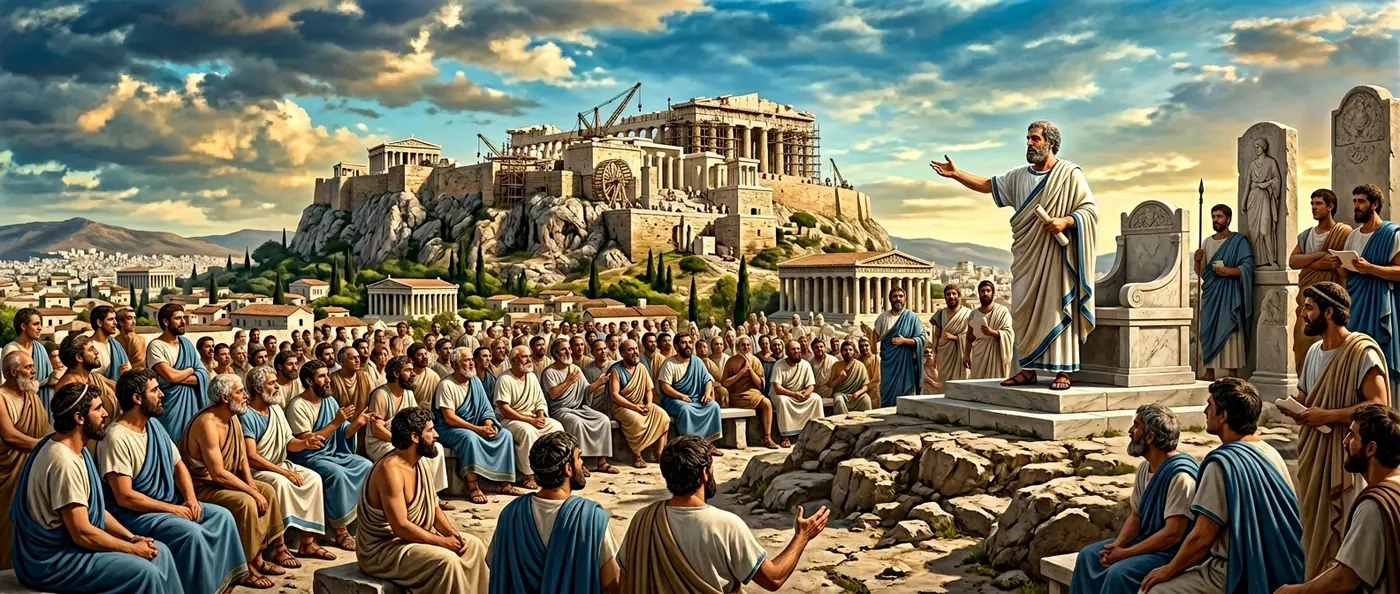
447 BC. Pericles announced a construction program that would remake the Acropolis into an architectural miracle. At its heart stood the Parthenon, a temple to Athena that would become the most copied building in Western history. Architects Ictinus and Callicrates, supervised by the master sculptor Phidias, created a structure that married mathematical precision with aesthetic perfection.
Every detail was calculated. The columns bulged slightly in the middle to correct optical illusions. The entire building tilted imperceptibly inward. No straight lines existed anywhere — yet the human eye saw perfect geometry. It was architecture as high art, engineering as philosophy.
The program didn't stop with the Parthenon. The Propylaea formed a monumental gateway to the sacred hill. The Erechtheion featured six female figures — the Caryatids — supporting a roof with their heads. The tiny temple of Athena Nike perched on a bastion, celebrating military victory.
But here's the scandal: Pericles funded it all with money from the Delian League, Athens' naval alliance. The allies had contributed cash to fight Persia, not to beautify Athens. Critics accused him of dressing up the city "like a vain woman wearing expensive jewelry." Pericles shot back that Athens protected the alliance and could spend the money however it chose.
The controversy raged. The buildings rose anyway.
Parthenon
Athena's temple featured 46 exterior columns and Phidias' gold-and-ivory statue of the goddess. It became the template for neoclassical architecture worldwide.
Propylaea
Mnesicles designed this monumental entrance, blending Doric and Ionic styles in a harmonious composition that still awes visitors today.
Erechtheion
Six Caryatids — female figures carved as architectural supports — represent the pinnacle of Ionic design and sculptural integration.
🎭 When Genius Walked the Streets
Periclean Athens became a magnet for brilliance. The three great tragedians defined dramatic art for all time. Aeschylus laid the foundation before dying early in Pericles' era. Sophocles, a personal friend of the leader, wrote "Antigone" and "Oedipus Rex" — plays that still pack theaters 2,500 years later. Euripides, the most modern of the three, dissected human psychology with surgical precision.
Philosophy exploded in every direction. Anaxagoras introduced the concept of Mind as a cosmic principle. Protagoras and other sophists taught rhetoric and relativism to ambitious young men. A peculiar character named Socrates began wandering the marketplace, asking questions that would reshape human thought forever.
History was born when Herodotus wrote his "Histories" in Athens, chronicling the Persian Wars. Thucydides, who served as a general, started recording the Peloponnesian War with scientific rigor. In sculpture, Phidias and his school created works still considered the peak of classical art.
📖 Read more: Battle of Marathon: The Victory That Rewrote History
The city hummed with intellectual energy. Foreign scholars flocked to Athens like moths to flame. Ideas cross-pollinated in symposiums and public debates. For a brief, shining moment, human creativity reached heights that make our own age look timid by comparison.
💡 The Funeral Oration
In his famous Funeral Oration, recorded by Thucydides, Pericles described Athens as "a school for all Greece" and celebrated democratic values: "Our constitution does not copy the laws of neighboring states; we are rather a pattern to others than imitators ourselves."
⚔️ Empire Built on Naval Power
Under Pericles, Athens transformed from alliance leader to imperial master. The Delian League, founded in 478 BC to defend against Persia, became an instrument of Athenian domination. In 454 BC, the alliance treasury moved from Delos to Athens — a symbolic end to any pretense of equality.
Cities that tried to leave faced brutal suppression. Naxos, Thasos, and Samos were crushed when they attempted rebellion. Athenian settlers established colonies at strategic points, ensuring control of the Aegean Sea. The Athenian navy, with over 300 triremes, ruled the waves unchallenged.
This aggressive expansion inevitably triggered conflict with Sparta. In 431 BC, the Peloponnesian War erupted. Pericles' strategy relied on naval superiority and fortification behind the Long Walls connecting Athens to its port. Athenians would avoid land battles with superior Spartan hoplites while exhausting the enemy through naval raids.
The plan was brilliant in theory. Reality proved more complicated.
🏺 Life in the World's First Democracy
Fifth-century Athens pulsed with contradictions. The population of Attica reached 250,000-300,000, but only 30,000-40,000 enjoyed full citizenship. Metics — foreign residents — formed a crucial part of the economy while remaining political outsiders. Slaves did much of the manual labor that kept the democracy running.
The agora served as the city's beating heart. Merchants from across the Mediterranean hawked everything from Black Sea grain to Eastern silk. Workshops produced pottery, weapons, and jewelry exported throughout the known world. Piraeus, Athens' port, ranked among the busiest in the Mediterranean.
Education for young Athenian males included grammar, music, and athletics. Wealthy families added rhetoric lessons from sophists. Women faced severe restrictions on public life, though Aspasia, Pericles' companion, ran a philosophical salon that attracted the city's intellectual elite.
Religious festivals punctuated the calendar. The Panathenaea honored Athena with processions, sacrifices, and athletic contests. The City Dionysia showcased new tragedies and comedies. These weren't just entertainment — they were expressions of civic identity and democratic values.
🏛️ Athens by the Numbers
💀 Plague, War, and the End of an Era
430 BC brought catastrophe. With rural populations crammed inside Athens' walls to escape Spartan raids, a deadly plague erupted. The disease — possibly typhoid fever — killed one-third of the population, including Pericles' two sons from his first marriage.
Athenians, maddened by loss, turned on their leader. They stripped him of his generalship and imposed a massive fine. Though later reelected, Pericles was a broken man. In autumn 429 BC, the plague claimed him too.
His death marked more than the end of a life. The Golden Age died with him. Athens would fight on for another 27 years, but the vision, the unity, the sense of limitless possibility — all vanished with the man who had embodied them.
Yet his legacy endures. The monuments he built still stand as symbols of human achievement. The democratic principles he championed inspired governments worldwide. The cultural flowering he fostered laid the foundation of Western civilization.
Thucydides, who recorded his words and deeds, called him "the first man of the city." He was a leader who combined vision with practical wisdom, eloquence with action, idealism with realism. In an age of crisis and transformation, he guided Athens to the pinnacle of its glory.
Today, when we visit the Acropolis and marvel at the Parthenon, we see tangible proof of one man's vision. He believed his city could become "a pattern for all Greece." The Golden Age of Pericles lasted only a few decades, but its light continues to shine across the centuries.