550 BC. A young prince from the mountains of Persia launched a campaign that would redraw the map of the ancient world forever. Within decades, the Persians built history's first true superpower — an empire stretching from Macedonia and Libya in the west to the Indus River in the east, from the Caucasus and the Aral Sea in the north to the Persian Gulf and Arabian Desert in the south.
📖 Read more: Alexander the Great: World Conqueror Who Changed History
🏛️ Birth of a Superpower
The Achaemenid dynasty took its name from the legendary ancestor Achaemenes (Hakhamanish in Persian), beginning its rise in the early 7th century BC. From Teispes' son emerged two royal lines that would shape Persia's destiny.
The elder line included Cyrus I, Cambyses I, Cyrus II the Great, and Cambyses II. After Cambyses II died in 522 BC, the younger line seized the throne with Darius I. The dynasty met its end when Darius III fell in 330 BC, defeated by Alexander the Great.
Persian greatness wasn't accidental. Achaemenid rulers fused military might with administrative genius, creating a governance system that allowed dozens of different peoples to coexist under the Persian umbrella.
⚔️ The Great Conquerors
Cyrus II the Great (559-529 BC) was the empire's true founder. Persian dominance began with his reign. Starting from a small mountain kingdom in modern-day Iran, he united Medes and Persians, conquered Croesus' Lydia and Babylon, creating history's first multinational empire.
Darius I (522-486 BC) excelled as an administrator. Under his rule, the empire organized into satrapies — provinces governed by satraps who faced regular inspections from officials reporting directly to the king. This system ensured effective control across vast distances.
Xerxes I (486-465 BC) completed many buildings Darius had started and continued expansionist policies, though his Greek campaign ended in failure. Still, during his and his father's reigns, the empire reached its maximum extent.
🗺️ The Reach of Dominion
The Achaemenid Persian Empire was the largest the world had ever seen. At its peak, it encompassed territories that today belong to more than 20 countries. From Macedonia and Thrace in the west to the Indus River in the east, and from the Caucasus mountains and Aral Sea in the north to the Persian Gulf and Arabian Desert in the south.
The Persians transformed these territories into an integrated system. Persians created a system enabling smooth operation and communication between regions. The famous "Royal Road" connected Sardis in Asia Minor with Susa, allowing rapid message transmission and troop movement.
Western Borders
Macedonia, Thrace, Asia Minor, Egypt, and Libya. Persians controlled the entire eastern Mediterranean and much of North Africa.
Eastern Borders
To the Indus River (Hyphasis/Beas), including modern Central Asia, Afghanistan, and parts of India.
North-South Extent
From the Caucasus and Aral Sea in the north to the Persian Gulf and Arabian Desert in the south.
🏛️ Administration and Organization
Persian success wasn't just military prowess. They mastered governing such a large, diverse empire. Darius I's satrapy system was revolutionary for its time.
Each satrapy was governed by a satrap, usually from Persian nobility or the royal family. Satraps wielded broad powers but faced regular checks from the "eyes and ears of the king" — special inspectors traveling throughout the empire.
Persian administration was generally liberal toward conquered peoples. They allowed local communities to keep their customs, religions, and often their local leaders, provided they paid taxes and supplied soldiers when needed.
📖 Read more: Krypteia: Sparta's Secret Police and Terror Machine
💡 Linguistic Diversity
Royal inscriptions were typically trilingual, written in Old Persian, Elamite, and Akkadian. For administrative correspondence, however, Aramaic served as the empire's lingua franca.
🎨 Art and Architecture
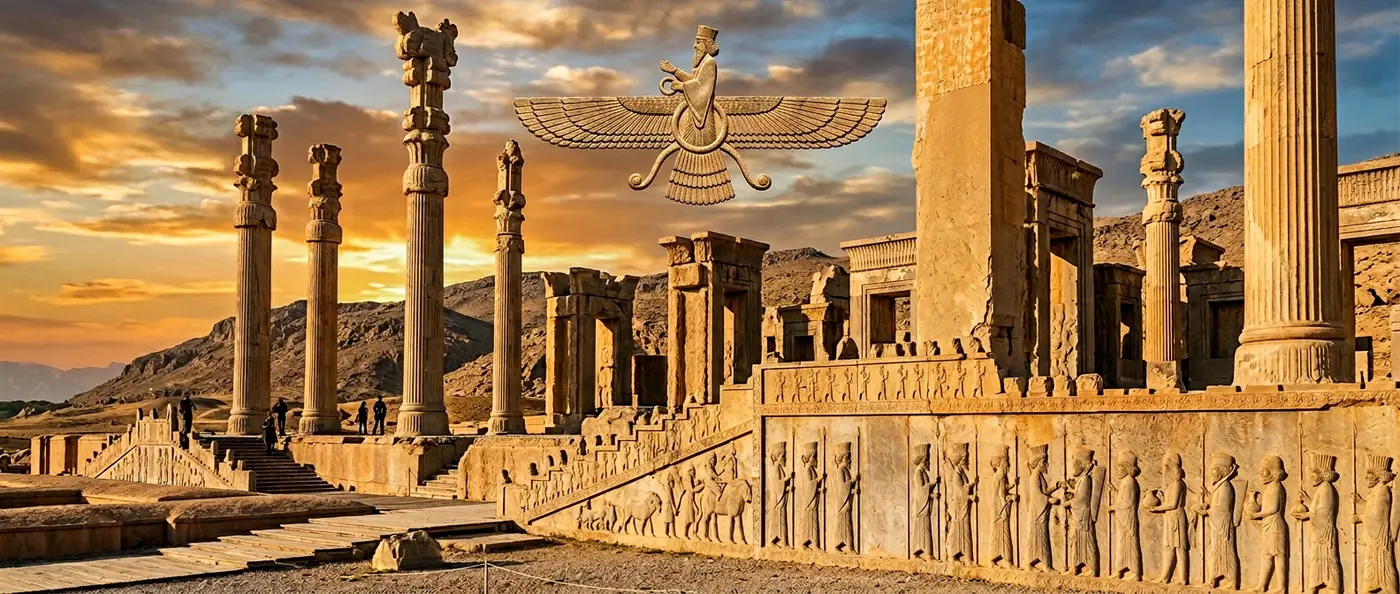
Construction activity during the empire's peak was extensive. Among the various Achaemenid capitals, ruins at Pasargadae and Persepolis are perhaps the most impressive. Persepolis, built by Darius I and completed by Xerxes, stands as one of the ancient world's greatest architectural achievements.
Achaemenid reliefs and numerous smaller artworks show consistent artistic vision across the empire. Metalwork, especially in gold, was highly developed, with various carefully executed examples surviving that testify to Persian craftsmen's high skill.
Persian art combined influences from all empire regions, creating a unique style reflecting the Persian state's cosmopolitan character. From Mesopotamia they took monumental relief traditions, from Egypt architectural elements, from Greece sculptural techniques.
⚔️ The Empire's Fall
The Persian Empire that seemed invincible for centuries finally fell to a young Macedonian king's military genius. Alexander III of Macedon, known as Alexander the Great, began his campaign against Persia in 334 BC.
In just four years, Alexander conquered the entire Persian Empire. Decisive battles at Granicus, Issus, and Gaugamela marked the end of Persian dominance. The last Achaemenid king, Darius III, was murdered by his own men in 330 BC, marking the dynasty's definitive end.
Despite its fall, the Persian Empire's legacy survived. Alexander himself adopted many Persian governance practices, and the Hellenistic kingdoms that followed retained elements of the Persian administrative system. The idea of a multinational empire respecting its subjects' cultural diversity was a Persian achievement that influenced all subsequent empires.
📊 Comparison with Other Ancient Empires
🔱 The Persian Legacy
The Achaemenid Persian Empire left an indelible mark on world history. It was the first empire to successfully unite so many different peoples under central authority while maintaining their cultural identity.
The satrapy administrative system influenced all subsequent great empires. Tolerance toward different religions and cultures became a model for governing multinational states. Even the idea of a world state uniting East and West has its roots in the Persian vision.
Today, Persepolis' ruins stand as witnesses to this greatness. Visitors can still admire the monumental columns, impressive reliefs depicting representatives from all empire corners bringing gifts to the Great King, and imagine the splendor of an empire that once ruled the known world.
Persian history teaches us that an empire's true strength lies not only in military power, but in its ability to unite different peoples, respect diversity, and create governance systems allowing peaceful coexistence. This is perhaps the greatest legacy the Achaemenid kings left us — the vision of a world where diversity isn't a threat but a source of strength.