🏺 The Discovery That Shook Archaeology
The summer of 1908 found excavations at the palace of Phaistos in full swing. The Italian archaeological mission, under Luigi Pernier's direction, was working methodically through the ruins of Crete's second-largest Minoan palace. In a small room near the palace's central archive, among layers of ash and burnt earth, Pernier spotted something unusual.
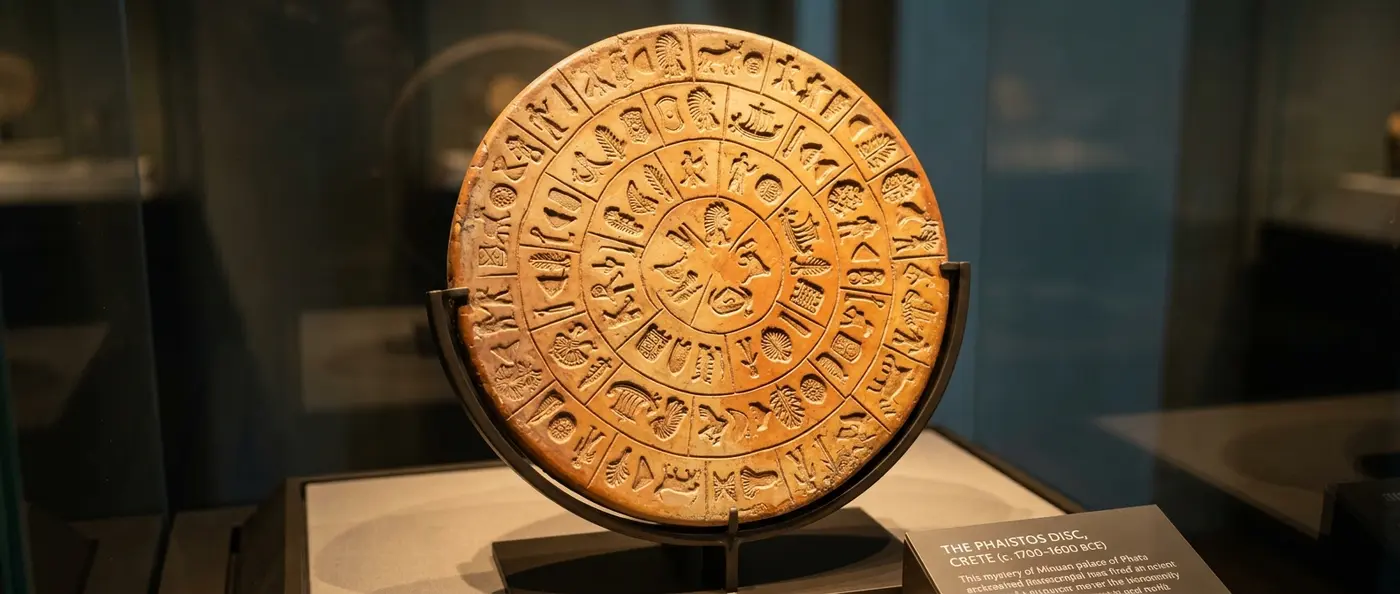
The disc was found alongside a Linear A clay tablet, the undeciphered writing system of the Minoans. The stratigraphy indicated dating around 1700-1600 BCE, the height of Minoan civilization. What immediately made the disc unique was its construction method: the symbols weren't hand-carved but stamped with seals, making it perhaps the first example of "typography" in history.
From the first moment, the disc sparked intense debate. Some scholars initially questioned its authenticity, considering it a forgery. Today, however, its authenticity is generally accepted by the scientific community, though some voices continue to express doubts.
💡 Did You Know?
The Phaistos Disc is the only known example of this type of writing. No other object with similar symbols has been found, making its decipherment nearly impossible without reference points.
📜 The Mysterious Symbols
The disc bears a total of 241 symbols, representing 45 different types. The symbols are arranged in a spiral pattern that starts from the center and moves outward, on both sides of the disc. Each group of symbols is separated from the next by vertical lines, possibly indicating "words" or phrases.
The symbols depict recognizable forms: human figures with feathered headdresses, animals like birds and fish, plants, weapons, tools, and various everyday objects. One of the most characteristic symbols is the "head with mohawk," which appears 19 times. Other frequent symbols include a "walker," a "shield," and a "branch."
The exact reading sequence remains uncertain. While most researchers believe reading proceeds from center outward, others support the opposite. Even the direction of writing (left to right or right to left) remains contentious.
For more than a century, dozens of scholars have attempted to decipher the disc. Proposed interpretations vary dramatically, reflecting the lack of comparable material and the complexity of the endeavor.
Early attempts argued that the symbols represent an early form of Greek writing describing a religious sacrifice ceremony. In 2004, a new interpretation proposed it was a letter about a land dispute, written in the Luwian language of ancient Anatolia. Other researchers have suggested it's written in Hittite, Egyptian, or even some unknown language.
Some of the most intriguing theories include the idea that the disc is a hymn to a goddess, a funeral poem, or even an ancient board game. The variety of interpretations underscores the fact that without more examples of this writing, definitive decipherment remains an elusive dream.
🏛️ Minoan Civilization and Writing
To understand the significance of the Phaistos Disc, we must place it within the broader context of Minoan civilization. The Minoans, who flourished in Crete from approximately 3000 to 1100 BCE, created one of the first complex European civilizations.
Their culture was renowned for its sophisticated art and architecture. The palaces of Knossos, Phaistos, Malia, and Zakros are architectural masterpieces, featuring complex drainage systems, multi-story buildings, and stunning frescoes. The Minoans were also skilled sailors and traders, with commercial contacts extending throughout the Eastern Mediterranean.
Regarding writing, the Minoans developed at least two systems: Hieroglyphic script (c. 2000-1600 BCE) and Linear A (c. 1800-1450 BCE). Neither has been fully deciphered, though Linear B, later used by the Mycenaeans to write an early form of Greek, was deciphered in 1952.
🗿 New Discoveries in Crete
Recent archaeological discoveries in Crete have revealed more about Minoan civilization, though the Phaistos Disc stands apart. In June 2024, archaeologists discovered a 4,000-year-old circular structure near Kastelli Heraklion, likely used for ceremonial purposes.
The structure, with a diameter of 48 meters, consists of eight concentric stone rings with small walls crossing them to form rooms. Its almost labyrinthine design recalls the mythical labyrinth of King Minos. Based on ceramic finds, the structure dates between 2000 and 1700 BCE, roughly the same period as the Phaistos Disc.
The numerous animal bones found at the site suggest the structure was used for communal ceremonial feasts with food, wine, and other offerings. The find confirms that religious ceremonies played a central role in Minoan society.
Modern technological methods have offered new insights into the disc's construction. Clay analysis shows it likely originates from the Phaistos area, reinforcing the view that it was made locally. The firing temperature is estimated around 600-700 degrees Celsius, typical for pottery of the era.
The most impressive feature is the symbol stamping method. Each symbol appears to have been created with a separate seal, pressed into the soft clay before firing. This means the creator had access to a set of at least 45 different seals. The precision and uniformity of the impressions suggest a skilled craftsman.
Interestingly, some symbols appear to have been "corrected" - that is, the craftsman seems to have made mistakes and attempted to fix them. This suggests the text was copied from some template and wasn't spontaneous creation.
Unique Technique
The use of seals to stamp symbols makes the disc the earliest known example of "movable type," a precursor to printing.
Possible Origin
While the clay is local, the symbol style has parallels with cultures of Anatolia and the Aegean, suggesting cultural contacts.
Unsolved Mystery
After more than a century of attempts by dozens of researchers, the disc's message stays locked away.
🌊 Theories About the Disc's Purpose
The absence of similar objects makes determining the disc's use difficult. The main theories proposed include a religious text, such as a prayer or hymn to some deity. The spiral arrangement and repeated symbols could suggest liturgical use.
Another theory proposes it's an astronomical calendar or map. Some symbols resemble constellations, and the disc's circular form fits with sky representation. However, no clear astronomical correspondence has been found.
More recent proposals include the board game theory, with symbols representing positions or moves. Other researchers have suggested it's a diplomatic document, perhaps a treaty or agreement between different groups. The truth is that without the ability to read the text, all theories remain hypotheses.
📊 Comparison with Other Writing Systems of the Era
🔮 The Future of Research
Despite the difficulties, research on the Phaistos Disc continues. Artificial intelligence and machine learning now provide tools that earlier scholars never had. Researchers are trying to identify patterns in symbol arrangement that might indicate grammatical structures or semantic relationships.
Hope for ultimate decipherment depends largely on discovering additional examples of this writing. If other objects with similar symbols are found, especially if they're bilingual (with text in a known language), they could serve as a "Rosetta Stone" for decipherment.
At the Heraklion Archaeological Museum, thousands of visitors each year stand before this clay puzzle, trying to imagine what message its ancient creator intended. For many, it represents not just an unsolved mystery, but the very allure of archaeology - the promise that the past still holds secrets waiting to be revealed.
The Phaistos Disc reminds us that despite tremendous advances in understanding the past, there are still aspects of ancient civilizations that elude us. It's a humbling lesson about the limits of our knowledge, but also a challenge for future generations of researchers. Perhaps someday, with new discoveries or new methods, the disc's secret will finally be revealed.