📖 Read more: Book of the Dead: Secrets of Ancient Egypt's Afterlife Guide
👑 Rise of an Unlikely Queen
Hatshepsut was born around 1507 BCE as daughter to Pharaoh Thutmose I and Queen Ahmose. She married her half-brother Thutmose II, following Egyptian tradition that kept royal power within the family. When her husband died prematurely in 1479 BCE, he left behind only a young son from another wife—the future Thutmose III.
Initially, Hatshepsut took the traditional role of regent for her underage stepson. For the first seven years, she ruled in his name, maintaining the titles and appearance of a queen. But something shifted around 1473 BCE. Hatshepsut made an unprecedented move: she declared herself pharaoh, equal to young Thutmose III.
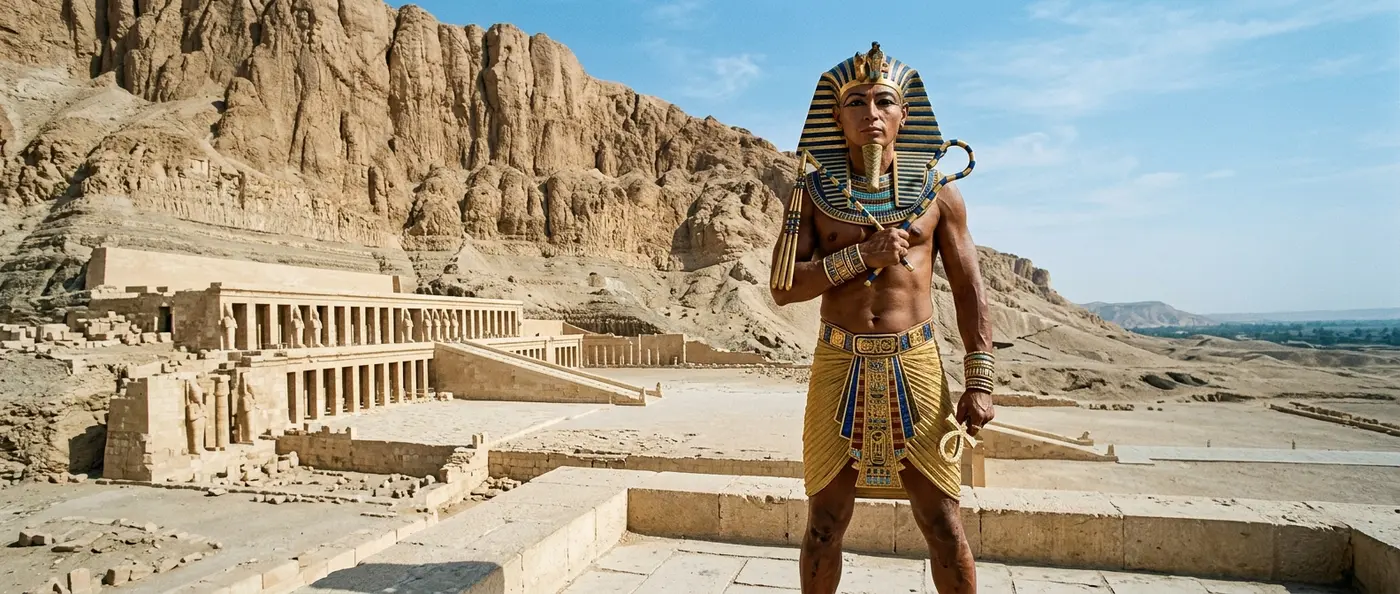
Her transformation from queen to pharaoh demanded more than a new title. She began appearing publicly with the traditional symbols of male power: the pharaoh's false beard, a short kilt instead of a long dress, and the double crown of Upper and Lower Egypt. In official depictions, she even adopted the broad masculine chest of the pharaohs.
💡 Why Become "Male"?
Hatshepsut wasn't trying to hide her gender—everyone knew she was a woman. The masculine appearance was necessary because the pharaoh's role was religiously masculine. The pharaoh was the living embodiment of the god Horus, son of the god Ra. To fulfill her religious duties, she had to adopt the masculine persona of the divine king.
🏛️ The Architectural Marvel of Deir el-Bahari
Hatshepsut's temple at Deir el-Bahari, near modern Luxor, stands as her greatest achievement. Known in antiquity as "Djeser Djeseru" (the Holiest of Holies), the temple was built on three levels with elegant colonnades that integrate harmoniously with the steep cliffs behind it.
The architect Senenmut, rumored to be the queen's lover, designed a building larger and more elaborate than any previous royal monument. The temple walls were decorated with detailed relief carvings that told the story of her reign's achievements, including the famous expedition to the land of Punt.
📖 Read more: Egyptian Mummification Secrets: Ancient Preservation
⚓ The Legendary Punt Expedition
Hatshepsut organized a massive trading expedition to the land of Punt, possibly modern-day Somalia or Eritrea. The expedition, carried out around 1470 BCE, included five massive ships with 210 sailors each.
Detailed depictions on her temple walls show the ships returning loaded with exotic treasures: gold, ebony, ivory, myrrh, frankincense, and living myrrh trees in pots. It was the first time plants had been transported alive from such a distance to be planted in foreign soil.
🔬 The Mystery of the Broken Statues
After Hatshepsut's death in 1458 BCE, many of her statues were found deliberately broken and buried in pits. For more than a century, Egyptologists believed Thutmose III launched a revenge campaign against his stepmother, trying to erase her memory from history.
Recent research by Jun Yi Wong of the University of Toronto challenges this theory. Studying excavation records from the 1920s and 1930s, Wong discovered the statues hadn't been smashed in the face or had their inscriptions destroyed. Instead, they had broken at the neck, waist, and feet—points that modern Egyptologists call "ritual deactivation."
📖 Read more: Nefertiti's Tomb: 2026 Discovery Within Reach?
Ancient Egyptians believed royal statues were powerful, possibly living entities. When a pharaoh died, it was customary to "deactivate" their statues by breaking them at their weak points. This practice wasn't unique to Hatshepsut—hundreds of "deactivated" pharaoh statues from various periods have been found throughout Egypt.
⚔️ Revenge or Ritual?
🗿 The Politics Behind the Erasure
While the statues at Deir el-Bahari were treated respectfully, Hatshepsut did suffer an erasure campaign at other Egyptian monuments. At many temples, her name and depictions were systematically erased. This campaign was started by Thutmose III, but not immediately after her death—he waited nearly 20 years.
Why this delay? Experts now believe the erasure wasn't personal revenge but political necessity. As Thutmose III aged and prepared his son Amenhotep II's succession, he may have worried that a female pharaoh's precedent could destabilize the dynasty. By erasing Hatshepsut from official records, he tried to ensure a smooth power transition from father to son.
Hatshepsut's reign was characterized by peace and prosperity. Unlike many predecessors and successors, she didn't pursue major military conquests. Instead, she focused on trade, architecture, and restoring temples that had been destroyed during the Hyksos occupation.
Hatshepsut's reign reveals the complex reality of power in ancient Egypt. Women could rise to absolute power, but only by playing within the rules of a system designed for men. Hatshepsut didn't try to change those rules—she used them masterfully.
Reign Duration
She ruled for nearly 22 years (1479-1458 BCE), one of the longest reigns of any female pharaoh in Egyptian history.
📖 Read more: Rosetta Stone: The Key That Unlocked Ancient Egypt
Architectural Legacy
Her temple at Deir el-Bahari is considered one of the masterpieces of ancient Egyptian architecture.
Peaceful Policy
She preferred trade and diplomacy over war, bringing wealth and stability to Egypt.
🔍 New Discoveries Continue
Excavations in the Deir el-Bahari area continue to reveal new evidence about Hatshepsut. Recently, archaeologists discovered 1,500 polychrome stone blocks that belonged to her valley temple, a building that stood near her main mortuary temple. These blocks still preserve vivid depictions of various scenes from her reign.
Even more intriguing is evidence showing that Thutmose III restored Hatshepsut's mortuary temple sometime after her death. This suggests their relationship was more complex than simple rivalry. Perhaps, despite the political necessity of erasing her name from official records, Thutmose III retained some respect for the woman who raised him and prepared him for the throne.
Hatshepsut stands among ancient Egypt's most remarkable rulers. She wasn't the first or last woman to rule Egypt, but she was perhaps the most successful. She held power for more than two decades, built monuments that survive today, and created a legacy that has outlasted every attempt to destroy it.