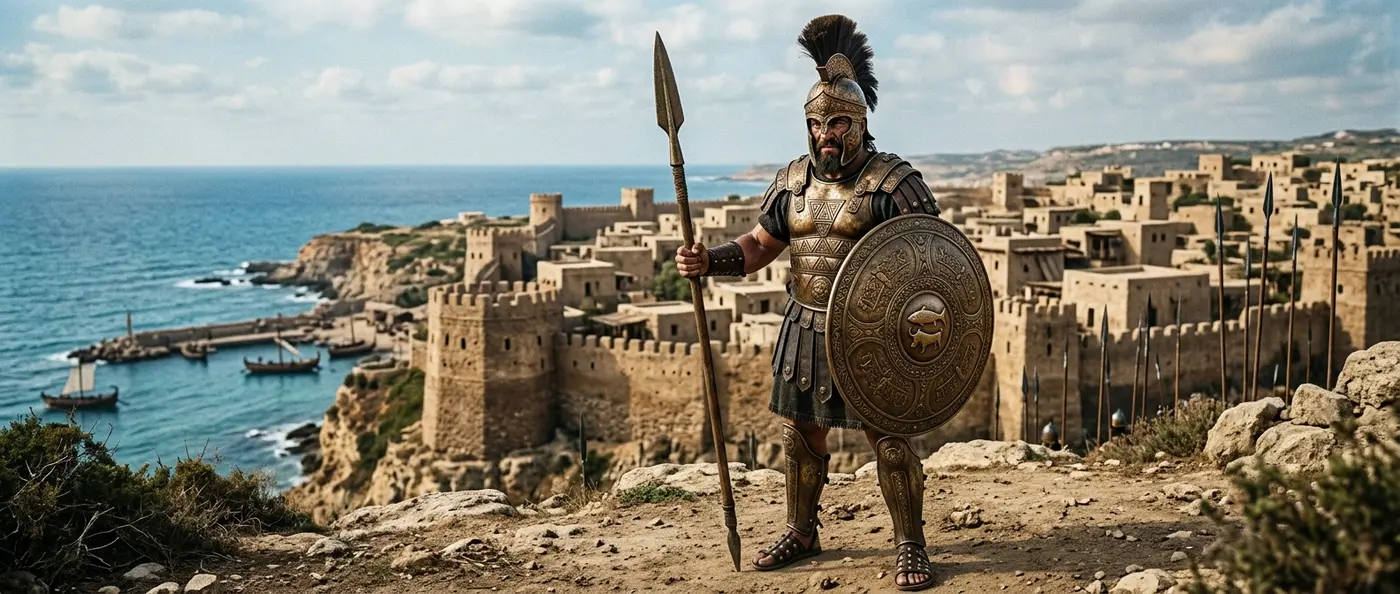
🗿 The Arrival of the Sea Peoples
The Philistines belonged to the mysterious "Sea Peoples" who flooded the Eastern Mediterranean at the end of the Bronze Age. According to inscriptions in the mortuary temple of Ramesses III at Medinet Habu in Egypt, they appear under the name "prst" as one of the invaders who attacked Egypt around 1190 BCE.
After being repelled by the Egyptians, they settled — possibly with Egypt's permission — in the coastal plain of Palestine, from Joppa (modern Tel Aviv-Jaffa) south to Gaza. This region became known as Philistia, the land of the Philistines.
Biblical tradition (Deuteronomy 2:23, Jeremiah 47:4) states that the Philistines came from Caphtor, which many identify with Crete. Although there's no archaeological evidence for Philistine occupation of Crete, their Aegean origins are confirmed by archaeological findings.
⚔️ The Philistine Pentapolis
The Philistines organized themselves into a confederation of five city-states, known as the Pentapolis. Each city was governed by a "seren" (ruler), and the five rulers cooperated closely for the common good of their nation.
The five cities of Philistia were strategically positioned along the coastal plain and trade routes. Gaza and Ashkelon were important ports, while Ashdod, Gath, and Ekron controlled the roads to the interior. This geographical position gave them significant advantages in trade and regional control.
Gaza
The southernmost port of the Pentapolis, a center of trade with Egypt and an important hub for caravans from Arabia.
Ashkelon
A major coastal center with strong walls, known for its naval power and commerce.
Ashdod
A fortified city that controlled the roads to the Judean highlands, with an important temple to the god Dagon.
🛡️ Military Superiority and Technology
The great advantage of the Philistines over their neighbors was their knowledge of iron metallurgy. According to the Bible (1 Samuel 13:19), the Philistines had a monopoly on the manufacture of iron tools and weapons in the region. They likely acquired this expertise in Anatolia before arriving in Palestine.
Their military organization was exceptionally advanced for the time. They used war chariots, had organized infantry with iron armor and weapons, and possessed a strong navy. This superiority allowed them to expand into neighboring areas and come into conflict with the Israelites.
💀 The Great Conflicts with the Israelites
The conflict between Philistines and Israelites dominated the region's history for centuries. Around 1050 BCE, the Philistines managed to occupy part of the Judean hill country, threatening the very existence of the Israelite tribes.
The Philistine threat was so great that it led the twelve tribes of Israel to unite under one king. Saul, the first king of Israel (approximately 1021-1000 BCE), spent most of his reign fighting the Philistines. Together with his son Jonathan, he won significant victories and managed to push them back from the central highlands.
⚡ The Battle at Mount Gilboa
Saul's final battle at Mount Gilboa was catastrophic. The Philistines, attempting to invade the Jezreel Valley, clashed with Israelite forces. Saul and his sons were killed in the battle, leaving Israel once again vulnerable to the Philistine threat.
👑 David and the Final Defeat
The definitive defeat of the Philistines came with King David in the 10th century BCE. David, who had lived for a time among the Philistines when fleeing from Saul, knew their tactics and weaknesses well.
After their defeat by David, Philistine history became a story of individual cities rather than a unified people. After the division of the kingdom into Judah and Israel in the 10th century BCE, the Philistine cities regained their independence and often clashed with neighboring kingdoms.
🏛️ Philistines vs Israelites
🏺 Culture and Religion
Despite their military strength, the Philistines gradually assimilated culturally with the indigenous Canaanites. Their language, for which no written texts have been found, was replaced by Canaanite, Aramaic, and later Greek.
The gods worshipped by the Philistines, such as Dagon, Astarte, and Beelzebub, have Semitic names and were probably adopted from the conquered Canaanites. Excavations at Ashdod, Ekron, and Tel Qasile have uncovered temples and sanctuaries that combine elements of Aegean design with local influences.
A characteristic element of Philistine culture is their pottery. At their early settlement sites, a distinctive type of pottery has been found that represents a variation of 13th-century BCE Mycenaean styles, confirming their Aegean origins.
📜 The Legacy of the Philistines
After the 7th century BCE, the Philistine cities became vassals of the Assyrians and later the Egyptians. With the conquests of Babylonian king Nebuchadnezzar II (605-562 BCE), they became part of the Neo-Babylonian Empire. They subsequently came under the control of the Persians, Greeks, and Romans.
The most enduring legacy of the Philistines is the name they gave to the land where they lived. From "Philistia" came the Greek term "Palestine," which was used to describe the entire region. Thus, a people who disappeared thousands of years ago continues to live through the name of the land.
Assyrian Sources
The first non-biblical reference to the Philistines after their settlement is in the chronicles of Assyrian king Adad-nirari III (810-782 BCE), who boasted of collecting tribute from Philistia.
International Relations
The Philistine cities maintained commercial and diplomatic relations with Egypt, Assyria, and other powers of the time, functioning as important intermediaries in international trade.
🔬 Modern Archaeological Discoveries
Modern excavations at ancient Philistine cities continue to reveal new information about this mysterious people. At Ashdod, Ekron, and Tel Qasile, impressive architectural remains have been discovered that confirm connections to the Aegean world.
The study of Philistine pottery has revealed a gradual evolution from Aegean models toward a hybrid type that combines elements from various traditions. This reflects the process of cultural assimilation experienced by the Philistines during their centuries of residence in Palestine.
The Philistines remain one of the most fascinating ancient peoples of the Near East. From mysterious invaders who came from the sea, they became a dominant power in the region, left an indelible mark on history, and ultimately gave their name to an entire country. Today, archaeologists still uncover Philistine pottery shards at Ekron and Ashdod, fragments of a civilization that gave Palestine its name.