🚢 Masters of the Mediterranean
The Phoenicians emerged around 1500 BCE along a narrow strip of coastline between the sea and the Lebanese mountains. Geography trapped them. But that trap became their superpower. With nowhere to expand inland, they turned to the Mediterranean and found their destiny.
Unlike other ancient peoples who built massive land empires, the Phoenicians created a network of city-states stretching from Syria to Spain. Tyre, Sidon, Byblos — these names became synonymous with wealth and maritime power. Each city operated independently, but all shared the same language, culture, and obsession with trade.
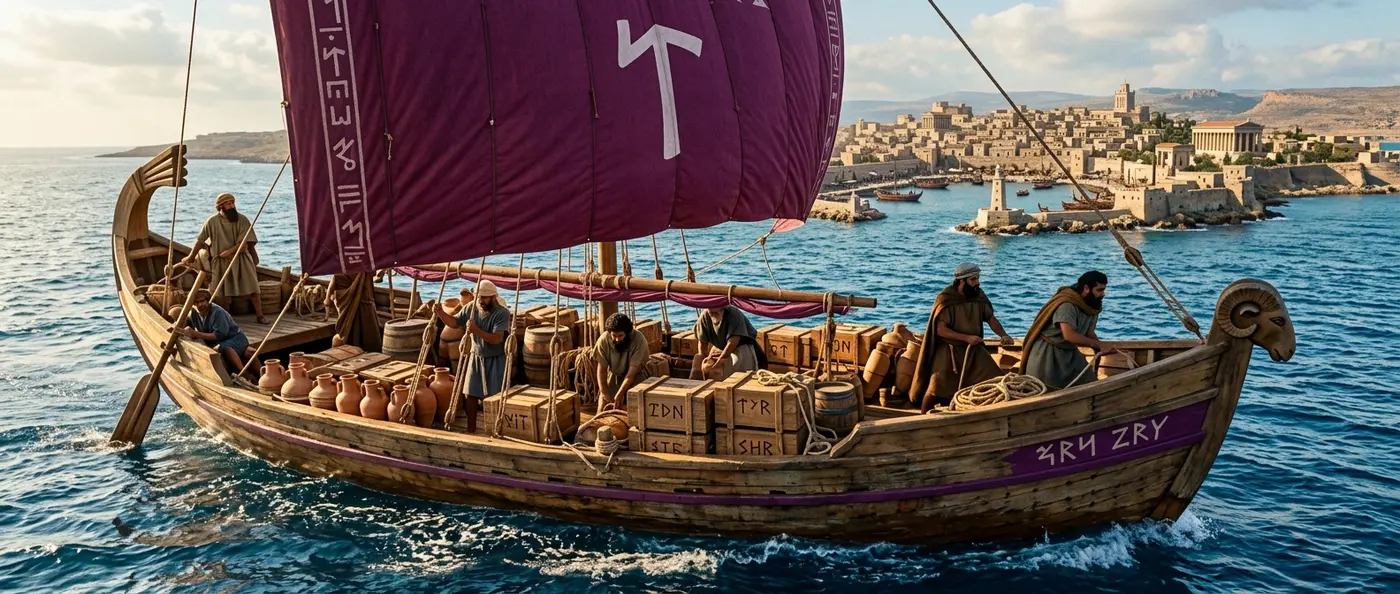
Their ships, built from the legendary cedars of Lebanon, traveled distances other peoples couldn't even imagine. They crossed the entire Mediterranean, passed through the Pillars of Hercules (modern Gibraltar), and reached Britain for tin. They may have reached the West African coast — two millennia before European explorers.
📜 The Alphabet Revolution
The Phoenicians' greatest gift to humanity wasn't their purple dye or their ships. It was a writing system so revolutionary it changed forever how humans communicate. The first alphabet appeared around 2000 BCE with the proto-Sinaitic script, developed by Canaanite workers in Egyptian turquoise mines in the Sinai.
The Phoenicians took this early alphabetic form and turned it into something practical and efficient. Their alphabet consisted of just 22 symbols, each representing a sound. This was radically different from the complex writing systems of the time — Egyptian hieroglyphs or cuneiform script required hundreds or thousands of symbols.
The simplicity of the Phoenician alphabet made it accessible. You no longer needed years of training to learn to write. Merchants, sailors, craftsmen — anyone could master the basics in weeks. This shift transformed trade, diplomacy, and culture across the ancient world.
🏺 The Trade That Changed the World
The Phoenicians weren't just traders — they were the architects of the world's first global commercial network. Their products traveled from Britain to Mesopotamia, creating an exchange system that connected civilizations and continents.
Their most famous product was purple dye, extracted from sea snails. It took thousands of snails to produce a few grams of dye, making it as valuable as gold. Only kings and emperors could afford clothes dyed with Phoenician purple. The phrase "born to the purple" that we still use today comes from this ancient luxury.
But the Phoenicians didn't trade only luxury goods. They carried metals from Spain, grain from Egypt, timber from Lebanon, ivory from Africa. Every ship leaving a Phoenician port was a floating commercial center, packed with products from dozens of different civilizations.
Purple Dye
The most precious dye in the ancient world, symbol of royal power. Extracted from Murex snails through an extremely laborious process.
Cedar of Lebanon
The finest wood for shipbuilding and construction. Used in Solomon's Temple and Egyptian tombs.
Glass
The Phoenicians perfected glassmaking, creating transparent and colored glass objects that amazed the ancient world.
⚓ Naval Supremacy
Phoenician ships were engineering marvels for their time. Using the exceptional quality of Lebanese cedars, they built vessels that could travel farther and carry more cargo than any other ships of the era.
They developed two main types: the gaulos, a round merchant ship with large capacity, and the trireme, a fast warship with three rows of oarsmen. The trireme later became the standard warship of Greeks and Romans, but the technology started with the Phoenicians.
But shipbuilding was just the beginning. The Phoenicians were masters of navigation, using stars to find their way across open seas. The North Star was known to ancient Greeks as "Phoenice" — the Phoenician star. They also developed detailed charts of coastlines and harbors, information they guarded as trade secrets.
🌟 Did You Know?
According to Herodotus, Phoenician sailors working for Pharaoh Necho II of Egypt (610-595 BCE) were the first to circumnavigate Africa. The journey took three years and, if true, preceded Vasco da Gama by 2,000 years!
🏛️ The Cities That Ruled the Seas
Each major Phoenician city had its own identity and specialization. Byblos, one of the world's oldest continuously inhabited cities, was the center of papyrus trade. Its name gave us the root for "book" in many languages. Sidon was famous for its glassmaking and metalwork. Tyre, built on an island, was nearly impregnable and became the wealthiest of all Phoenician cities.
Carthage, perhaps the most famous Phoenician colony, was founded by Tyre in 814 BCE in modern Tunisia. Within centuries, it evolved into a superpower that challenged Rome itself for control of the Mediterranean. The Carthaginians, though culturally Phoenician, developed their own identity and became one of Rome's greatest rivals.
The network of Phoenician cities and colonies operated more like a loose confederation than a unified empire. Each city maintained its independence, but all cooperated in trade and supported each other during crises. This flexible system allowed the Phoenicians to adapt to changing political conditions and survive even when conquered by larger powers.
🔱 Religion and Mythology
Phoenician religion was polytheistic, with each city having its own patron deity. Baal, god of storms and fertility, and Astarte, goddess of love and war, were the most widespread deities. Melqart, protector of Tyre, was later identified with Heracles by the Greeks.
Their religious practices included animal sacrifices and offerings to temples. There are controversial references to human sacrifices, particularly of children, mainly from Roman sources describing Carthaginian practices. Modern archaeologists continue to debate whether these accounts are accurate or propaganda from their enemies.
The Phoenicians believed in an afterlife and buried their dead with objects they would need in the other world. Wealthy tombs contained jewelry, weapons, and even small ship models, suggesting that the sea played a role even in their beliefs about the afterlife.
📊 Phoenician Influence on Ancient Civilizations
💫 The Legacy That Lives On
The Phoenician legacy reaches into our daily lives. Their alphabet became the foundation for the Greek alphabet, which in turn spawned the Latin alphabet we use today. Every time we write, we use a system that began with Phoenician merchants 3,000 years ago.
Every seafaring people that followed learned from Phoenician techniques and commercial practices. From Greeks and Romans to Venetians and Portuguese, all owe something to the Phoenician pioneers. The idea of international trade, commercial colonies, and maritime networks started with them.
Even today, Lebanon, the ancient homeland of the Phoenicians, keeps the image of the cedar on its flag — the tree that gave their ancestors the power to conquer the seas. Cities like Beirut and Tyre continue to be inhabited, living testimonies to a civilization that changed the world.
The Phoenicians remind us that real power doesn't always lie in the size of an empire or military might. Sometimes, it lies in the ability to connect people, share ideas, and create communication tools that transcend borders and time. The Phoenician alphabet, simple but revolutionary, remains perhaps the greatest gift any civilization ever gave to humanity.