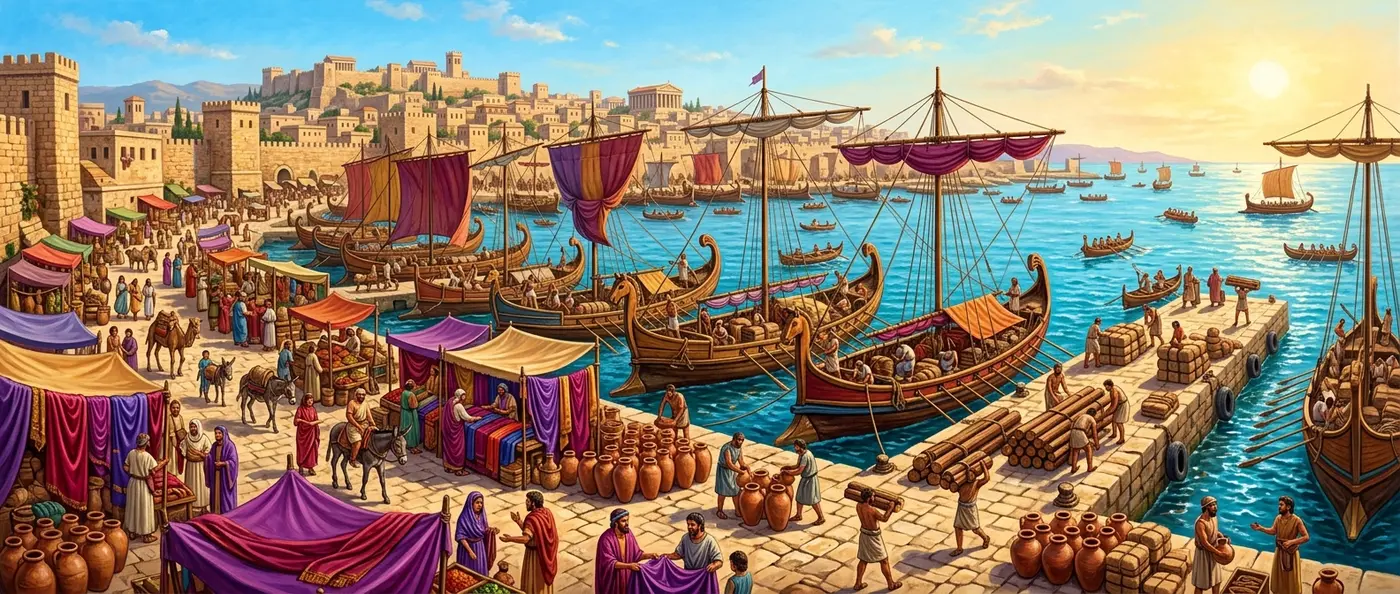
A Tyrian merchant loads his ship with dozens of amphorae filled with the most precious dye in the ancient world. It's the early 10th century BCE. The purple costs more than gold. It will travel across the Mediterranean alongside Lebanese cedars and exquisite textiles. These Phoenicians built the world's first global commercial network.
📖 Read more: Ancient Lydia: Where the World's First Coins Were Minted
🚢 Birth of a Maritime Empire
Phoenicia's strategic position at the crossroads of land and sea routes in the eastern Mediterranean gave its people a unique advantage. Under Egyptian protection during the 18th dynasty, the Phoenicians expanded their trade across the Mediterranean. An Egyptian tomb mural depicts seven Phoenician merchant ships that had just arrived at an Egyptian port, loaded with their characteristic wine amphorae from Canaan.
Werket-el from Tanis in the Nile Delta owned 50 ships that traveled between Tanis and Sidon. This wasn't exceptional. The Sidonians were famous in Homer's epics as craftsmen, merchants, pirates, and slave traders. Their reputation had spread everywhere.
The biblical Book of Ezekiel, in a famous denunciation of the city of Tyre, describes the vast extent of its trade, covering most of the world as the prophet knew it. Tyre had become the center of a commercial network stretching from Egypt to Spain.
💜 The Secret of Purple
Tyrian purple was the most coveted product in the ancient world. Extracted from the Murex snail, it required thousands of mollusks to produce just a few grams of dye. The process was so complex and time-consuming that purple's price far exceeded that of gold.
Only kings and high officials could afford clothes dyed with this pigment. In Rome, purple became a symbol of imperial power. The Phoenicians jealously guarded the production secret, maintaining their monopoly for centuries.
💡 The Color of Power
Byzantium later coined the phrase "born to the purple" (porphyrogenitos) for children born to reigning emperors. The delivery room in the palace was decorated with purple.
🌍 The Phoenician Trade Network
Phoenician exports included cedars and pines from Lebanon, fine linen from Tyre, Byblos, and Beirut, textiles dyed with the famous purple, embroidery from Sidon, metalwork and glass, enameled pottery, wine, salt, and dried fish.
In exchange, the Phoenicians imported raw materials like papyrus, ivory, ebony, silk, amber, ostrich eggs, spices, incense, horses, gold, silver, copper, iron, tin, jewelry, and precious stones.
According to Herodotus, the Phoenicians also conducted significant transit trade, particularly with the industrial products of Egypt and Babylonia. From the lands of the Euphrates and Tigris, regular trade routes led to the Mediterranean. In Egypt, Phoenician merchants soon gained a strong position — they were the only ones who could maintain profitable trade during the anarchic times of the 22nd and 23rd dynasties (approximately 943-730 BCE).
Maritime Expertise
The Phoenicians are credited with discovering and using the North Star for navigation. Fearless and patient sailors, they dared to travel to regions where no one else dared to go.
Secret Routes
Careful to protect their monopoly, the Phoenicians carefully guarded the secrets of their trade routes, their discoveries, and their knowledge of winds and currents.
Epic Explorations
According to Herodotus, Pharaoh Necho II (610-595 BCE) organized the Phoenician circumnavigation of Africa. The Carthaginian Hanno led another expedition in the mid-5th century BCE.
🏛️ Colonies and Expansion
Tyre's first colony, Utica in North Africa, was founded perhaps as early as the 10th century BCE. Phoenician expansion at the beginning of the 1st millennium BCE is possibly connected to the alliance of Hiram of Tyre with Solomon of Israel in the second half of the 10th century BCE.
Cyprus had Phoenician settlements by the 9th century BCE. Kition, in the southeastern corner of the island, became the main Phoenician colony in Cyprus. Elsewhere in the Mediterranean, several smaller settlements were planted as stations along the route to Spain and its mineral wealth in silver and copper.
New discoveries in Morocco reveal that northwestern Africa was inhabited long before the Phoenicians arrived. At the Kach Kouch archaeological site, archaeologists discovered the remains of a 4,200-year-old settlement that predated the Phoenicians. When the Phoenicians arrived around 800 BCE, they didn't simply occupy the space. Instead, evidence shows that the ancient people there built houses using a mixture of Phoenician and local architectural styles.
📜 The Alphabet Legacy
The Phoenicians gave Western civilization its alphabet. The discovery of the alphabet and its use and adaptation for commercial purposes helped the rise of a mercantile society.
The extent of Greece's debt to Phoenicia alone can be fully measured by the adoption, probably in the 8th century BCE, of the Phoenician alphabet with very little variation, along with Semitic loanwords, characteristic Phoenician decorative motifs in pottery and architectural examples, as well as the universal use in Greece of Phoenician standards of weights and measures.
🏺 Exports and Imports
⚓ Political Organization and Governance
Kingship appears to have been the earliest form of Phoenician governance, with each major city having its own king. Royal houses claimed divine descent, and the king could not be chosen from outside their members. His power was limited by that of the merchant families, who wielded great influence in public affairs.
Connected to the king was a council of elders — such at least was the system in Byblos, Sidon, and possibly Tyre. During the reign of Nebuchadnezzar II (approximately 605-561 BCE), a democracy replaced the monarchy in Tyre, and the government was administered by a succession of suffetes (judges).
Under the Persians, a federal bond was formed connecting Sidon, Tyre, and Aradus. Federation on a larger scale was never possible in Phoenicia because there was no sense of political unity to connect the different states among themselves.
🗺️ Mediterranean Influence
The Phoenicians shaped what they traded. They adapted Egyptian and Babylonian goods for new markets, created hybrid architectural styles, and transformed raw materials into luxury products. The Carthaginians appear to have reached Corvo island in the Azores, and may even have reached Britain, as many Carthaginian coins have been found there.
The Phoenicians' ability in navigation and seamanship was essential to establishing their commercial supremacy. Fearless and patient navigators, they dared to enter regions where no one else dared to go, and always, with an eye to their monopoly, they carefully guarded the secrets of their trade routes and discoveries and their knowledge of winds and currents.
🌟 A Living Legacy
Phoenician influence extends far beyond trade. Their alphabet became the basis for most modern writing systems. Their techniques in shipbuilding and navigation influenced all subsequent Mediterranean civilizations. Even today, Lebanon takes pride in its Phoenician heritage.