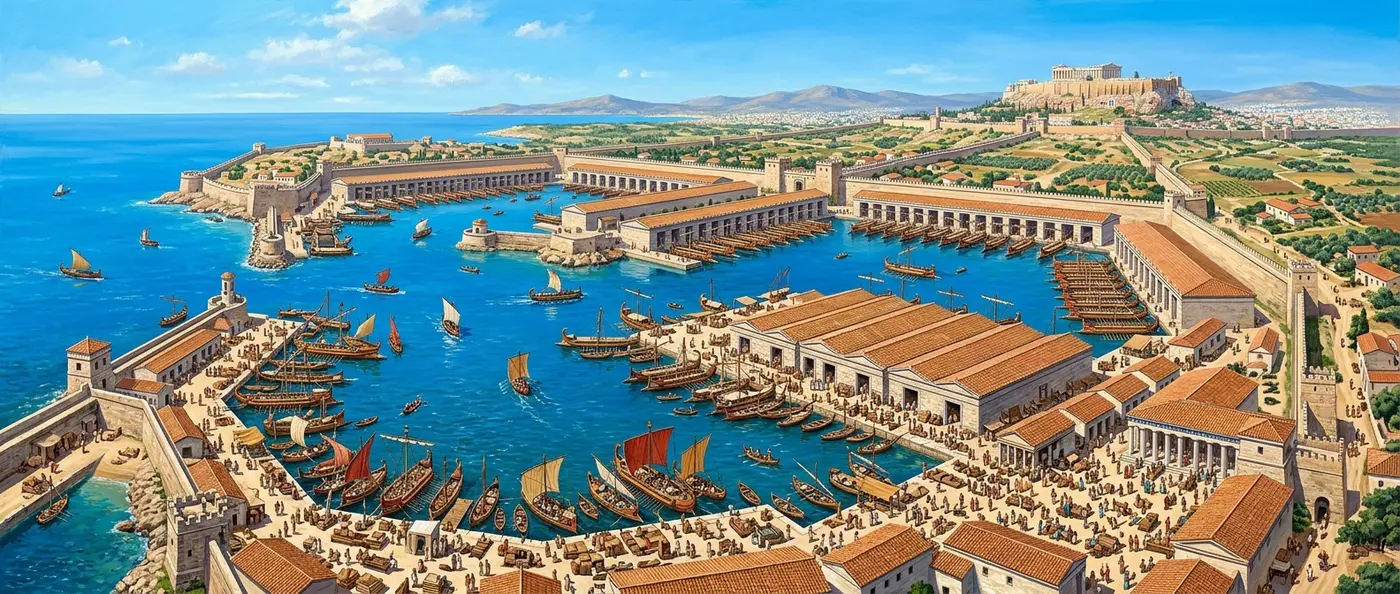
In the early 5th century BCE, an Athenian merchant stands on the wharf watching dozens of ships arrive from every corner of the Mediterranean. Piraeus isn't just a port — it's the beating heart that keeps the Athenian empire alive, the nexus where civilizations, goods, and ideas from three continents converge in spectacular fashion.
📖 Read more: Demosthenes: Athens' Voice Against Philip of Macedon
🏛️ Birth of the World's Greatest Harbor
Piraeus wasn't always the epicenter of Athenian naval power. Until the 5th century BCE, Phaleron served the city's needs. But Themistocles' strategic genius changed everything.
In 493 BCE, Themistocles recognized Piraeus' unique geographical position. The peninsula with three natural harbors — Kantharos, Zea, and Munichia — offered protection that no other point in Attica could guarantee. The transformation began immediately.
Within years, the rocky hill metamorphosed into one of the ancient world's most impressive harbor complexes. Engineers of the era constructed wharves, ship sheds, and warehouses with remarkable precision.
⚓ Three Harbors, One Maritime Empire
Each harbor at Piraeus served a specific role in Athens' naval and commercial life. Kantharos, the largest of the three, formed the commercial heart. Here, ships docked daily from Egypt, Sicily, the Black Sea, and every corner of the Mediterranean.
Zea and Munichia housed the war fleet. In the ship sheds — covered berths for triremes — hundreds of warships could be sheltered simultaneously. The organization was so efficient that the entire fleet could be readied for departure within hours.
Kantharos - The Commercial Hub
The largest harbor hosted all commercial activity. Warehouses, markets, and customs facilities served thousands of merchants daily. Black Sea grain that fed Athens passed through here, along with luxury goods from across the known world.
Zea - The Naval Base
With 196 ship sheds, Zea housed most of the war fleet. Facilities included shipyards, equipment warehouses, and crew training areas. This was where Athens' naval supremacy was forged and maintained.
Munichia - The Support Harbor
The smallest harbor with 82 ship sheds operated as backup. Ship repairs and maintenance happened here, while it also housed part of the reserve fleet and specialized naval equipment.
📖 Read more: Socrates, Plato & Aristotle: The Giants of Western Thought
🏺 Trade That Reshaped the Ancient World
Piraeus wasn't merely a transit point for goods. It was where the global economy of the era took shape. Merchants from every corner of the known world gathered in its markets, bringing together diverse languages, currencies, and cultures.
Black Sea grain was vital for Athens' survival. The city imported over 400,000 medimnoi of wheat annually — enough to feed its population for an entire year. But trade wasn't limited to basic commodities.
Luxury items from the East, metals from Iberia, timber from Macedonia and Thrace — everything passed through Piraeus. Athenians exported olive oil, wine, and especially their famous pottery, coveted throughout the Mediterranean.
💡 The Secret of Success
Piraeus developed a sophisticated customs system. The "pentekosté" — a 2% tax on all goods' value — generated enormous revenue for Athens' treasury, funding the fleet and major public works projects.
🔱 Athens' Naval Supremacy
Athenian power at sea began at Piraeus. After the Battle of Salamis in 480 BCE, where the Athenian fleet distinguished itself, the city systematically invested in naval strength. Piraeus was the center of this power.
The ship sheds at Piraeus were engineering achievements. Each trireme had its designated berth, with special ramps allowing quick hauling of ships onto land for maintenance. The system was so effective it became the template for other naval powers.
Crew training also took place at Piraeus. Thousands of rowers, sailors, and marines drilled daily in the harbor waters. This constant readiness gave Athenians the advantage in every naval engagement.
⚔️ Piraeus vs Other Ancient Ports
📖 Read more: Ancient Greek Education: Schools and Gymnasiums
🏰 The Long Walls - Piraeus' Shield
The construction of the Long Walls demonstrated Piraeus' strategic value to Athens. This unique fortification project, completed around 450 BCE, connected Athens to Piraeus with two parallel walls roughly 4 miles long each.
The walls created a protected corridor ensuring communication with the sea even during siege. This provided Athens with a crucial strategic advantage — as long as its fleet dominated the sea, the city couldn't starve.
During the Peloponnesian War, the Long Walls' importance proved decisive. When Spartans invaded Attica, the rural population took refuge in the protected space between the walls. Despite hardships, Athens could continue functioning thanks to supplies arriving by sea.
🗺️ Political and Social Life
Beyond its role as a port, Piraeus developed into a distinct city. Hippodamus of Miletus, history's first urban planner, designed the city with straight streets intersecting at right angles — a revolutionary system for the time.
Piraeus housed mainly sailors, merchants, craftsmen, and metics. Society was more cosmopolitan and open than Athens proper. Here you'd meet people from every Mediterranean corner, bringing new ideas and cultures.
Democratic tradition ran strong in Piraeus. Residents actively participated in political life, and many fleet sailors were citizens with full rights. This created a powerful sense of community and patriotism.
Population and Composition
Piraeus hosted tens of thousands of residents, from Athenian citizens to metics and slaves. This multicultural composition made the city a center of innovation and idea exchange.
Courts and Institutions
Piraeus had its own courts for maritime and commercial cases. "Commercial trials" allowed quick dispute resolution, facilitating trade and maintaining the port's reputation for fairness.
📖 Read more: Battle of Marathon: The Victory That Rewrote History
💀 Decline and Destruction
Athens' defeat in the Peloponnesian War in 404 BCE marked the beginning of the end for Piraeus. Spartans imposed the demolition of the Long Walls and harbor fortifications. Without their protection, Piraeus lost much of its strategic importance.
Despite reconstruction efforts in the 4th century BCE, Piraeus never regained its former glory. Macedonia's rise and later Rome's transformed the port into a regional center. In 86 BCE, Roman general Sulla destroyed what remained of the fortifications.
For centuries, Piraeus remained a small fishing village. Only in the 19th century, with the establishment of the new Greek state, did it begin to revive. Today, it's once again Greece's largest port — a living reminder of its ancient glory.
🔬 Modern Archaeological Discoveries
Underwater surveys at Piraeus have revealed impressive finds: ship shed foundations, anchorages, even merchant ship wrecks with intact cargo. Each discovery adds new information about life in the ancient world's greatest port.
🏛️ Piraeus' Enduring Legacy
Ancient Piraeus left an indelible mark on history. It was the first port systematically designed to serve both commercial and military needs simultaneously. Innovations in organization and administration became templates for later harbors.
Beyond strategic importance, Piraeus was a place of cultural exchange. Here Greeks and barbarians met, merchants and philosophers, sailors and artists. This diversity influenced classical Athens' international outlook.
Piraeus demonstrated how sea power and trade could elevate a city to global prominence. But this power must be continuously protected and renewed. When Athens lost naval supremacy, it lost its place in the world.
Today, walking through modern Piraeus, one can still discern traces of the glorious past. Sections of ancient walls, ship shed foundations, even the Hippodamian street system remind us of the era when the heart of the world's first maritime democracy beat here.