📖 Read more: Roman Camps: 1,700-Year-Old Discoveries in Germany
🌋 The Day Time Stopped
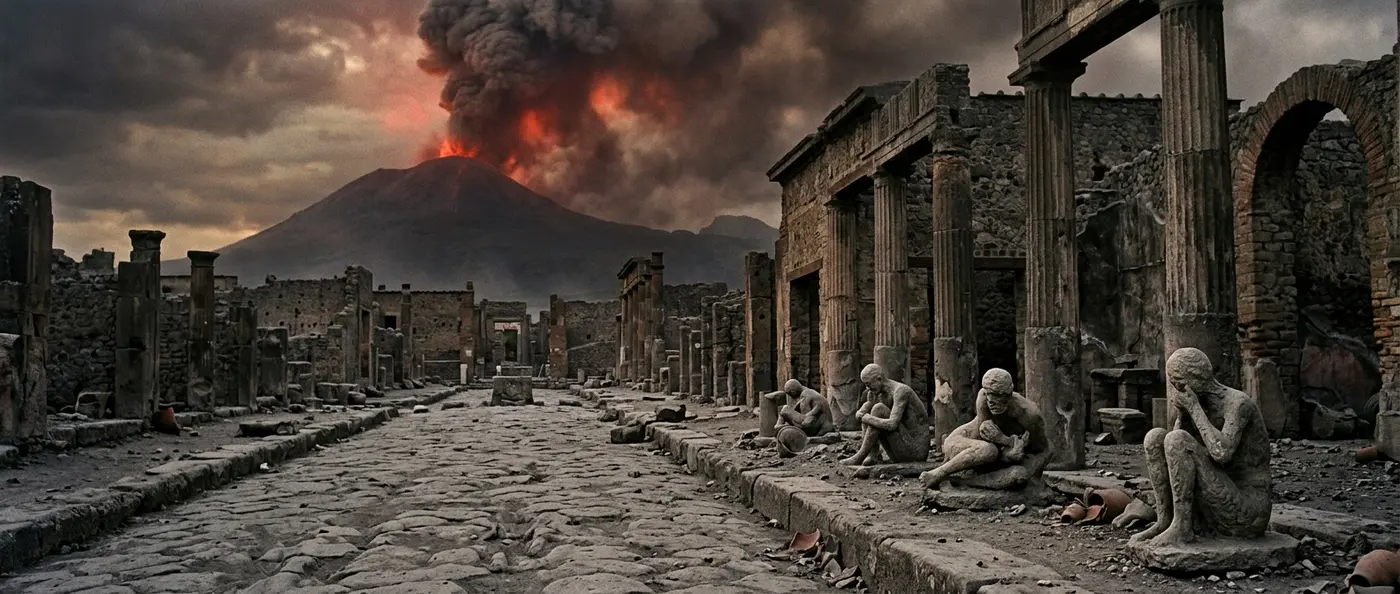
Vesuvius didn't just erupt — it created a time machine. The blast buried Pompeii under more than 9 feet of ash in a matter of hours, according to the latest archaeological data from National Geographic. But here's what killed most people: it wasn't the ash itself.
On the morning of August 25th, pyroclastic flows — superheated mixtures of rock fragments, gas, and trapped air moving at over 50 mph — slammed into the city. These flows caused most of the deaths, not the gradual burial under ash that many people imagine.
A recent discovery challenges everything we thought we knew about the timing. Workers found graffiti on a wall dated October 17th, complete with a crude joke. Some researchers now think the eruption happened in October, not August — a theory backed by finds of autumn fruits and heavier clothing on the victims.
🏛️ A City Bursting With Life
Pompeii wasn't some sleepy provincial town. This was a thriving commercial hub with over 200 craft workshops — tanners, weavers, bakers. The production of garum, a popular fish sauce, formed the backbone of the local economy.
Recent excavations in Region V have revealed a wealthy neighborhood with stunning frescoes and artifacts. Among the finds: the House of the Garden and the House of Orion, featuring mythological scenes in vivid colors that survived almost intact.
One standout discovery is a mausoleum at Porta Stabia, the city's southern gate. This marble monument, built just before the eruption, bears the longest funerary inscription ever found — over 13 feet long — revealing intimate details about life in Pompeii.
From 2012 until December of last year, Pompeii operated under a kind of archaeological intensive care known as the Great Pompeii Project. With $114.8 million in funding from the European Union, the project responded to UNESCO's threat to add Pompeii to its List of World Heritage in Danger.
By 2010, after decades of neglect, poor drainage, earthquakes, mass tourism, and vandalism, Pompeii was literally falling apart. Only 10 of the city's buildings were open to the public, compared to 64 in 1956. More than 70% of the site was closed to visitors.
Today the situation has changed dramatically. Nearly 40 buildings are now open to the public, including the Schola Armaturarum where gladiators trained. According to Massimo Osanna, director of the Pompeii Archaeological Park, the city is now in "incomparably better condition than in the past."
Modern Techniques
Archaeologists use drones, ground sensors, CT scans, and virtual reality to reveal new secrets without destroying the finds.
Unexplored Areas
About one-third of Pompeii's 170 acres remains unexplored, promising even more discoveries in the future.
Protection & Conservation
Restoration and conservation are now considered as important as new discoveries, ensuring the city's preservation for future generations.
📖 Read more: Roman Gladiators: The Brutal Truth Behind the Arena
💀 The Final Moments
Recent excavations have uncovered 12 more victims of the eruption. One headless skeleton found in Region V was initially thought to have been decapitated by a massive stone. But archaeologists later found the skull and determined death came from asphyxiation during the pyroclastic flow.
Not everyone died, though. Cart wheel tracks found in 2017 near Porta Stabia, preserved in the ash, suggest some managed to escape. Archaeologists estimate that of the city's 15,000 residents, about 2,000 lost their lives — far fewer than you'd expect.
The bodies of victims, preserved as voids in the hardened ash, have become plaster casts. These haunting figures capture the final moments of people who lived nearly 20 centuries ago. A three-year-old child found in 1974 with two adults, likely his parents, is now undergoing DNA analysis as part of the Great Pompeii Project.
🗓️ When Did the Eruption Happen?
Traditional dating places the eruption on August 24th, based on a letter by Pliny the Younger. But the discovery of an inscription dated October 17th, along with finds of autumn fruits and heavier clothing on victims, suggests the disaster may have occurred in October.
🏺 The Legacy That Survived
Pompeii keeps revealing its secrets. The Villa of the Mysteries, discovered in 1909, contains what Massimo Osanna calls "the best-preserved iconographic cycle of antiquity." The House of the Vettii, found in 1894, was the first Pompeii house discovered with all its frescoes and furniture in place.
Pompeii's preservation tells only half the story. It gives us a snapshot of daily life in a first-century Roman city. From graffiti on walls to fast-food restaurants (thermopolia) and political posters, the city reveals a society strikingly modern in its concerns and habits.
Despite extensive excavations lasting centuries, Pompeii remains one of the longest-running archaeological sites in the world. Giuseppe Fiorelli, who led research for 12 years until 1875, uncovered about one-third of the city. Amedeo Maiuri directed the site for 40 years until 1961, bringing another third to light.
Both men recognized that restoration and conservation are sometimes more important than new discoveries. This philosophy continues today. Future excavations will focus on Region VIII, a decision based on urgent safety and conservation needs.
The Great Pompeii Project has proven that Pompeii still has many mysteries to reveal. Using the most advanced techniques, archaeologists continue to uncover new finds that reveal the daily routines of people who lived in Pompeii and bring them closer to us than ever before.
📊 Pompeii by the Numbers
Pompeii's story didn't end that day in 79 AD. It continues with every new discovery, every preserved building, every visitor who walks its ancient streets. This is a city that refuses to be forgotten, a window to the past that remains open for anyone willing to look through it.