⚔️ When Titans Collide
Carthage had everything going for it. Founded by Phoenician colonists in the 9th century BC, it controlled Mediterranean trade like Amazon controls e-commerce. Its merchant ships reached Britain for tin, sailed to West Africa for gold, and dominated every profitable sea route between. The Carthaginian navy was untouchable — 500 warships patrolled waters from Spain to Sicily.
Rome was different. A scrappy Italian city-state that had just finished conquering its neighbors through sheer bloody-mindedness. Romans were farmers who fought, not sailors who traded. But they had something Carthage lacked: an unbreakable will to win and citizens who'd rather die than surrender.
The spark came from Sicily. The Mamertines — Italian mercenaries who'd seized the city of Messana — found themselves trapped between Carthaginian forces and Syracuse. They begged Rome for help. The Roman Senate hesitated. Cross into Sicily and they'd be declaring war on the Mediterranean's greatest naval power. Stay home and watch Carthage control the entire island, just three miles from Italy's coast.
🏛️ First Punic War: Learning to Swim
Rome chose war. Problem: they had no navy. Carthage ruled the waves with 500 years of naval expertise. Romans had never built a proper warship in their lives. So they did what Romans do — they improvised, adapted, and refused to quit.
When a Carthaginian quinquereme washed up on their shores, Roman shipwrights reverse-engineered it. In 60 days, they built 120 warships from scratch. But Romans couldn't out-sail Carthaginians any more than Carthaginians could out-march Romans. So they changed the game.
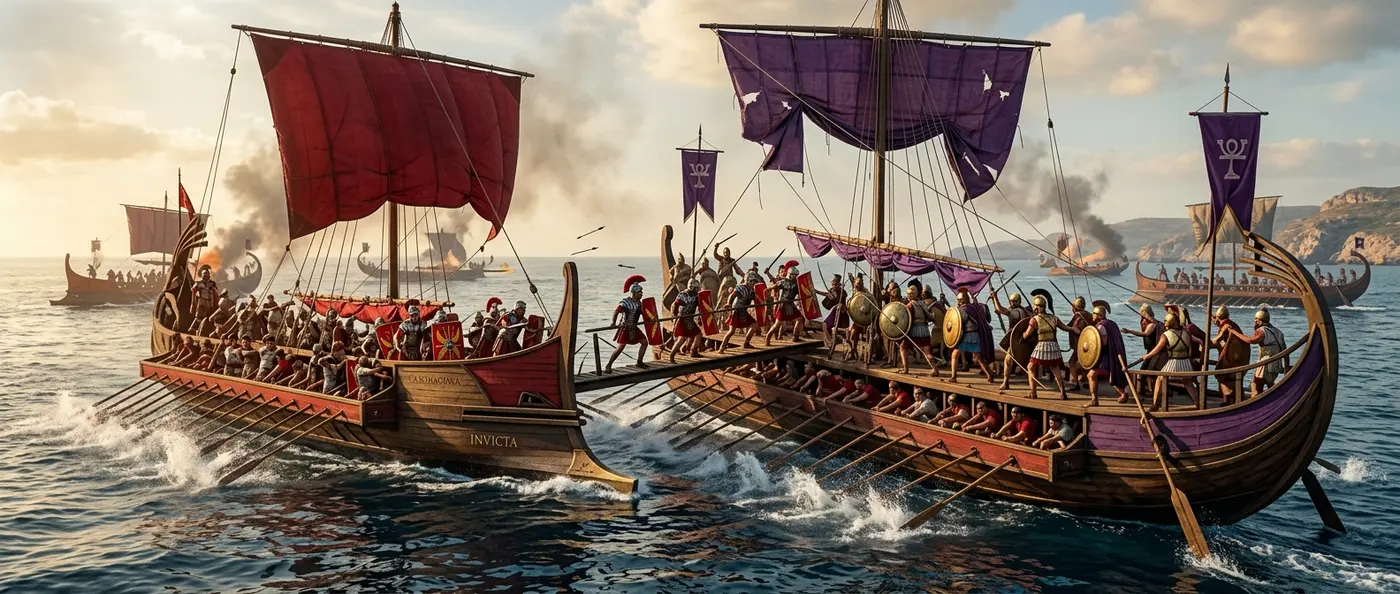
Enter the corvus — a 36-foot boarding bridge with a massive spike that crashed down onto enemy ships. Suddenly, naval battles became land battles fought on floating platforms. Roman legionaries could do what they did best: get up close and stab people with swords. At Mylae in 260 BC, Consul Gaius Duilius used this contraption to capture 50 Carthaginian ships. Rome had learned to fight on water.
But the sea fought back. Storms destroyed entire Roman fleets — 284 ships and 100,000 men lost in 255 BC, another 120 ships in 249 BC. Each time, Rome rebuilt. The final showdown came at the Aegates Islands in 241 BC, where a rebuilt Roman fleet crushed Carthage's last hope. Sicily became Rome's first overseas province.
🐘 Second Punic War: Hannibal's Revenge Tour
Twenty-three years of peace ended when a 29-year-old Carthaginian general decided to rewrite military history. Hannibal Barca had sworn a childhood oath to destroy Rome. Now he had the army to do it — and a plan so audacious it bordered on insanity.
Instead of sailing across the Mediterranean where Rome's new navy waited, Hannibal would march from Spain through Gaul and across the Alps. In winter. With elephants. His father Hamilcar had conquered most of Spain to build this moment. Hannibal inherited an army of 50,000 infantry, 9,000 cavalry, and 37 war elephants — the ancient equivalent of tanks.
The Alpine crossing nearly killed them all. Avalanches, frostbite, and hostile tribes whittled the army down to 26,000 men and a handful of surviving elephants. But what emerged from those mountains was the most dangerous force Rome had ever faced. Hannibal didn't just win battles — he gave masterclasses in military genius.
Battle of Trebia
December 218 BC: Hannibal lures Romans into a frozen river ambush. Roman losses: 20,000 of 40,000 soldiers.
Battle of Lake Trasimene
June 217 BC: History's greatest ambush. 15,000 Romans slaughtered in 3 hours along the lakeshore mist.
Battle of Cannae
August 216 BC: The perfect tactical encirclement. 70,000 Romans dead in one day — Rome's worst defeat ever.
After Cannae, Rome teetered on the brink. Hannibal controlled southern Italy and key allies were defecting. Any sane government would have sued for peace. Rome's response? They banned the word "peace" from public discussion, raised new armies, and appointed Fabius Maximus as dictator. His strategy: avoid pitched battles, shadow Hannibal's army, cut his supply lines, and slowly bleed him dry.
The Romans called Fabius "the Delayer" — not exactly a compliment. But it worked. Hannibal was trapped in Italy without reinforcements, watching his army slowly waste away. Meanwhile, a young Roman general named Publius Cornelius Scipio was learning Hannibal's tactics and applying them in Spain.
🗺️ The War Goes Global
Scipio understood something the Roman Senate didn't: you can't beat Hannibal by hiding from him. You beat him by cutting off his support and forcing him to fight on your terms. In Spain, Scipio systematically destroyed Carthage's supply bases and recruited local tribes with a combination of Roman discipline and Carthaginian cunning.
By 204 BC, Scipio was ready for the ultimate gamble. He landed in North Africa with 30,000 men and threatened Carthage itself. For the first time in 15 years, Hannibal was recalled from Italy. The two greatest generals of their age would finally meet face-to-face.
💡 Hannibal's Military Genius
Military academies still study Hannibal's tactics 2,200 years later. At Cannae, he deliberately weakened his center to draw the Romans into a trap, then crushed them with his strong flanks — the classic "double envelopment" that inspired everyone from Napoleon to Patton. He never lost a major battle until his final confrontation with Scipio.
⚔️ Zama: The Final Showdown
October 202 BC, near Carthage. Two master tacticians faced each other across a dusty plain. Scipio had learned from every one of Hannibal's victories. When the war elephants charged, Roman troops opened corridors in their ranks, letting the beasts pass harmlessly through. When Hannibal's veterans attacked, they met Romans who fought with Carthaginian flexibility and Roman discipline.
The battle hung in the balance until Numidian cavalry — former Carthaginian allies now fighting for Rome — struck Hannibal's rear. For the first and only time in his career, Hannibal was outgeneraled. Carthage sued for peace on humiliating terms: surrender their fleet, pay massive reparations, and never wage war without Roman permission.
🔥 Third Punic War: The Final Solution
Fifty years of peace made Carthage prosperous again. That prosperity terrified Rome. Senator Cato the Elder ended every speech with "Carthage must be destroyed" — regardless of what he'd been talking about. When Carthage fought a border war with Numidia in 149 BC, Rome found its excuse.
The Carthaginians tried everything to avoid war. They surrendered weapons, hostages, even agreed to pay tribute. But when Rome demanded they abandon their city and move inland, they chose to fight. The siege lasted three years. Every house became a fortress. Women cut their hair to make bowstrings. Children melted jewelry to forge weapons.
🏛️ The Siege of Carthage
When Scipio Aemilianus finally breached the walls in 146 BC, six days of street fighting followed. The final act was barbaric even by ancient standards. The city burned for 17 days. Survivors were sold into slavery. Legend claims the Romans sowed the ruins with salt so nothing would grow — probably myth, but the sentiment was real. Carthage was erased.
🌍 The World After Carthage
The Punic Wars transformed Rome from regional power to Mediterranean hegemon. Victory brought unimaginable wealth but also new challenges. Governing overseas territories required new institutions that ultimately transformed the Republic into the Empire. The Roman army that emerged from these wars was the most effective killing machine the ancient world had ever seen.
For Carthage, the destruction was total. A city that had been a center of trade and culture for 700 years simply vanished. Libraries, archives, and an entire cultural tradition disappeared. Today we know Carthaginian history mainly through Roman eyes — the winners wrote the history books.
The wars showcased both human adaptability and brutality. Rome learned to build fleets from scratch. Hannibal crossed mountains with elephants. Scipio mastered enemy tactics and turned them against their creators. But the ultimate lesson was darker: in total war, there are no rules. The complete destruction of Carthage left Rome without a rival — and perhaps contributed to its eventual internal collapse.
📚 Lessons from the Ashes
The Punic Wars teach timeless lessons about innovation, persistence, and the price of victory. They show how technological adaptation (the corvus) can overturn traditional advantages. They prove that military genius (Hannibal) means nothing without political support and resources. They demonstrate that resilience beats brilliance — Rome lost more battles but won the wars.
Perhaps the most sobering lesson is the cost of total victory. Carthage's destruction deprived the ancient world of a dynamic civilization and left Rome without a worthy rival. As historian Polybius wrote, Scipio Aemilianus wept watching Carthage burn, fearing that someday the same fate would find Rome. He was right — just not for another 600 years.
Today, in the hills of modern Tunisia, Carthage's ruins remind visitors of this epic struggle. The foundations of houses that once sheltered one of antiquity's most cosmopolitan societies are barely visible. The harbors that once housed the Mediterranean's most powerful fleet are now quiet lagoons. Their silence speaks louder than any history book about the price of war and the fragility of empires.