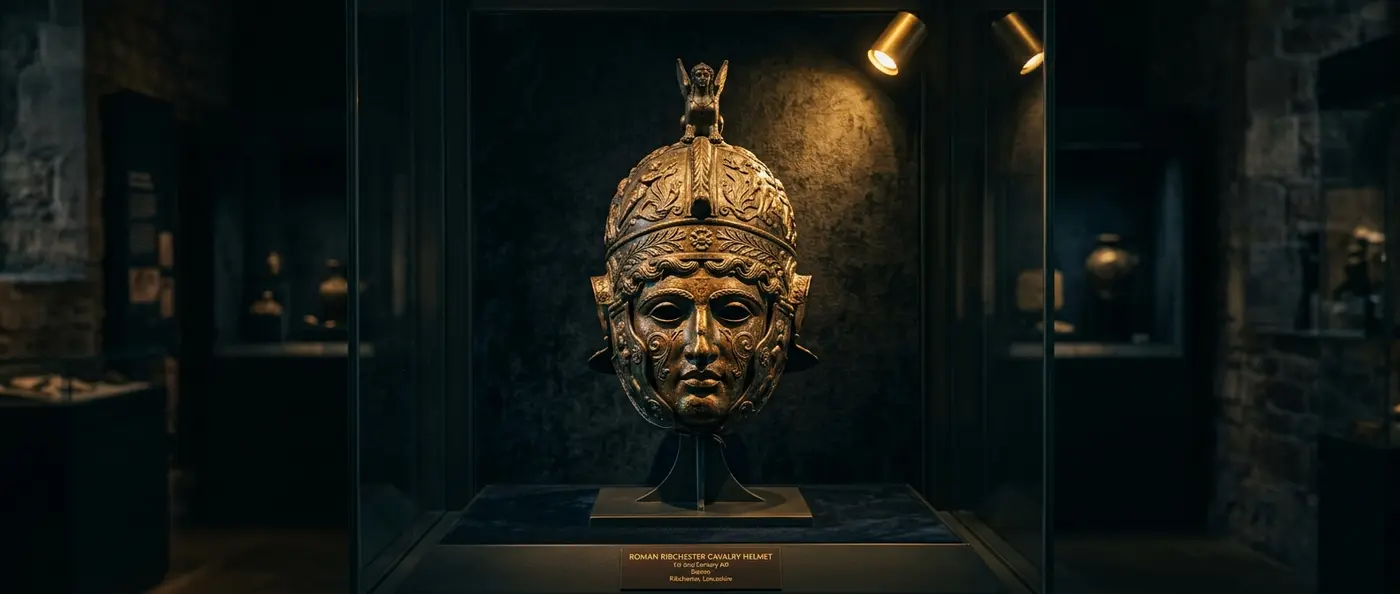
A boy stumbled across a hole in an English field in 1796. What he pulled from the earth changed everything we know about Roman military life in Britain. Buried among 30 bronze objects lay a cavalry helmet with a face mask, crafted around 100 AD and forgotten for 17 centuries. The Ribchester Helmet ranks among the rarest finds from Roman Britain — only three masked helmets have ever been discovered on the island.
📖 Read more: Hercules Tomb: 2,400-Year-Old Shrine Found Near Rome
🏛️ The Discovery That Stunned Archaeologists
The boy was running through fields behind his house in Ribchester, northwest England, when he tripped over a depression in the ground. Inside that hollow lay a treasure that had waited nearly 1,700 years to see daylight again. The hoard contained more than 30 bronze objects — military equipment likely stored near the Roman fort of Bremetennacum Veteranorum.
The fort was abandoned in the late 2nd century AD, and this cache was simply forgotten. Someone had probably stashed the gear in a chest or box, planning to retrieve it later or melt it down for the bronze. That day never came. By 1813, the helmet had found its way to the British Museum, where it remains one of the most striking pieces in their Roman collection.
The find's significance lies in its rarity. Only three face-mask helmets have ever been found in Roman Britain. The combination of exceptional preservation, intricate decoration, and historical significance makes the Ribchester Helmet invaluable for understanding Roman military culture in the empire's northern provinces.
The helmet itself weighs 2.9 pounds (1.3 kg) and consists of two main parts: the bowl and the face mask depicting a young man's features. Every inch of its surface tells a story through elaborate metalwork that would have taken skilled craftsmen months to complete.
⚔️ The Art of War Decoration
The helmet's bowl showcases a dramatic battle scene that favors the mounted warrior. Six cavalry riders face off against 11 foot soldiers in a clash that doesn't end well for the infantry. Two fallen warriors lie dead on the ground, emphasizing cavalry supremacy despite being outnumbered. The scene includes two palmettes — victory symbols — along with shields and spears representing enemy spoils.
What catches the eye are the holes punched into the helmet's back, around the neck area. Archaeologists believe ribbons or streamers hung from these openings, fluttering as the rider moved and adding theatrical flair to an already impressive display. Picture a cavalry officer thundering across a field, bronze gleaming and colorful ribbons streaming behind him.
The metalwork demonstrates techniques that Roman craftsmen had perfected over centuries. Each figure in the battle scene was carefully hammered and chased into the bronze, creating depth and movement that brings the ancient conflict to life. The level of detail suggests this wasn't standard military issue but equipment reserved for elite units or special occasions.
🎭 The Face Behind the Mask
The mask portrays a youthful, beardless face with an expressionless gaze. The young man's hair forms curls that transform into four snake heads — a visual reference to Medusa and the Gorgons. This motif wasn't unusual in Roman military equipment, as they believed it offered protection and terrified enemies.
Crowning the hair sits a diadem shaped like a "corona muralis" — a crown resembling city walls. This was one of Rome's highest military decorations, awarded to soldiers who first scaled the walls of a besieged city. Its presence on the helmet indicates the high symbolism and prestige associated with its wearer.
The eye holes and nostril openings tell a different story. The eye holes and nostril openings are extremely small, making practical use in real combat nearly impossible. This detail led archaeologists to reconsider the helmet's true purpose entirely.
The mask's craftsmanship rivals the finest portrait sculpture of the period. Every detail, from the perfectly symmetrical features to the intricate hair treatment, speaks to the skill of Roman metalworkers. This wasn't just protective gear — it was wearable art designed to impress and intimidate.
Hippika Gymnasia
The helmet was used in special military exercises called "hippika gymnasia" — cavalry tournaments that combined training with entertainment for soldiers and visitors.
Theatrical Battles
Riders dressed as Greeks, Trojans, or Amazons and participated in mock battles, with men and horses adorned in spectacular equipment.
Symbol of Prestige
The corona muralis on the helmet was one of Rome's highest decorations, indicating that its wearer was part of the army's elite.
🏰 Fort Bremetennacum Veteranorum
The Roman fort where the treasure was found occupied the site of modern Ribchester village. Bremetennacum Veteranorum controlled roads and trade routes in northwest England from a strategically crucial position at the intersection of major Roman highways.
The fort housed veteran soldiers — hence "Veteranorum" in its name. These experienced warriors had completed active service and settled in the area with their families. The presence of such elaborate equipment as the Ribchester Helmet suggests the fort hosted high-status units, possibly elite cavalry.
When the fort was abandoned in the late 2nd century AD, it coincided with a period of Roman military reorganization in Britain. As imperial priorities shifted and new threats emerged on other frontiers, many forts in northern England were abandoned or reduced in garrison strength.
📖 Read more: Roman Tombs at Ostia: 2026 Necropolis Discovery
Archaeological evidence shows the fort wasn't just a military installation but a thriving community. Civilian settlements grew up around the walls, complete with shops, workshops, and temples. The soldiers' families, local traders, and craftsmen created a multicultural environment where Roman, Celtic, and Germanic influences mixed.
💡 Did You Know?
The Ribchester Helmet has become so iconic that it's appeared in countless books, documentaries, and exhibitions as the definitive example of high-quality Roman military equipment found in Britain. It's literally the poster child for Roman Britain.
🔬 Modern Research and New Discoveries
In 2019, archaeologists Jamie Kaminski and David Sim published a detailed study in Arms & Armour journal that shed new light on the helmet's use. Their research confirmed the helmet wasn't designed for actual combat but for "hippika gymnasia" — elaborate military displays that functioned as both entertainment and training.
These events were spectacular performances where the unit's best riders showed off their skills. Dressed in fancy equipment, often portraying mythical heroes and ancient warriors, they staged shows that combined military precision with pure spectacle. Their horses wore ornate harnesses and decorative elements that matched the riders' gear.
The study revealed that similar helmets have been found across the Roman Empire, from Germany to Syria. This indicates that hippika gymnasia were a pan-Roman phenomenon, part of military culture that united legions from Britain to the East. These weren't local British customs but empire-wide traditions that reinforced Roman identity and military pride.
Modern analysis using X-ray spectroscopy has revealed details about the bronze alloy composition, providing clues about metal sources and manufacturing techniques. The helmet contains tin and lead in proportions that suggest sophisticated metallurgy, with different alloys used for different parts to optimize both strength and workability.
🗿 The Helmet's Legacy
More than 200 years after its discovery, the Ribchester Helmet continues to captivate visitors and researchers. At the British Museum, where it's been on permanent display since 1813, it ranks among the most popular exhibits in the Roman collection. Thousands of visitors annually stand before its case, trying to imagine the cavalryman who once wore it.
Museums worldwide have created reproductions and replicas of the helmet. Museums and historical groups worldwide have created copies for educational purposes and historical reenactments. These reproductions allow the public to see how the helmet would have appeared when new, with polished bronze gleaming and ribbons fluttering in the wind.
The helmet provides direct evidence of Roman military traditions. It teaches us that the Roman army wasn't just a war machine but a complex social organism with its own traditions, ceremonies, and forms of entertainment. The hippika gymnasia described by Kaminski and Sim were events that boosted morale, allowed skill demonstration, and kept military traditions alive.
The helmet also represents the multicultural nature of the Roman Empire. While found in Britain, it was likely made by craftsmen trained in Mediterranean techniques, worn by a soldier who might have come from anywhere in the empire, and used in ceremonies that blended Roman military tradition with local customs.
⚔️ Comparison with Other Roman Helmets
📚 The Future of Research
The Ribchester Helmet's story isn't over. New technologies allow researchers to examine the artifact in ways unimaginable just years ago. X-ray spectroscopy reveals alloy composition, providing clues about metal origins and construction techniques. 3D scanning creates high-precision digital models that can be studied without risking the original.
Excavations at Ribchester continue. Each year brings new finds that illuminate daily life at the Roman fort. Pottery, coins, tools, and other objects help archaeologists reconstruct the daily lives of soldiers and their families who lived there nearly two millennia ago.
Recent discoveries include evidence of metalworking shops within the fort, suggesting that elaborate equipment like the helmet might have been manufactured locally rather than imported from the Mediterranean. This challenges assumptions about Roman military supply chains and highlights the sophistication of frontier workshops.
The helmet reminds us that archaeology isn't just about discovering objects but understanding the people who created and used them. Behind every ancient artifact hide human stories — tales of craftsmen who worked with patience and precision, soldiers who took pride in their equipment, spectators who marveled at cavalry displays. These stories, more than anything else, make archaeology so compelling.