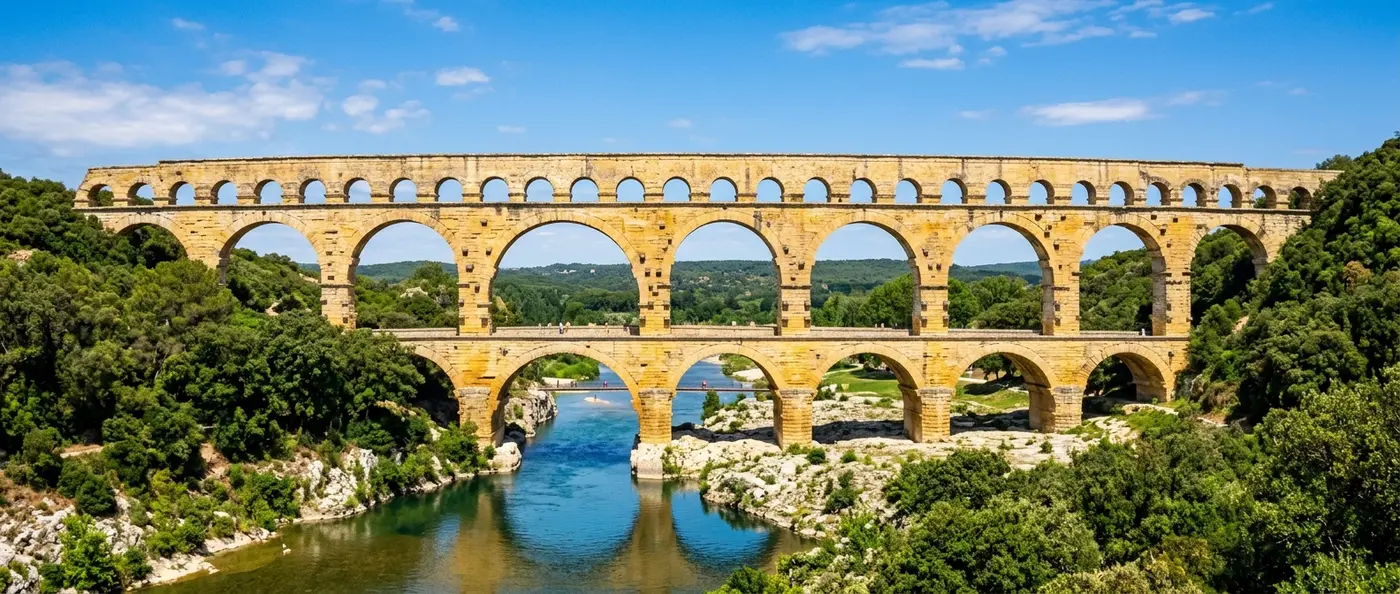
Stand beneath the arches of Pont du Gard in southern France and look up. You'll feel dizzy. Romans built this three-tiered aqueduct 2,000 years ago, and it still stands untouched by time. How did ancient engineers move water across dozens of miles, crossing mountains and valleys, without pumps or electricity?
📖 Read more: Roman Roads: The Network That United an Empire
Roman aqueducts weren't just engineering projects. They were symbols of Roman dominance, monuments that proclaimed Rome's ability to tame nature itself. From Spain to Syria, these colossal structures carried not just water, but civilization itself.
🏛️ The Legacy of Ancestors
Romans didn't invent water management from scratch. According to National Geographic, they borrowed techniques from Greeks, Etruscans, Egyptians, and Babylonians, then perfected them with their practical genius. The Minoans in Crete had developed sophisticated rainwater collection systems by the middle of the 3rd millennium BC.
The secret of Roman success lay in the practical application of centuries of mathematical and physics discoveries. The laws of hydraulics defined by Archimedes in the 3rd century BC came to life when Romans began building reservoirs, aqueducts, and harbors. Archimedes' screw, a hollow cylinder with a helical screw inside, was used extensively in aqueduct sections where steep gradients had to be overcome.
Greek Theory
Mathematicians like Archimedes and Ctesibius of Alexandria laid the theoretical foundations of hydraulics and pneumatics.
Roman Practice
Romans transformed theory into magnificent infrastructure projects that served millions of citizens.
💧 The Network That Connected an Empire
At its peak, the Roman Empire boasted an astonishing network of aqueducts. Rome alone was fed by 11 aqueduct systems totaling 315 miles (507 kilometers). Of these, 269 miles ran underground and only 46 miles above ground. The impressive arched bridges we associate with aqueducts made up just 12% of the total length.
Rome's first aqueduct, the Aqua Appia, was built in 312 BC by Appius Claudius Caecus. It was just one mile long and ran almost entirely underground. As the city's population grew—reaching one million by the 1st century AD—new aqueducts were added to the system.
⚒️ The Art of Construction
Building an aqueduct was a titanic project requiring enormous resources and workforce. Roman engineers first had to design a route with a gentle downward slope from source to city, since the only force moving the water was gravity.
For underground sections, they used an ancient Persian technique known as qanat. They dug shafts (putei) about 70 meters apart along the planned route. When they reached the desired depth, construction of the channel (specus) began. The shafts served to remove earth in baskets and lower building materials.
Channel walls were lined with stone blocks, bricks, or concrete, depending on material availability. The channel was waterproofed with a layer of opus signinum, a type of mortar made from crushed tiles and amphora fragments. This technique ensured precious water wouldn't be lost to leaks.
🌉 The Triumphant Bridges
Only when there was no other choice—when they had to cross a valley or avoid a steep drop—did Romans build their impressive arched bridges. These structures, sometimes several stories high, still dominate the Mediterranean landscape.
🏗️ Engineering Precision
Pont du Gard in France, built in 19 BC, stands 49 meters high and consists of three rows of arches. Its stones, weighing up to 6 tons each, were placed without mortar—their perfect fit has kept the bridge standing for 2,000 years.
Engineers preferred narrow arches that provided maximum strength. Base piers could measure 3x3 meters to withstand enormous weight. During construction, they used wooden scaffolding and forms that supported the arch until the final wedge-shaped stone (keystone) was placed. Once supports were removed, the stones could bear their own weight.
📖 Read more: How Ancient Egyptians Moved 100-Ton Stone Blocks
🏺 Water for Everyone
Aqueducts didn't just supply drinking water. They fed public fountains, baths, private homes, and even decorative fountains. Public baths, like the Baths of Caracalla that opened in 217 AD, became an integral part of Roman life thanks to abundant water supply.
Managing this complex system required constant maintenance. Special officials, the aquarii, were responsible for operating and repairing aqueducts. They cleaned channels of sediment, repaired cracks, and ensured continuous water flow.
📊 Major Aqueduct Comparison
🗺️ From Spain to Syria
Aqueduct technology wasn't limited to Rome. Throughout the empire, from Emerita Augusta (modern Mérida) in Spain to Caesarea in Syria, Romans built hundreds of aqueducts. The Prosperina aqueduct in Mérida, known locally as Los Milagros ("the miracles"), still impresses with its triple-level arches rising 30 meters high.
Each aqueduct adapted to local conditions. In Constantinople, the Basilica Cistern (Yerebatan Sarnıcı) could store 80,000 cubic meters of water. In Misenum, Italy, the Piscina Mirabilis, built to supply the Roman fleet, had a capacity of nearly 13,000 cubic meters with a dome supported by 48 columns.
⚙️ The Legacy That Survives
Many Roman aqueducts continued operating for centuries after the empire's fall. Some are still used today. The Segovia aqueduct in Spain, built between the late 1st and early 2nd centuries AD, remained operational until the mid-20th century.
Roman commitment to quality explains this longevity. They always used the best materials, precise construction, and made no compromises. Every detail mattered. Their techniques remained unsurpassed until relatively recently.
Monuments of Power
Aqueducts proclaimed Roman supremacy and the ability to bend nature to the empire's will.
Technical Perfection
Precision in measuring gradients and construction quality allowed many aqueducts to survive millennia.
Cultural Impact
Access to abundant water transformed Roman daily life and laid the foundations of modern urban civilization.
Two millennia later, Roman aqueducts still carry water through Spanish cities. Engineers today study Roman concrete formulas, trying to match durability that has outlasted empires. Without them, there would have been no great cities, no public baths, no gardens and fountains that made life in Rome so unique. Even today, as we stand beneath their arches, they remind us that a civilization's true power is measured not only by its conquests, but by its ability to improve its citizens' lives.