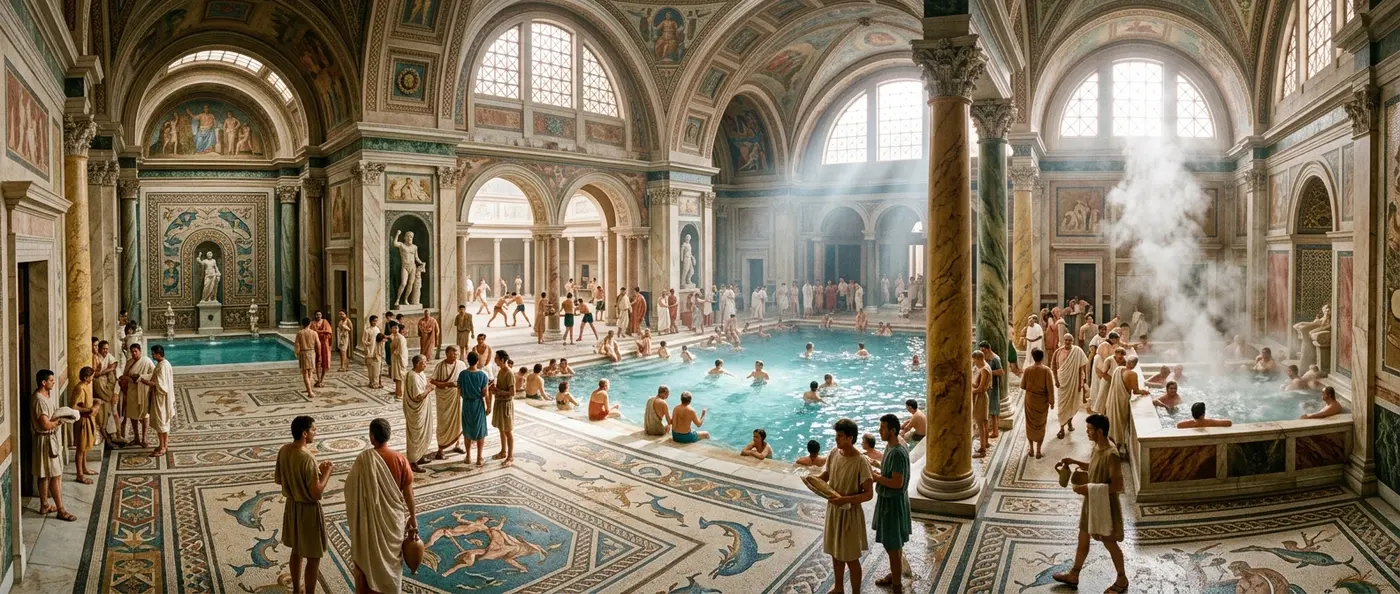
In the heart of ancient Rome, where modern buildings and bustling streets now stand, massive complexes once operated that forever changed how people understood hygiene, social interaction, and political power. Roman thermae weren't just baths. They were entire microcosms where patricians met plebeians, where deals were struck, and where imperial authority displayed its might through marble and water.
📖 Read more: Roman Siege Warfare: The Machines That Crushed Cities
🏛️ Architectural Marvels of the Thermae
Roman baths dwarfed anything built before them. The largest complexes, like the Baths of Caracalla and Diocletian, covered areas that could accommodate entire modern neighborhoods. The underfloor heating system (hypocaustum) used by the Romans was so advanced that similar technologies didn't reappear in Europe for over a thousand years.
Each bath complex featured a series of rooms with different temperatures. The frigidarium with its cold pools, the tepidarium with lukewarm water, and the caldarium with hot baths created a ritual journey that bathers followed. Beyond the bathing areas, these complexes included gymnasiums, libraries, gardens, and spaces for philosophical discussions.
Building such colossal structures required enormous resources and advanced engineering. Aqueducts transported millions of liters of water daily, while armies of slaves and specialized craftsmen worked to maintain them. The Baths of Caracalla alone could accommodate up to 1,600 bathers simultaneously.
🤝 Social Fabric and Class Coexistence
Although Roman society was strictly hierarchical, the baths were among the few spaces where social classes mingled. Patricians, equites, plebeians, and even freed slaves shared the same spaces. Of course, this equality was more superficial than real. The wealthy brought entire retinues of servants, while the poorer had to wait in lines.
Admission was extremely cheap - just one quadrans, the smallest Roman coin. Often entry was free, thanks to the generosity of some wealthy citizen or the emperor himself seeking popular favor. This accessibility wasn't accidental. Rome's rulers understood that a clean and satisfied population was less prone to rebellion.
Complex social networks developed within the baths. Merchants negotiated agreements in the tepidarium, philosophers debated in the walkways, while young aristocrats displayed their physical condition in the palaestrae. The baths functioned as spaces of social mobility, where an ambitious plebeian could meet a powerful patron.
⚖️ Political Power and Imperial Propaganda
Far from simple public works, the baths became weapons of political influence and imperial propaganda. Almost every new emperor built new baths or renovated existing ones, leaving his name carved in marble for future generations. Trajan, Caracalla, Diocletian - all left their mark through monumental bathing complexes.
The political dimension of the baths extended beyond their architectural grandeur. Secret meetings took place there, public opinion was gauged, and rumors spread that could make or break political careers. Emperors often visited the baths to show their closeness to the people, though always with appropriate escort and security.
The bath system reflected and reinforced the Roman idea of civilitas - the civilized way of life that distinguished Romans from "barbarians." Wherever the legions conquered, engineers followed to build baths, spreading the Roman lifestyle from Britain to Syria.
📖 Read more: Roman Slavery: The Dark Engine of Empire
Imperial Generosity
Emperors funded the construction and operation of baths as a means of gaining popular support. Free admission on special days was common practice.
Political Meetings
Senators and officials conducted informal negotiations in bath spaces, away from the formality of the Senate.
Rumor Centers
Baths functioned as hubs for spreading news and rumors, influencing public opinion more effectively than any official announcement.
🎭 Culture and Daily Life
Beyond their function as hygiene spaces, the baths served as cultural centers that brought together all forms of art and entertainment. Their libraries housed thousands of papyrus scrolls with works by poets and philosophers. Their corridors displayed statues and paintings that would grace the greatest museums today.
A typical Roman citizen's day often revolved around visiting the baths. After the morning meal and professional obligations, which usually ended early in the afternoon, most headed to the baths. There they spent several hours, not just washing but exercising, discussing, playing board games, or simply relaxing.
Women also had access to the baths, though usually at different hours from men or in separate areas. This created one of the few public spaces where Roman women could socialize freely, away from the constraints of their households.
💡 Did You Know?
Romans used a special tool called a strigil to scrape dirt and oil from their skin. There was no soap as we know it today - instead, they rubbed olive oil on their bodies and then scraped it off along with the dirt!
🔬 Technology and Engineering Genius
Roman bath technology would impress engineers today. The hypocaust system I mentioned earlier was based on a clever principle: hot air from furnaces circulated beneath floors and through walls, heating spaces uniformly. Engineers calculated air flow and heat distribution with precision.
The water supply system was equally advanced. Lead pipes carried water from aqueducts to storage tanks. From there, a complex network channeled water to various pools, fountains, and washbasins. Used water was removed through an extensive sewage system leading to the Tiber or other water recipients.
Maintaining these systems required constant work. Teams of specialized craftsmen - plumbers, stokers, cleaners - worked continuously to keep the baths operational. Just heating the large complexes burned dozens of tons of wood daily.
📖 Read more: Rome's Via Appia: The Road That Never Ends
📜 Rules, Customs, and Social Behavior
Beneath their relaxed atmosphere, the baths ran on rigid written and unwritten codes. Entry was forbidden to those suffering from contagious diseases, while theft of objects was severely punished. Special guards supervised the spaces and maintained order.
The bathing process followed an established sequence. First, bathers exercised in the palaestra to work up a sweat. Then they passed through the tepidarium to adjust to the temperature, then to the caldarium for the hot bath, and finally to the frigidarium to cool down. The entire process could last hours.
Social conventions imposed specific behavioral patterns. It was rude to stare persistently at other bathers or speak too loudly. On the other hand, conversation and social contact were encouraged. Many business agreements and political alliances began with a chance meeting in the caldarium.
⚔️ Comparison of Rome's Great Baths
🏺 Decline and Legacy
With the fall of the Western Roman Empire in the 5th century AD, the baths gradually began to decline. Barbarian invaders lacked both the technical knowledge and desire to maintain these complex systems. Aqueducts were destroyed, furnaces went cold, and marble statues were looted or converted to lime.
In Byzantium, the tradition of public baths continued but on a smaller scale and with more modesty. Christian morality viewed the display of nudity and excessive emphasis on physical well-being with suspicion. Nevertheless, baths remained an important element of Byzantine life.
The influence of Roman baths extends to today. Modern spas and wellness centers follow the same basic principle: connecting physical health with social interaction and relaxation. Even the word "spa" is believed to derive from the Latin "salus per aquam" - health through water.
The ruins of the great baths that survive today in Rome and other cities of the former empire remind us of a civilization that managed to combine technological progress with social cohesion. In an age without electricity and modern conveniences, the Romans created spaces that offered comfort, hygiene, and sociability to millions of people. This is perhaps their greatest legacy.