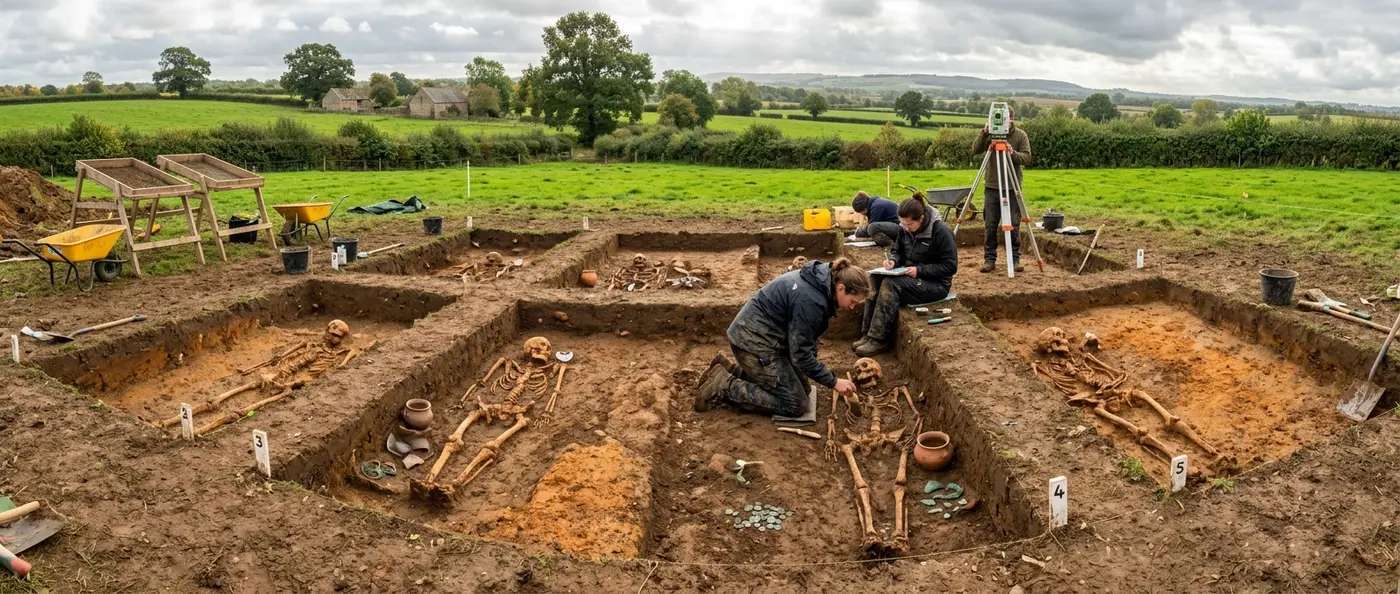
Forty-seven graves. Four centuries of death. One cemetery that rewrites what we know about Roman Britain. Archaeologists from Cotswold Archaeology just finished analyzing a Roman-era burial ground in southern England, and the results shatter assumptions about life, death, and identity in the empire's most distant province. These aren't just bones in the dirt — they're immigrants, soldiers, and locals whose DNA reveals a multicultural society that existed from the 1st to 4th centuries CE.
🏛️ Roman Britain: A World in Flux
Emperor Claudius invaded Britain in 43 CE with four legions and changed everything. For nearly four centuries, Britannia became Rome's northernmost outpost — a place where Mediterranean civilization collided with Celtic traditions and created something entirely new.
Southern England transformed fastest. Roman roads carved straight lines across ancient landscapes. Aqueducts brought fresh water to growing towns. Bath houses, theaters, and villas sprouted where Iron Age roundhouses once stood. But the Romans didn't just build infrastructure — they brought Mediterranean burial customs and beliefs about the afterlife.
The Gloucestershire site where these burials emerged sat at the crossroads of major Roman highways. The River Severn flowed nearby, making this a natural hub for trade and movement. That strategic location explains why such an extensive cemetery developed here — this was where people from across the empire came to live, work, and eventually die.
💀 The Graves: Windows Into Ancient Lives
Forty-seven burials might not sound like much. But these graves span three centuries and preserve details that usually vanish from the archaeological record. Most date to the 2nd and 3rd centuries CE — the height of Roman power in Britain.
This cemetery stands apart for its mix of burial practices. Cremations and inhumations appear side by side, tracking the slow shift from Rome's traditional practice of burning the dead to burying them intact. This transition accelerated in the 3rd century as new religious ideas spread through the empire.
The grave goods tell individual stories. Pottery vessels, glass bottles, jewelry, and coins accompanied many of the dead — provisions for the journey to the underworld. But these weren't random offerings. Each burial reflects careful choices about identity, status, and belief.
🏺 Grave Goods: Stories Without Words
The objects buried with these Romans reveal daily life in the provinces. Ceramic vessels dominate the assemblage — some imported from Gaul, others made locally in Roman styles. This mix reveals how global trade networks reached even remote British settlements.
One standout find: a glass unguentarium (perfume bottle) that still contained traces of aromatic compounds. Chemical analysis revealed rose-based perfume — a luxury import from the Mediterranean. Only wealthy individuals could afford such exotic goods, marking this burial as elite.
The presence of military equipment in several graves underscores the army's central role in Roman Britain. Veterans who settled locally after completing their service brought more than just weapons — they carried skills, connections, and cultural practices that transformed provincial society.
Perfumed Oils
Glass containers with traces of perfumes and aromatics found in multiple burials, highlighting the ritual preparation of bodies for the afterlife.
Charon's Obol
Bronze coins placed in mouths or over eyes of the dead, following Greco-Roman tradition of paying the ferryman to cross the river Styx.
Food for the Journey
Ceramic plates and cups containing food residues, placed to nourish the deceased in their passage to the underworld.
🔬 Modern Science Meets Ancient Bones
Isotope analysis of teeth and bones revealed something remarkable: many of these "Romans" weren't born in Britain at all. They migrated from across the empire, bringing diverse backgrounds to this provincial cemetery.
One 35-year-old man spent his childhood in the Mediterranean — probably southern Gaul or Iberia — before moving to Britain. His grave goods included a high-quality gladius and military fittings, marking him as an army veteran who settled locally after discharge. His bones document imperial mobility that written sources rarely capture.
DNA analysis, still ongoing, may reveal more about population mixing. Early results show genetic influences from the Mediterranean, Gaul, Germany, and native Celtic populations. Roman Britain was a melting pot centuries before that term existed.
💡 The Mystery of the Headless Burials
Three graves contained a puzzling feature: skulls placed beside the feet instead of attached to the neck. This practice, observed at other Roman sites in Britain, remains unexplained. Some researchers link it to superstitions about the "living dead," while others suggest ritual punishment or ceremonial practice. The mystery endures.
⚔️ Soldiers and Civilians: A Society in Motion
Military artifacts in multiple burials highlight the army's transformative role in Roman Britain. Legions weren't just conquerors and guards — they were agents of cultural change, technological transfer, and economic development.
Veterans who settled after completing their service brought specialized skills in agriculture, construction, and trade. Many married local women, creating families that blended Roman and Celtic traditions. Their children grew up bilingual, comfortable in both worlds.
Female burials show distinct patterns. Jewelry combining Roman techniques with Celtic motifs shows how cultural fusion worked at the personal level. One bronze brooch with enamel inlay represents this synthesis perfectly — Roman craftsmanship expressing Celtic aesthetic preferences.
🗺️ The Geography of Death
The cemetery's layout reveals social hierarchies frozen in time. Wealthy burials cluster near the ancient road, while simpler graves occupy the periphery. This spatial organization mirrors the living community's structure.
Graves group into small clusters, likely representing family units. DNA analysis confirmed this pattern in one cluster — parents and three children who died over roughly twenty years. Death brought families together in ways that life sometimes couldn't.
⚖️ Burial Practices: Evolution Over Time
🏰 The End of an Era
The cemetery's latest burials, dating to the early 5th century, reflect the chaotic final decades of Roman rule in Britain. Grave goods become poorer. Imported items disappear. Local burial practices that had been abandoned for centuries suddenly reappear.
One burial from this period contained a man buried with his full weapons — extremely rare in classical Roman times. His sword, though Roman in type, bears decorative elements that anticipate the coming Anglo-Saxon period. We're watching history turn the page.
These final graves don't just document the past — they illuminate how cultures transform. Romans didn't vanish overnight from Britain. They merged gradually with local populations and new settlers, creating the foundation for medieval England.
🔍 Conclusions and Future Research
The southern England Roman burials document a pivotal period of British history. Beyond individual finds, they reveal a multicultural society where Romans, Celts, and other peoples coexisted, interacted, and created new cultural syntheses.
Research continues with additional DNA and isotope analysis expected to reveal more about diet, health, and population mobility. Comparisons with other contemporary cemeteries across Britain will help build a fuller picture of the Roman province.
Roman Britain was never uniform, but a patchwork of different communities, each with its own history and traditions. The dead of southern England, silent for nearly two millennia, now reveal through science the complexities of life, death, and cultural change in Roman Britain.