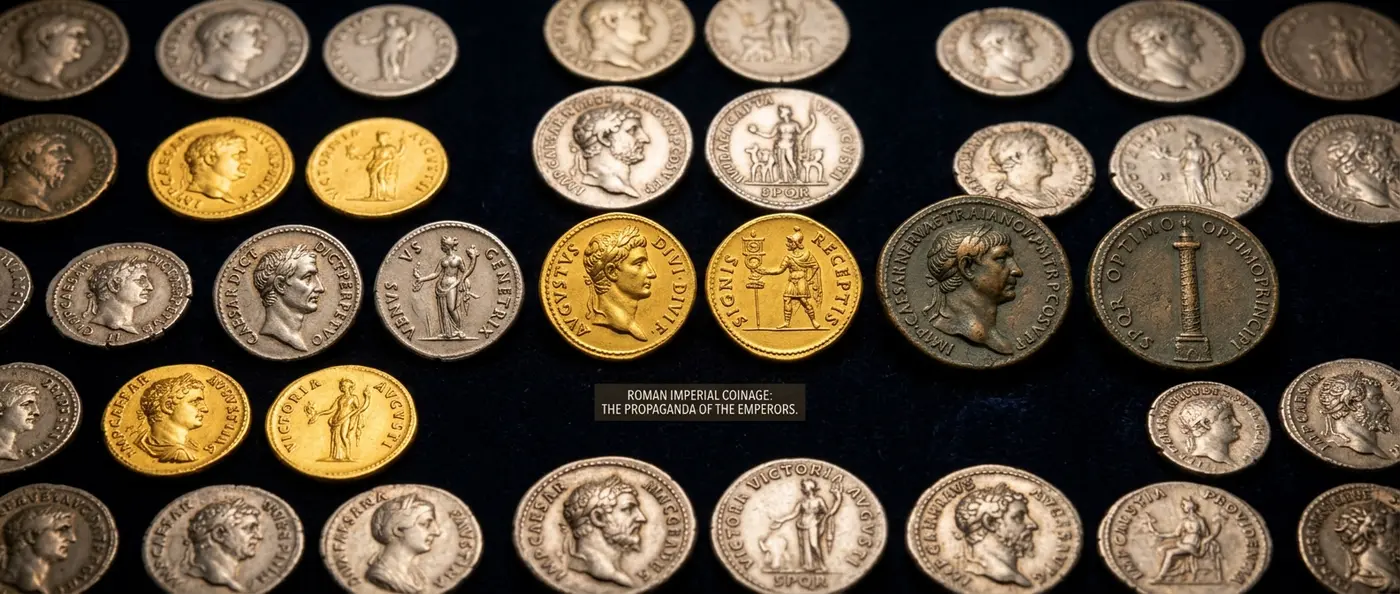
A silver denarius of Augustus sits in a Roman coin collector's palm, worth far more than its silver content. The emperor's carefully crafted portrait, Latin inscriptions, and symbols of power transform this small piece of metal into a powerful political communication tool that reached every corner of the vast empire.
📖 Read more: Augustus: Emperor Who Transformed Rome Forever
💰 Birth of Imperial Coinage
Julius Caesar shattered Roman tradition when he placed his living portrait on coins. Until then, Roman currency featured religious symbols and references to mythical ancestors. Caesar broke this precedent, stamping his own face onto coins while still breathing.
After his assassination in 44 BC, a freed supporter erected a column over Caesar's ashes in the Forum and began offering worship to him as a divine being. Many citizens joined this cult. Within days, Caesar's heir Octavian pushed for official deification — something the Senate approved with a decree in 42 BC.
Augustus, as Octavian became known, built on this precedent to create a comprehensive system of numismatic propaganda. In 27 BC he established a monetary system based on the gold aureus (1/42 of a pound of gold), equivalent to 25 silver denarii. Each denarius weighed 1/84 of a pound of silver, with metals struck nearly pure.
🏛️ The Mint System
Augustus's first gold and silver coins were struck mainly in the East — in cities like Ephesus and Pergamon, as well as briefly at Emerita in Spain. Bronze coins were also produced primarily in the East, though some were minted at Nemausus (modern Nîmes) in Gaul.
Rome's mint reopened around 20 BC for gold and silver coins and remained active for this purpose until about 12 BC. From 12 BC, Lugdunum (modern Lyon) took over the main western minting operations in gold, silver, and bronze. After 64 AD, Rome again became the principal mint for all metals.
Bronze coins from Rome carried the marking SC (Senatus Consulto - "by decree of the Senate"). However, SC also appeared on bronze coins from Lyon and Antioch in imperial provinces, showing that the emperor exercised effective control over all metals everywhere, despite the Senate's nominal rights.
📖 Read more: Goths and Vandals: How Barbarians Sacked Rome Twice
🎨 The Art of Imperial Portraiture
From Augustus to Romulus in 476 AD, imperial portraits created an unbroken artistic record spanning five centuries. Many of the finest portraits appeared on large bronze sestertii until the 3rd century and on even larger bronze medallions produced as gifts.
Special care was taken with portraits on gold coins. Gold, being softer, allowed beautiful and extremely sensitive representation. Nothing is known about the artists who created these portraits, though many likely came from the Greek East, where the tradition of portraiture was strong.
Realistic Depiction
Imperial portraits were strikingly realistic, allowing recognition of each ruler from their distinctive facial features.
Symbols of Power
Laurel wreaths, scepters, and other imperial symbols accompanied portraits, reinforcing the message of absolute authority.
Family Promotion
Empresses, sons, and deceased members of the imperial family also appeared on coins, projecting dynastic continuity.
📜 Messages and Propaganda in Metal
Roman coins did double duty as both currency and propaganda, carrying political messages to every corner of the empire. Each new issue could convey specific political messages.
📖 Read more: Polynesian Navigation: Stars Instead of Compass
Inscriptions on coins announced military victories, building programs, religious reforms, and political slogans. For example, Nero in 64 AD lightened the aureus to 1/45 of a pound and the denarius to 1/96, but silver debasement continued. Under Septimius Severus it reached 40%, and Caracalla issued a debased double denarius weighing only 1.5 denarii.
💡 Coins as Mass Media
Before mass media, coins were Rome's most effective communication tool, touching every hand in the empire. From the wealthiest merchant to the simple soldier on the frontier, everyone saw the emperor's face and messages daily.
🔱 Deification of Emperors
Emperor worship, prominently displayed through coins, had roots in the 4th century BC when Alexander the Great first received honors as a superhuman being. By 25 BC, the city of Mytilene had organized annual worship ceremonies honoring Augustus and communicated their forms to Tarraco in Spain as well as other Greek cities in the East.
By 12 BC, divine honors to Caesar and Augustus's genius had been established through imperial initiative both at the Gallic capital Lugdunum and at crossroads chapels in Rome. Emperor worship took hold across the provinces within decades.
Within a few generations, cities everywhere had built new temples dedicated to worship that dominated their forums or had dedicated old temples to the joint service of a former god and the imperial family. These temples became focal points where citizens could demonstrate loyalty to Rome and emperor.
📖 Read more: Roman Calendar: How We Still Measure Time Today
⚔️ Coins in Times of Crisis
During political crises and civil wars, coins became even more crucial as propaganda tools. Each claimant to the throne rushed to mint their own coins to legitimize their power.
Gallienus's double denarius, made from copper and silver with surface treatment to appear richer in silver, marked a numismatic collapse. Diocletian and Constantine later restored some stability by returning to a gold standard backed by pure silver and bronze.
⚖️ Evolution of Monetary Value
🌍 Impact on the Empire
The emphasis on the emperor's personality, sometimes extending to empresses, sons, or deceased members of the imperial family, was a powerful propaganda tool on currency circulating throughout a massive empire. Coins carried the emperor's face and name in every transaction, from British markets to Syrian bazaars.
Official mints were supplemented by a mass of regional or local mints, while official issues from eastern mints provided necessary currency for local Roman frontier forces. This system ensured that the message of imperial power reached everywhere.
Among the institutions most crucial for smoothing regional differences was emperor worship, which was intensively promoted through numismatic iconography. Coins weren't simply payment methods — they were ideology carriers, symbols of unity, and tools of political control that reached the hands of every Roman subject.