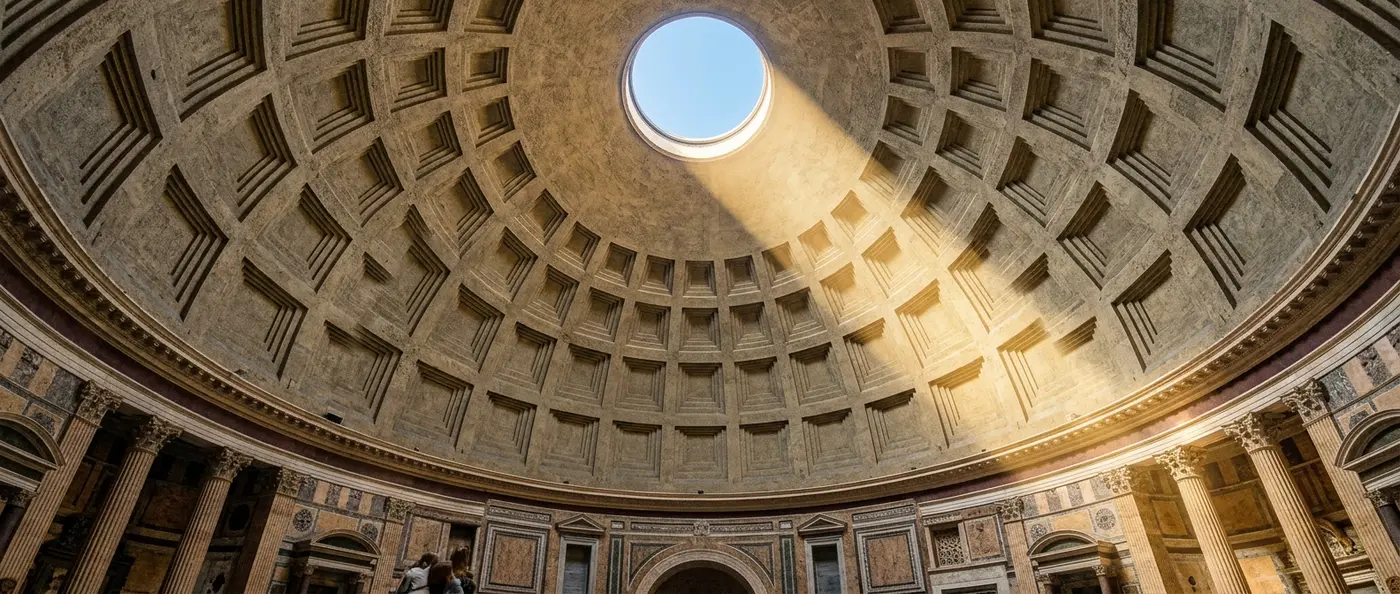
Stand beneath the Pantheon's massive dome in Rome and crane your neck upward. You're staring at nearly 2,000 years of concrete that hasn't budged an inch. Meanwhile, modern concrete highways crack after 50 years. Parking garages crumble after a century. The secret behind Roman concrete's supernatural durability stumped engineers for centuries — until recent breakthroughs revealed the ingenious chemistry that makes ancient structures stronger with age.
🏛️ The Engineering Revolution That Built an Empire
Roman concrete, known as opus caementicium, transformed construction across the Mediterranean. According to Britannica, Romans inherited their early construction techniques from the Etruscans of northern Italy, who had mastered the true stone arch and advanced brick-making technology.
The shift from stone to concrete took decades of experimentation. Initially, Romans used the standard mix of sand, lime, and water for their mortar. But in the 2nd century BCE, they introduced a game-changing ingredient: pozzolan.
This volcanic material, named after the town of Puteoli (modern Pozzuoli) near Naples, formed on Mount Vesuvius and was quarried from its slopes. When mixed with lime, pozzolan created a natural cement far stronger and more weather-resistant than simple lime mortar. The kicker? It hardened underwater.
That underwater curing ability transformed Roman engineering. Suddenly, harbors, aqueducts, and bridges could be built in conditions that would destroy traditional materials. The Romans had discovered a formula that would puzzle engineers for two millennia.
🔬 Cracking the Ancient Formula
Roman concrete's composition resulted from centuries of experimentation and refinement. According to Britannica, the mortar of lime, sand, water, and pozzolan was mixed with stones and broken bricks to form the actual concrete — opus caementicium.
This concrete was initially used with brick forms in walls, but Romans quickly began placing it in wooden forms that were removed after the material hardened. This innovation enabled complex shapes and structures impossible with traditional methods.
One of the earliest surviving examples of this concrete construction is the Temple of the Sibyl (or Temple of Vesta) at Tivoli, built during the 1st century BCE. The temple features a circular design with a peristyle of stone columns and lintels on the exterior, but the wall of the circular sanctuary inside is built of concrete.
Romans developed more than a new material — they created an entire system. Romans developed sophisticated mixing ratios, layering techniques, and curing processes that maximized the volcanic ash's chemical potential. Engineers refined the formula with each new project.
⚔️ Strategic Advantage and Imperial Expansion
Roman concrete development wasn't just technological progress — it was strategic warfare. Brick construction, particularly around Rome, became a massive industry and eventually, under the empire, a state monopoly. Brick construction was cheaper than stone due to economies of scale in mass production and the lower skill level required for installation.
Pozzolanic mortars were so strong and cheap, and could be installed by such low-skilled workers, that Romans began using them instead of bricks in wall interiors. The outer brick layers served mainly as forms for placing the pozzolan.
This technology enabled Romans to build an extensive infrastructure network across the empire. According to Britannica, Romans constructed 50,000 miles of hard roads, primarily for military purposes, using pozzolan-lime concrete for foundations and surfaces.
The speed advantage was crushing. While enemies struggled with traditional stone-cutting and transport, Roman legions could establish permanent fortifications using local materials and standardized techniques. Concrete didn't just build the empire — it secured it.
Bridges & Aqueducts
The Pont du Gard in France, with its 72-foot span, and the bridge over the Tagus at Alcántara in Spain, spanning nearly 100 feet, prove Roman concrete's durability in hydraulic engineering.
Road Network
Roman roads were famous for their straightness, solid foundations, curved surfaces that facilitated drainage, and the use of pozzolan concrete throughout their construction.
Public Buildings
Temples, baths, amphitheaters, and other public buildings used the revolutionary material, enabling unprecedented architectural designs and scales.
🗿 Monuments That Mock Time
After two thousand years, Roman concrete structures outlast modern buildings by centuries. Structures like the Pantheon, with its massive 142-foot diameter dome, remain in pristine condition after nearly two millennia.
But it's not just the grand monuments. Harbor installations, piers, and breakwaters built from Roman concrete continue resisting the corrosive action of seawater, while modern concrete structures in the same environment collapse within decades.
Recent scientific studies revealed the secret lies in the chemical reaction between seawater and volcanic ash. This reaction creates new crystals that fill microscopic cracks, making the material even more resistant over time. Essentially, Roman concrete heals itself.
The Pantheon's dome remains the world's largest unreinforced concrete dome. After 1,900 years, it shows no signs of structural stress. Modern concrete structures require steel reinforcement and still don't match its longevity.
💡 Did You Know?
Roman concrete actually gets stronger when exposed to seawater, unlike modern concrete which corrodes. This happens through the formation of a rare mineral, aluminum tobermorite, created when seawater penetrates microscopic cracks.
🏺 The Construction Technique
Building with Roman concrete required careful planning and execution. First, wooden forms were created in the desired shape. Then, the concrete mixture was placed in layers, with each layer carefully compressed before adding the next.
For large structures like domes, Romans used lighter aggregates in upper sections to reduce weight. In the Pantheon, for example, they used lightweight pumice instead of heavy stones in the dome's upper portion.
This technique also required sophisticated lifting machinery and complex wooden scaffolding to support structures during curing. While detailed descriptions of these machines haven't survived, the existence of the structures themselves proves the high level of Roman engineering.
The curing process was equally critical. Romans understood that slow, controlled curing produced stronger concrete. They often kept structures moist for weeks, allowing the pozzolan-lime reaction to reach full strength.
🔱 Lost Knowledge and Modern Rediscovery
After the fall of the Roman Empire, knowledge of durable concrete construction gradually disappeared. Medieval craftsmen tried building "the Roman way," but without understanding the chemistry behind pozzolan, their results were inferior.
Today, as we face climate change and sustainability challenges, scientists are turning back to Roman concrete for inspiration. Modern Portland cement production accounts for roughly 8% of global CO2 emissions. In contrast, Roman concrete required much lower temperatures for production and had a far longer lifespan.
Research teams worldwide now work to reproduce and improve the Roman formula, using modern volcanic ashes and other natural materials. The goal is creating a new concrete type that combines the ancient material's strength and longevity with modern construction requirements.
The irony is striking: we're reverse-engineering 2,000-year-old technology to solve 21st-century problems. Sometimes the future lies in the past.
⚖️ Roman vs Modern Concrete
📜 Lessons from the Past
Roman concrete's story teaches us several things. First, real innovation often comes from careful observation and utilization of natural materials. Romans didn't "invent" pozzolan — they discovered it and understood its properties.
Second, it reminds us that progress isn't always linear. We lost Roman concrete knowledge for over a thousand years, and we're only now beginning to fully understand its chemistry.
Third, it shows the importance of long-term thinking in construction. Romans built for eternity, not decades. In an age where sustainability is critical, this approach becomes relevant again.
The chemistry is elegant in its simplicity. Volcanic ash contains silica and alumina that react with lime in the presence of water. This creates calcium silicate hydrate — the same binding agent in modern concrete — but with a twist. The volcanic glass continues reacting for centuries, constantly strengthening the matrix.
Construction companies in several countries now test Roman-inspired concrete formulas using local volcanic materials. The first commercial buildings using these methods could break ground within the decade.