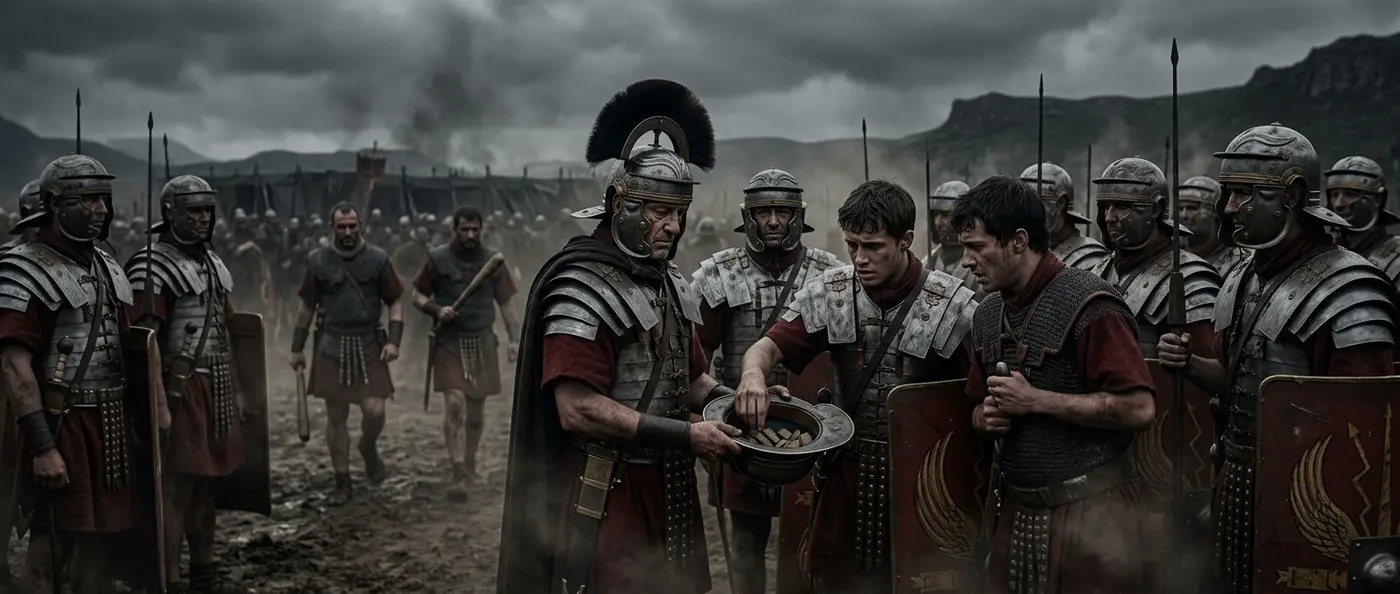
A Roman legion camps somewhere in Gaul, early 1st century BC. The soldiers had shown cowardice in battle. Now they wait for punishment. Their commander orders them into rows of ten. Every tenth man will die — not by enemy hands, but beaten to death by his own comrades. This was decimatio, the most terrifying collective punishment in military history.
📖 Read more: Roman Navy: Mare Nostrum - Masters of the Mediterranean
🗡️ What Was Decimatio
Decimatio came from the Latin "decem" — ten. One in ten dies. The math was simple. The psychology was devastating. When entire Roman units displayed cowardice, disobedience, or desertion, commanders could order this extreme punishment.
The process was brutally straightforward. Soldiers divided into groups of ten. Lots were drawn. One man from each group faced execution. The twist that made decimatio uniquely horrific? The other nine had to kill the tenth with clubs and stones.
This created psychological warfare against Rome's own soldiers. Every soldier lived with the terror that he might be next. Meanwhile, the guilt of executing comrades haunted survivors forever. Roman commanders demanded absolute obedience. Decimatio was the ultimate enforcement tool.
⚖️ The Legal Foundation of Terror
Decimatio wasn't random violence. It was codified military law, rooted in collective responsibility. When a unit failed, everyone shared the blame. This philosophy strengthened bonds between soldiers but also created crushing pressure to maintain standards.
Triggers for decimatio included battlefield cowardice, mass desertion, mutiny, or disobeying orders. The decision typically came from consuls or commanding generals. They didn't make it lightly — losing 10% of a unit was a serious blow to military strength.
After the executions, survivors faced additional humiliation. They slept outside the fortified camp, exposed to enemy attacks. Their rations changed from wheat to barley — animal feed. These degradations continued the message: failure has lasting consequences.
The random selection sent a chilling message. Even the bravest soldier could die if his unit failed. This encouraged everyone to maintain high standards and pressure their comrades to do the same. No one wanted to be responsible for friends' deaths.
📜 Historical Cases of Decimatio
Though legal, decimatio was used sparingly. Roman commanders understood that overuse could destroy morale and effectiveness. But when applied, it left an indelible mark on history.
Marcus Licinius Crassus used decimatio in 71 BC during the Third Servile War against Spartacus. When his legions showed cowardice against the rebel slaves, Crassus ordered 500 men executed from 5,000. His harshness restored discipline and eventually led to victory.
Another famous case occurred under Octavian Augustus. When legions in Sicily retreated before Sextus Pompey's forces, the future emperor applied decimatio. The act sent a clear message — the new order would not tolerate weakness.
Julius Caesar, despite his reputation for clemency, reportedly considered decimatio during the Gallic Wars. However, most sources suggest he preferred other punishments that didn't reduce his military strength so drastically.
📖 Read more: Roman Camps: 1,700-Year-Old Discoveries in Germany
💀 The Psychological Cost
Survivors of decimatio often suffered what we'd recognize today as post-traumatic stress. Killing a comrade with your own hands left deep psychological scars that lasted a lifetime.
🏛️ The Philosophy Behind the Brutality
Why did Romans resort to such brutality? Their military culture valued collective responsibility above individual lives. The Roman army served as the foundation of empire. Its discipline and effectiveness allowed Rome to conquer and hold territory from Britain to Mesopotamia.
Decimatio functioned as the ultimate deterrent. Every soldier knew that cowardice wouldn't just punish him but his comrades too. This created intense social pressure for bravery. No one wanted to be responsible for friends' deaths.
The random selection reinforced that no one was safe. Even the most courageous soldier could die if his unit failed. This encouraged everyone to maintain high standards and pressure colleagues to do the same.
Roman military culture valued the group over the individual. Personal survival mattered less than unit effectiveness. Decimatio embodied this philosophy in its most extreme form. The message was clear: the legion's success trumped individual lives.
Collective Responsibility
Every unit member was responsible for everyone's actions. This strengthened bonds but also created immense pressure for performance.
Random Justice
Lottery selection ensured punishment was impartial. No one could accuse commanders of favoritism or bias.
Psychological Impact
Fear of decimatio was often more powerful than the execution itself. It worked preventively across the entire army.
🛡️ Evolution and End of the Practice
As the Roman Empire evolved, decimatio became increasingly rare. Emperors of the 2nd and 3rd centuries AD preferred punishments that didn't so drastically reduce their military strength. The last recorded case occurred in the 4th century AD.
The gradual abandonment reflected broader changes in Roman society. The army transformed from a citizen force to a professional and later mercenary organization. New soldiers, often barbarian foederati, lacked the same relationship with Roman traditions.
The rise of Christianity brought new moral values that conflicted with such extreme practices. Christian emperors struggled to justify a punishment considered so inhumane. The empire's military needs also changed as it shifted from conquest to defense.
By the late empire, Roman armies faced different challenges. Barbarian invasions required flexibility and mobility rather than the rigid discipline that decimatio enforced. The practice became both morally questionable and militarily obsolete.
📖 Read more: Hannibal's War Elephants: How 37 Giants Crossed the Alps
🔍 Modern Discoveries and Archaeological Evidence
Recent archaeological discoveries shed new light on Roman military organization and discipline. In the Swiss Alps, researchers discovered a 2,000-year-old military camp at 7,283 feet elevation. The camp, dating to the 1st century BC, was protected by three ditches and a defensive wall.
In the Netherlands, archaeologists found a temporary Roman camp beyond the empire's northern borders. The discovery at Hoog Buurlo shows Romans operated far beyond their official limits. The camp covers 8.9 acres and had a ditch 6.5 feet deep.
These discoveries underscore the Roman army's organizational capabilities. Their ability to create fortified camps in remote locations and maintain discipline under extreme conditions partly explains why they needed such harsh punishments as decimatio.
Excavations at Roman military sites across Europe reveal standardized layouts and equipment. This uniformity required incredible discipline to maintain. The threat of decimatio helped enforce the standards that made Roman legions so effective.
⚔️ Military Punishment Comparison
💭 The Legacy of Decimatio
Though decimatio disappeared with the Roman Empire, its influence continued. The term "decimate" passed into modern languages, though with changed meaning. Today it describes great destruction, not necessarily 10%.
Military historians study decimatio as an example of extreme discipline. Some argue its threat helped create antiquity's most effective army. Others emphasize the human cost and question whether results justified the barbarity.
Modern military psychology recognizes the damage such practices would cause. The trauma of killing comrades would likely create more problems than it solved. Contemporary armies rely on different methods to maintain discipline and morale.
Decimatio remains one of military history's darkest chapters. It reminds us that Rome's power rested not just on technology and tactics but on ruthless commitment to discipline. It was a civilization that reached great heights but also terrible depths in pursuit of dominance.