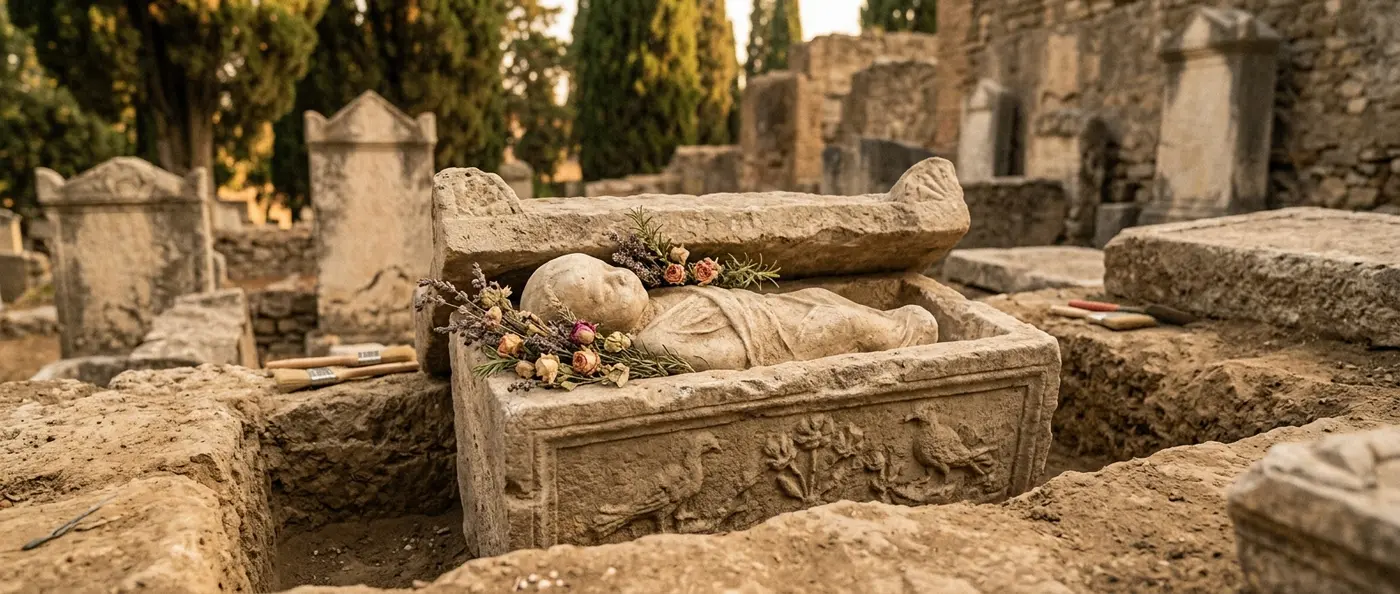
Beneath a modern street in Ljubljana, Slovenia, archaeologists uncovered a Roman cemetery hiding a 1,700-year-old mystery. At its center lies the tomb of an unknown woman, buried beside a stunning blue glass cup inscribed "Drink and live forever." Around her grave, dozens of Christians from ancient Emona chose their eternal rest, following the "ad sanctos" tradition — burial near sacred figures.
📖 Read more: Portugal's Roman Mosaics: Hercules and Medusa Unearthed
🏛️ The Discovery in Ancient Emona
August 2017. Construction crews broke ground on Gosposvetska Street in downtown Ljubljana. What they found stopped work cold — an extensive Roman cemetery with over 350 burials dating from the 4th to 5th centuries AD. This area once formed part of ancient Emona, a Roman colony founded 2,000 years ago.
Emona housed thousands of settlers expelled from northern Italy due to land shortages, alongside war veterans who helped establish the Roman Empire. The city flourished for centuries until the Huns destroyed it in the 5th century AD. This cemetery represents the final period of Roman presence in the region, when the Christian community had begun to thrive after the last persecutions under Emperor Diocletian in the early 4th century.
💎 The Mysterious Glass Cup
The grave's centerpiece was a translucent blue glass cup, 20 centimeters across, decorated with grapes and vine leaves. Inside, a Greek inscription urges: "Drink and live forever, for many years!" Chemical analysis revealed it was manufactured in the eastern Mediterranean.
⚰️ The Ad Sanctos Tradition
The mysterious woman's tomb sat at the center of a small chapel. According to Slovenian archaeologist Andrej Gaspari, within a decade of her burial, the square chapel was demolished and replaced by a larger 9x12-meter structure that enclosed her grave. Around and within this new construction, Emona's Christian community began practicing the burial custom of "ad sanctos."
"Ad sanctos" (near the saints) was a practice where believers chose burial near the tombs of saints or other figures considered sacred. The belief was that proximity to holy relics would ensure protection and blessing in the afterlife. In Emona's case, the unknown woman apparently held such a position of reverence that dozens of community members chose to spend eternity near her.
📖 Read more: Sinai Rock Art: 10,000 Years of Human Expression
The Gosposvetska cemetery revealed a variety of burial practices reflecting the social stratification of Roman Emona. Excavations uncovered simple graves, sarcophagi, and family mausoleums. Only wealthy citizens could afford burial in sarcophagi, which were carved from limestone quarried from Moravče, about 32 kilometers to the east.
🔬 Archaeological Challenges in Jerusalem
While Slovenian archaeologists uncovered Emona's secrets, another team of scientists faced serious challenges at Jerusalem's Church of the Holy Sepulchre. The National Technical University of Athens (NTUA) completed restoration of the Edicule, the small structure enclosing Christ's traditional tomb, but discovered there is "very real danger" of collapse unless the unstable foundations are reinforced.
Antonia Moropoulou, chief scientific supervisor from NTUA, warned: "When it fails, the failure will not be a slow process, but catastrophic." During restoration work, scientists discovered that much of the Edicule rests on foundations of unstable debris, deteriorated mortar, and tunnels.
Ground-penetrating radar and robotic cameras revealed that some sections of the Edicule's foundations sit atop ruins of earlier buildings. Other parts rest directly on the edge of steeply sloped, quarried rock. The foundation mortar has crumbled due to decades of exposure to moisture from drainage channels running several meters below the rotunda floor.
Historic Destructions
The church was destroyed by Persian invaders in the 7th century and again by the Fatimids in 1009. It was rebuilt in the 11th century and modified by the Crusaders.
Modern Restoration
The Greek NTUA team reinforced walls with titanium rods and repositioned masonry layers dating back over a thousand years.
📖 Read more: Sumerian Beer: The World's Oldest Alcoholic Drink
Foundation Risks
Several of the 22-ton columns supporting the rotunda dome rest on more than 1.2 meters of non-compact debris.
🏺 New Discoveries in Cornwall
Parallel to discoveries in Slovenia and Jerusalem, archaeologists in Cornwall, Britain made a find that revises the region's prehistoric chronology. Charred hazelnut shells found at Tregunnel Hill near Newquay yielded radiocarbon dates between 3985 BC and 3793 BC, pushing back the start of the Neolithic period in Cornwall by at least a century.
Excavations revealed a rich and complex archaeological landscape with evidence of human activity spanning more than 10,000 years. Among the most significant finds were several prehistoric pits containing deliberately placed deposits. One particularly large pit revealed a structured sequence of carbon-rich ash, broken pottery including a Carinated Bowl, stone tools, animal bones, and beach pebbles.
The Neolithic period marks one of the most fundamental changes in human history — the transition from nomadic hunter-gatherer lifestyles to settled agricultural communities. This change brought with it the domestication of plants and animals, such as wheat, barley, pigs, and cattle, as well as new technologies like pottery.
The Tregunnel Hill finds provide crucial new information about when and how these practices first reached Cornwall and southwestern Britain. The new dates suggest a faster and earlier adoption of agriculture and settled life in this part of Britain than previously believed.
📊 Archaeological Discovery Comparison
📖 Read more: Viking Women Warriors Were Real, DNA Proves
📜 The Significance of Burial Customs
Burial customs provide windows into the beliefs and social structures of ancient civilizations. In the case of Roman Emona, the "ad sanctos" practice reveals the deep faith of the early Christian community in the power of proximity to saints. The fact that so many chose burial near the mysterious woman suggests she held an exceptional position in the community.
The cup's inscription deepens the puzzle. The decoration with grapes and vine leaves has roots in motifs connected to Dionysus, the pagan god of wine, but acquired new meaning in the Christian Eucharist. Pagan and Christian symbols blended together in 4th-century Rome.
Planned analyses of the woman's physical remains are expected to shed more light on her identity. Was she a local leader of the Christian community? A martyr? A benefactor? Until the analyses are complete, her identity remains one of the many mysteries hidden in the soil of ancient Emona.