📖 Read more: Roman Fortress Scotland: Beyond Hadrian's Wall
🏛️ The Imperial Procession of 337 AD
Constantine I died on May 22, 337 AD at Ancyrona, near Nicomedia. The first Christian emperor had transformed the empire, moving the capital to Constantinople and legitimizing Christianity. His body's journey to the new capital demanded a procession befitting imperial majesty.
The imperial procession included hundreds of soldiers, officials, and imperial family members. Alongside Constantine's coffin traveled sarcophagi of other dynasty members who had died in recent years, including one of his daughters. The route from Nicomedia to Constantinople — roughly 100 kilometers — wound through treacherous mountain passes of Bithynia.
Roman imperial burials followed strict protocol. Coffins were carved from porphyry marble, the material that symbolized imperial power. Inside lay gold and silver objects, jewelry, coins, and personal items of the deceased. For imperial family members, especially women, grave goods included precious textiles, perfumes in alabaster vessels, and figurines of precious stones.
⚰️ The Cliff Disaster
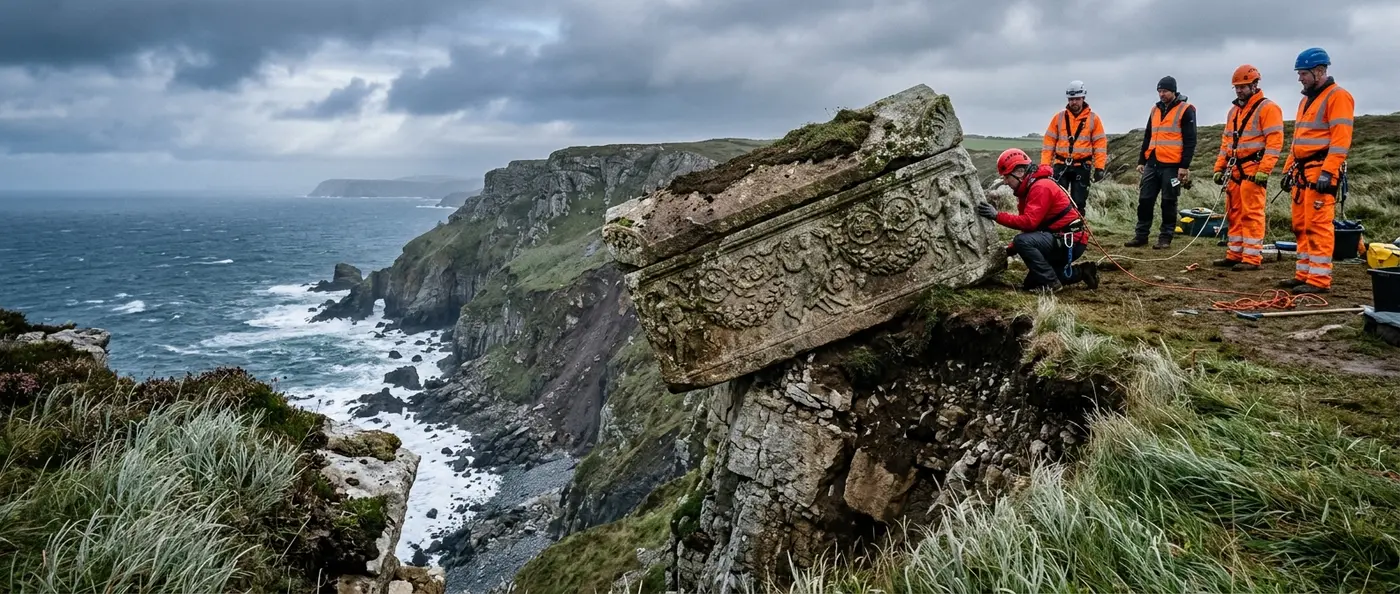
As the procession crossed a narrow mountain pass in Bithynia's peaks, tragedy struck. According to Byzantine sources, the cart carrying the princess's sarcophagus lost balance on a sharp turn. The cart's axles, strained by the marble sarcophagus's weight, gave way.
The sarcophagus slid from the cart and rolled down the cliff, shattering on rocks hundreds of meters below. Lost forever were not only priceless grave goods but a piece of Constantinian dynasty history. Soldiers who attempted to descend into the gorge found only marble fragments and scattered jewelry among the rocks.
The incident sent shockwaves through the imperial court. Courtiers whispered of bad omens for the new era beginning after Constantine's death. Pagans interpreted it as divine punishment for abandoning the old gods, while Christians saw it as a test of their faith.
📖 Read more: Why Rome Fell: Climate, Plague & the Empire's Real Demise
💎 The Lost Imperial Treasures
Fourth-century Roman princesses were buried with staggering wealth. Based on archaeological finds from other imperial burials of the era, we can reconstruct what the lost sarcophagus likely contained.
Jewelry would have included gold diadems with precious stones, necklaces of Red Sea pearls, gold bracelets with engraved inscriptions, and rings with seal stones. Clothing would be purple silk woven with gold threads. Personal items like polished silver mirrors, ivory combs, and small deity figurines would complete the collection.
Golden Diadem
Crown of pure gold with inset rubies and emeralds, symbol of imperial lineage.
Pearl Necklaces
Triple strands of Red Sea pearls, worth the equivalent of an entire province.
Seal Stones
Rings with engraved imperial emblems and personal symbols of the princess.
Coins placed in imperial burials held special significance. They usually included special editions minted for the funeral, bearing the deceased's portrait. These coins are extremely rare and valuable to collectors and historians today.
🏺 Fourth Century Roman Burial Traditions
Roman burial practices were changing in the 4th century. Christianity brought new ideas about death and afterlife, but imperial families clung to many ancestral customs.
📖 Read more: Roman Calendar: How We Still Measure Time Today
Sarcophagi of the era were true artworks. They were crafted by the empire's finest marble sculptors and decorated with relief scenes. For Christians in the imperial court, scenes combined biblical narratives with traditional Roman motifs. Common depictions included Old Testament scenes like Jonah and the whale or Daniel in the lions' den.
The burial process involved complex rituals lasting days. Bodies were embalmed with myrrh and aromatics imported from Arabia and India. They were then wrapped in linen cloths soaked with honey and wax for preservation. Placement in the sarcophagus required great care, with grave goods arranged around the body according to specific ritual.
🔍 Why Porphyry Marble?
Porphyry marble was quarried exclusively from one site in Egypt and was reserved for the imperial family alone. Its color symbolized power and divine origin of emperors. A sarcophagus from this material could weigh over 3 tons.
🗺️ The Dangerous Bithynian Route
Bithynia's mountain passes were notorious for their danger. Narrow roads carved into steep mountainsides barely allowed a single cart to pass. During winter months, rains turned roads into slippery mud paths.
Roman engineers had built an extensive road network, but certain routes remained extremely difficult. The specific route the imperial procession followed was the shortest to Constantinople, but also the most dangerous. Alternative routes would have added weeks to the journey.
After the accident, imperial authorities ordered improvements to the road network in the region. Protective walls were built at the most dangerous points and roads were widened where possible. Nevertheless, the route continued to be considered dangerous for centuries.
📖 Read more: Augustus: Emperor Who Transformed Rome Forever
📜 Historical Sources and Memory
The coffin's fall was recorded in various Byzantine sources, though with different details. Some chroniclers mention the princess was Constantia, Constantine the Great's daughter, while others speak of an unnamed relative. Source disagreements make precise identification difficult.
What remains constant in all accounts is the event's tragic nature and its impact on collective memory. For centuries, locals spoke of the "cursed cliff" where the princess was lost. Legends claimed that on full moon nights, weeping could be heard from the gorge.
📊 4th Century Imperial Burial Comparison
🔬 Modern Searches and Archaeology
Recent years have seen archaeologists and researchers attempt to locate the exact accident site. Using Byzantine source descriptions and modern technology like drones and ground-penetrating radar, they've explored various gorges along the ancient road.
In 2019, a team from the University of Constantinople discovered porphyry marble fragments in a remote gorge near modern Sapanca. While it cannot be confirmed these came from the lost sarcophagus, the discovery reignited interest in the story.
Research continues, hoping someday more evidence will emerge. Even if the sarcophagus was completely destroyed, metal objects like jewelry and coins might have survived. Such a discovery would shed new light on daily life and burial practices of the late Roman imperial court.
A single cart wheel's failure on a mountain pass erased a princess from history. Yet the story of her loss lived on in local memory for centuries, preserving details of imperial ritual that official chronicles forgot.