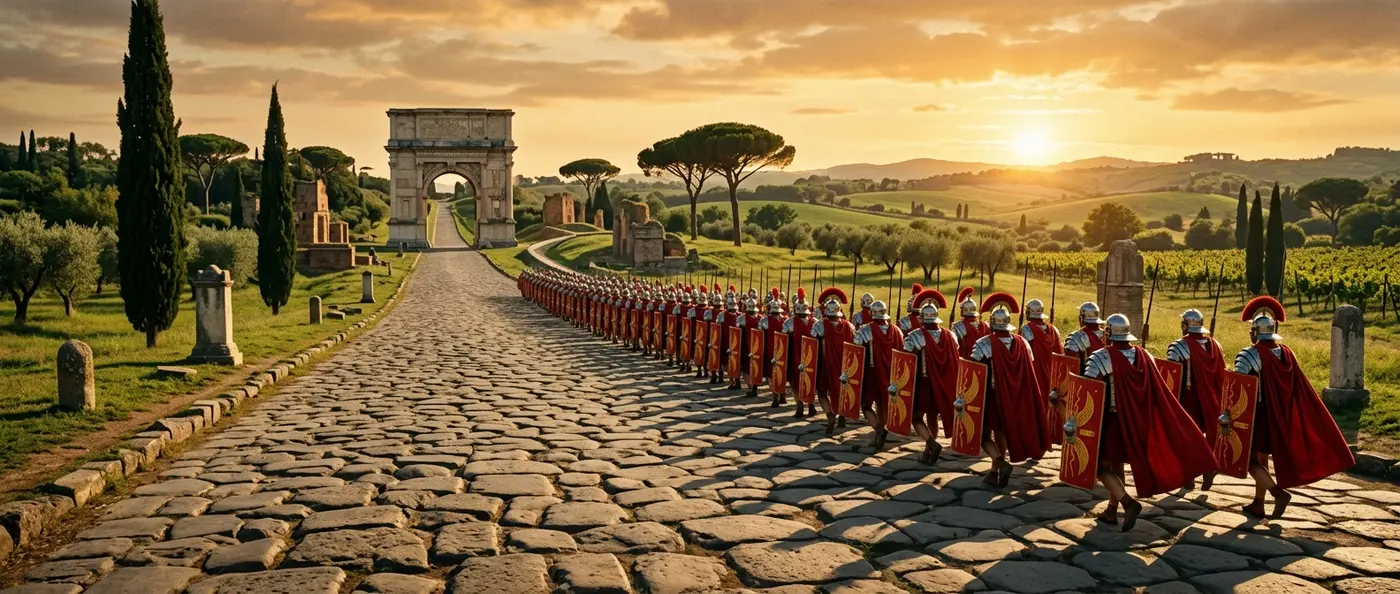
Picture traveling from Britain to Syria 2,000 years ago. You'd spend most of the journey on identical stone-paved roads. The Roman road network stretched over 400,000 kilometers — not just an engineering feat, but the nervous system that kept the ancient world's largest empire alive.
🛤️ Birth of the First Transnational Network
Romans didn't invent roads. Persians, Egyptians, and Greeks had built major networks before them. What made Romans unique was scale and systematization. As architect Vitruvius wrote, their approach centered on "utilitas" — utility that married technical excellence with practical application.
The breakthrough came in 312 BCE with the Via Appia, built by Appius Claudius the Blind. This road connecting Rome to Capua, later extended to Brindisi, set the standard for every future Roman road. Within decades, Roman engineers were laying stone across Gaul, Spain, and North Africa.
By the 2nd century CE, at the empire's peak, the network had reached 400,000 kilometers. Of these, 80,000 were fully stone-paved. To grasp this achievement's magnitude: this network covered over 5 million square kilometers and served one-fifth of the world's population.
⚒️ The Art of Construction
Building a Roman road demanded specialized engineers, surveyors, and thousands of workers. Romans used the groma — a measuring device borrowed from Egyptians — to mark straight lines with stunning precision.
Route selection came first. Engineers preferred accessible mountain slopes, lower hills, and sunny sides. They avoided water at all costs, as it posed the greatest threat to road stability. When crossing marshes or lakes, they built extensive drainage systems.
Construction itself followed a standardized multi-layer method — the origin of "strata," which gave us Italian "strada" and English "street." Workers first dug a deep trench, filled with large foundation stones. Multiple layers followed: smaller stones, gravel, sand, and finally the surface of large, flat stones fitted perfectly together.
🌉 Bridges That Conquered Time
Rivers posed the greatest challenge for Roman engineers. Bridge construction required massive resources and advanced techniques. Though most Roman bridges didn't survive floods, earthquakes, or abandonment, some still stand after two millennia.
Spain's Alcántara Bridge, built in the 2nd century CE, and northern Italy's Pont-Saint-Martin from the 1st century BCE are exceptional examples. They were built in geologically stable areas, away from rivers' most destructive currents. Their massive stone arches were designed to distribute weight and withstand hydraulic pressure.
The secret to their longevity? A combination of location, construction quality, and continuous use. Many of these bridges remained vital transport hubs throughout the Middle Ages and beyond, ensuring their maintenance by local communities.
Alcántara Bridge
Built in 106 CE over Spain's Tagus River. At 48 meters high and 194 meters long, it's still in use today.
Pont du Gard
Aqueduct-bridge in southern France, 49 meters tall. Carries the Nîmes aqueduct over the Gardon River.
Rimini Bridge
Built by Augustus and Tiberius (14-21 CE). Its five arches still handle modern traffic.
🏛️ More Than Simple Roads
Roman roads weren't just for military movements. An entire infrastructure system developed along them. Every 15-20 kilometers, stations (mutationes) let travelers change horses. Every 30-50 kilometers, larger stations (mansiones) offered inns, baths, and workshops.
Recent excavations in Gloucestershire, England revealed one such 2,000-year-old "service station." Archaeologists found building foundations, pottery, coins, and tools — an entire small community serving travelers. The pottery fragments included North African olive oil jars and Syrian glass — proof of the trade flowing along these routes.
The cursus publicus system — the state postal service — ensured messages and orders could travel from Rome to the most distant frontiers in weeks. A messenger could cover 80 kilometers daily by changing horses at stations.
💡 Did You Know?
The phrase "all roads lead to Rome" isn't just metaphor. The Milliarium Aureum, a golden milestone in Rome's Forum, was considered the zero point from which all distances in the empire were measured. Every mile along the roads was marked with stone milestones showing the distance from this central point.
📐 The Science Behind the Marvel
Romans borrowed freely — Greek mathematics, Egyptian surveying tools, Etruscan arch construction — then scaled everything up. They borrowed mathematical and physical principles from Greeks, surveying techniques from Egyptians, and construction methods from Etruscans.
Archimedes' screw, for example, was used extensively in infrastructure projects. This device — a cylinder with a helical screw inside — could lift water when rotated. Romans used it to drain construction sites, irrigate sloped terrain, and pump water from underground mines.
Pumps by Ctesibius and Hero of Alexandria, operating on compressed air, were adapted for large construction projects. These could lift heavy loads and pump water from great depths. This technology was vital for building bridge foundations in rivers.
🗺️ The Legacy That Survives
Many modern European roads still follow ancient Roman routes. Italy's Via Aemilia is today's SS9 highway. Parts of Spain's Via Augusta were incorporated into the modern AP-7 motorway. In Britain, Watling Street and Fosse Way remain major arteries.
Recent digital reconstructions revealed how the Roman road network continued shaping travel patterns for over a thousand years after the empire's fall. Medieval merchants, pilgrims, and armies followed the same routes Romans had carved centuries earlier.
Perhaps the greatest legacy isn't the roads themselves, but their idea. For the first time in history, a power managed to connect such vast territory with a unified transport system. This achievement set the standard for every subsequent empire and demonstrated infrastructure's power to unite peoples and civilizations.
📊 Road Network Comparison
🔍 Modern Discoveries
Archaeology continues revealing new details about the Roman road network. In 2023, archaeologists in Cluj-Napoca, Romania discovered a perfectly preserved 2,000-year-old Roman road section. The discovery happened during underground parking construction and revealed not just the road but adjacent building sections.
In Switzerland, 2025 brought the remains of a wooden Roman bridge at Aegerten. The discovery was exceptionally rare, as wood rarely survives so many centuries. The bridge dates to the 1st century CE and shows Romans used wooden constructions where stone was scarce or temporary solutions were needed.
These discoveries remind us that the Roman road network was far more than a military tool. It was the backbone of a civilization that managed to unite three continents under one law, one language, and one vision. Though the empire fell 1,500 years ago, its roads continue connecting us to the past and teaching us about engineering's power to change the world.