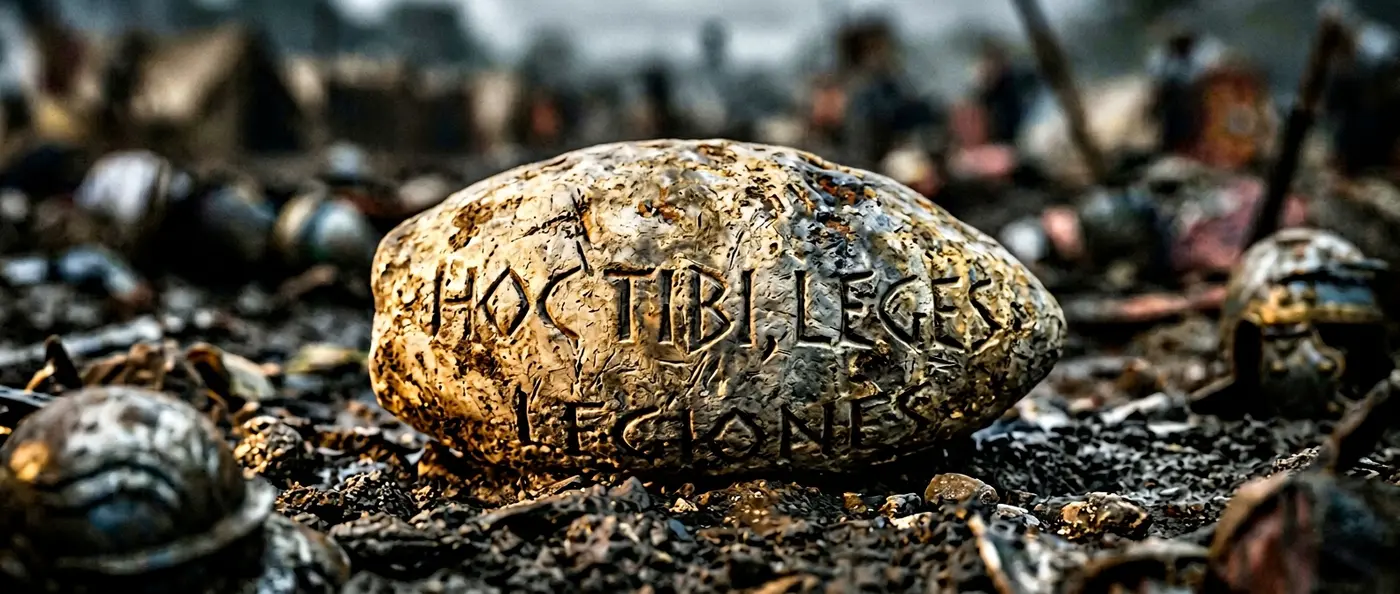
A lead bullet screams through the air at 100 mph. It punches through armor, shatters bone. But this one carries something extra — an insult. "Take this!" reads the Latin inscription. Roman soldiers didn't just kill their enemies. They mocked them to death.
📖 Read more: Attila the Hun: History's Most Feared Conqueror
🎯 The Sling: Rome's Precision Weapon
The sling was a sniper rifle in the hands of a Roman soldier. These weren't David-and-Goliath rocks hurled by shepherds. Roman slingers, called funditores, launched lead bullets over 400 meters with deadly accuracy. A skilled slinger could punch through helmets and shields at ranges that left archers fumbling for arrows.
The ammunition — glandes — were engineered projectiles. Oval-shaped lead bullets weighing 20 to 50 grams, aerodynamically designed to maintain velocity. At impact, they hit at 160 kilometers per hour. That's enough force to shatter a skull or cave in a ribcage.
Romans learned slinging from the Balearic islanders, who dominated the Mediterranean as mercenary slingers. But Rome systematized everything. They integrated slingers into auxiliary units that supported the legions. What started as tribal warfare became military science.
✍️ Death Threats in Lead
Here's where it gets weird. Roman soldiers carved messages into their bullets. Not unit numbers or tactical markers — insults. Threats. Jokes that would make a drill sergeant blush.
The messages were cast into molds before the lead was poured. This wasn't graffiti scratched by bored soldiers. It was organized psychological warfare, approved by commanders who understood that breaking enemy morale was as important as breaking enemy bones.
"DEXAI" — "take this" in Greek — appears on hundreds of bullets. Romans loved using Greek for their taunts, the ancient equivalent of dropping foreign curse words. Other bullets got more creative: "FULVIAE CULUM PETO" translates roughly to "I'm aiming for Fulvia's ass." Personal. Crude. Devastating if you're the target.
Some bullets carried death threats against specific enemy commanders. "PETO OCTAVIANUM CULUM" — "I'm targeting Octavian's rear end" — showed up during civil wars. Imagine being a general and finding bullets with your name carved into them scattered around your camp.
📖 Read more: Spanish Elephant Bone Links to Hannibal's War Machine
💀 Mind Games in Ancient Warfare
This wasn't random cruelty. Romans weaponized humiliation. A soldier might survive an arrow wound and fight another day. But getting hit by a bullet that insulted your mother? That cut deeper than lead.
The psychology worked on multiple levels. Roman slingers felt like they were launching personal attacks, not just projectiles. It boosted their morale, made them feel connected to the fight. Meanwhile, enemy survivors who found these bullets knew they weren't just facing soldiers — they were facing people who hated them enough to craft personalized death threats.
Other ancient armies used similar tactics. Greeks carved victory messages on their bullets centuries before Rome existed. Carthaginians inscribed religious symbols. But Romans turned it into an art form, with industrial-scale production of customized insults.
Psychological Impact
Insulting messages demoralized enemies and created fear. The prospect of dying from a bullet that mocked you personally added humiliation to death.
Morale Boost
Slingers felt they were participating in psychological warfare, enhancing their own morale and sense of engagement in battle.
🏛️ Archaeological Evidence
Archaeologists have unearthed hundreds of inscribed bullets across the former Roman world. From Spain to the Middle East, these lead messages paint a picture of an army that understood warfare wasn't just about tactics — it was about breaking the human spirit.
📖 Read more: Roman Decimatio: The Army's Most Brutal Punishment
The most significant discovery came from Perugia, Italy. Bullets from the 41-40 BC siege carried insults against Octavian (later Augustus) and his generals. These weren't random soldiers venting frustration. This was organized mockery at the highest levels of Roman politics.
British sites have yielded bullets with legion names and unit identifiers, showing the practice spread throughout the empire. Some carried luck symbols or religious invocations — lightning bolts, gods' names. Roman soldiers hedged their bets, combining divine favor with crude humor.
🔍 The Mystery of Coded Messages
Some bullets carry abbreviations or symbols archaeologists still can't decode. These might be inside jokes between soldiers or coded messages meaningful only to specific units. The Roman military had its own secret language of insults.
⚔️ Manufacturing Mockery
Creating inscribed bullets required skill. Craftsmen carved messages backwards into stone or clay molds. Pour in molten lead, let it cool, and out came a bullet with raised lettering. The process meant multiple identical bullets could be mass-produced from one mold.
This explains why archaeologists find clusters of bullets with identical messages at battle sites. It also proves the practice was systematic, not spontaneous. Someone in the Roman supply chain was dedicated to manufacturing personalized ammunition.
Molds often contained multiple bullet cavities, enabling mass production. A skilled craftsman could produce hundreds of bullets daily, ensuring slingers never ran out of ammunition or attitude.
📊 Types of Bullet Inscriptions
📖 Read more: Battle of Plataea: The Final Victory Against the Persians
🌍 Spreading the Practice
Romans didn't invent inscribed bullets, but they perfected the concept. Greeks were carving messages into sling bullets by the 4th century BC, long before Roman conquest. Greek bullets typically carried victory slogans or commander names — "NIKE" (victory) was popular.
Roman influence spread the practice throughout their empire. Local auxiliary forces adopted the technique, sometimes using their native languages. Middle Eastern sites have yielded bullets with Aramaic inscriptions, showing cultural exchange within Roman military units.
Romans turned ammunition into propaganda. Why just kill when you could kill and humiliate at the same time?
📚 Legacy of Ancient Warfare
These inscribed bullets offer a rare glimpse into the human side of ancient warfare. Behind the grand strategies and heroic narratives were ordinary soldiers with senses of humor, personal grudges, and very creative ways of expressing both.
War wasn't just about killing — it was about humiliation. Romans knew that a demoralized enemy was easier to defeat than a dead one who might inspire others.
Modern technology continues revealing new details about these artifacts. 3D scanning and chemical analysis uncover previously invisible inscriptions. Each discovery shows how little has changed about soldiers' need to personalize violence and mock their enemies.