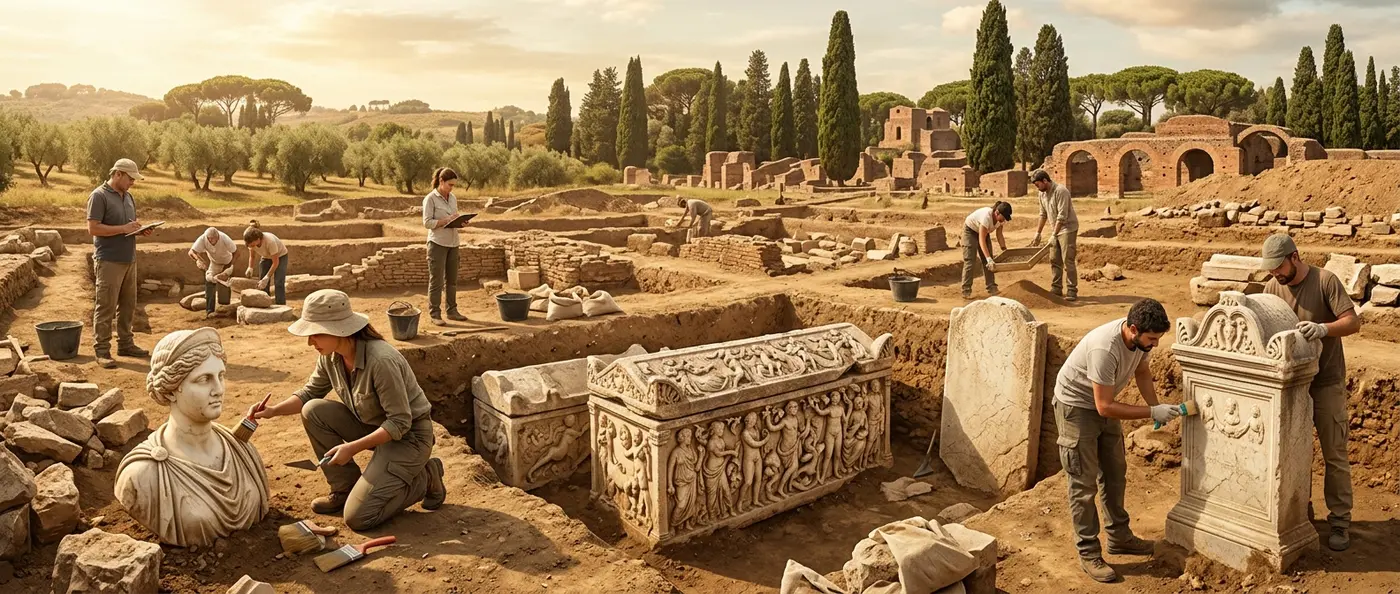
March 2026. Archaeologists working south of Rome hit something extraordinary in Ostia's ancient necropolis. Among tombs dating from the 1st to 4th centuries AD, they uncovered monuments decorated with winged Victory figures and inscriptions that reveal unknown aspects of Roman burial art. This discovery sheds new light on ancient Roman beliefs about life after death.
🏛️ The Ostia Necropolis
Ostia wasn't just Rome's port. It was a bustling city with thousands of residents, temples, theaters, and sprawling necropolises. The Ostiense necropolis, stretching along the ancient Via Ostiensis, served as the final resting place for merchants, sailors, craftsmen, and officials who lived and worked at the harbor.
The 2026 excavations revealed a section of the necropolis that had remained untouched for nearly two millennia. Unlike other areas looted during medieval times, this section was preserved under layers of silt from Tiber floods. The result? Roman tombs frozen in time, untouched since antiquity.
⚱️ Types of Burial Monuments
The variety of burial monuments in the necropolis reflects the social stratification of Roman Ostia. From simple graves with ceramic urns to imposing mausoleums with marble statues, each monument tells its own story.
Wealthier residents built family tombs that could house multiple generations. These tombs, known as columbaria because of their resemblance to dovecotes, had niches in the walls where ash urns were placed. Poorer citizens often joined burial guilds (collegia funeraticia) to ensure a decent burial.
🦅 The Winged Victories
Among the finds, reliefs of winged Victories stand out most dramatically. These goddesses of victory, holding wreaths and palm branches, decorate the facades of many tombs. Their presence isn't random.
In Roman thinking, death was a battle to be won. The winged Victories symbolized the soul's triumph over death and hope for eternal life. On one tomb, an inscription reads "VICTORIA AETERNA" - eternal victory. Next to it, Victory crowns a dead warrior, suggesting he won his final battle.
The artistic style of the reliefs varies from the classical realism of the 1st century to the more schematic approach of the 4th century. This evolution reflects broader changes in Roman art and religion as the empire moved toward Christianity.
Victory Symbolism
The winged figures represented the soul's triumph over death and ascension to the heavens.
Artistic Evolution
From 1st-century naturalism to 4th-century symbolism, the art reflects religious changes.
Christian Transition
Some later tombs combine pagan and Christian symbols, showing gradual change.
📜 Inscriptions and Names
The tomb inscriptions tell stories of Ostia's residents in their own words. Beyond the names of the dead, they mention occupations, ages, family relationships, and sometimes entire biographies.
One tomb belongs to a grain merchant named Marcus Aurelius Frumentarius. His inscription describes how he started as a simple dock worker and rose to become one of Rome's largest wheat suppliers. "I fed the city for 30 years," the inscription boasts.
Other inscriptions are more personal. A mother mourns her daughter who died at 16: "Dulcissima filia" - sweetest daughter. A husband dedicates a luxurious tomb to his wife after 40 years of marriage. Behind each inscription lies a life fully lived.
💡 Did You Know?
Many tombs had small tubes leading from the surface to the urn. Through these, relatives poured wine, honey, and perfumes to "feed" the dead during anniversaries and festivals of the dead (Parentalia and Lemuria).
🏺 Grave Goods and Offerings
Romans believed the dead needed objects for the afterlife. Ostia's tombs contained an impressive variety of grave goods: coins for Charon, oil lamps to light the darkness of Hades, vessels with food and drink, jewelry, and personal items.
In a child's tomb, archaeologists found tiny toys - a clay rattle, a doll with articulated limbs, and small terracotta animals. These objects speak to the tenderness of parents trying to comfort their child even in death.
Adults often took the tools of their trade with them. A doctor was buried with his surgical instruments, a painter with his palettes, a scribe with his reed pen and inkwell. These objects weren't merely symbolic - they believed they would continue their work in the next life.
🔬 Modern Analysis Techniques
Modern technology reveals secrets the Romans left behind. With 3D scanning, they create digital models of the tombs that allow virtual tours. Spectroscopy reveals the colors of wall paintings that have faded over time.
DNA analysis from bones reveals family relationships among the buried. In one case, it proved that a "family" tomb actually contained members of three different families who were likely connected by business rather than blood.
Isotopic analysis of bones and teeth reveals diet and origin. Many of the buried weren't locals - they had come from across the Mediterranean to work at Rome's busy port.
⚖️ Comparison of Burial Practices
🌅 Afterlife in Roman Thought
Ostia's tombs reflect the evolution of Roman beliefs about the afterlife. In early centuries, the traditional view of a shadowy Hades where souls existed as weak shades prevailed. Gradually, under the influence of Eastern religions and philosophical currents, more optimistic concepts developed.
Wall paintings in some tombs depict the Elysian Fields - a paradise where the virtuous enjoyed eternal bliss. Others show the deceased banqueting with gods or transforming into stars. These images offered comfort to the living.
The transition to Christianity is evident in later tombs. Symbols like the fish and anchor appear, while inscriptions speak of "sleeping in peace" and resurrection. However, many pagan traditions continued - Christians still left flowers and lit lamps at graves.
🏛️ Significance of the Discovery
Ostia's necropolis offers a unique window into daily life and death in the Roman Empire. Unlike the luxurious tombs of emperors and aristocracy, here we see how ordinary people - merchants, craftsmen, sailors - faced the great mystery of death.
The winged Victories decorating the tombs aren't merely decorative elements. They express a deep human need - the hope that death isn't the end but a transition, a victory of the soul freed from bodily bonds. It's a message that echoes through the centuries.
As excavations continue, more revelations are expected. Each tomb reveals another chapter of Roman history. The merchants, sailors, and craftsmen buried here faced death with the same hopes we carry today.