📖 Read more: Ancient India: Castes, Dharma and the Vedas Revealed
🏛️ Rise of the Sassanid Dynasty
In 224 CE, a local ruler from Persis named Ardashir I overthrew the last Arsacid king and founded the Sassanid dynasty. His victory wasn't just a change of dynasties. It marked the rebirth of Persian nationalism and a return to the ancient traditions of the Achaemenids.
The Sassanids ruled a massive territory stretching from Mesopotamia to the borders of India, and from the Caucasus to the Arabian Peninsula. For more than four centuries, their empire stood as Rome's primary rival in the East, and later Byzantium's greatest challenger.
Their capital, Ctesiphon, sat on the banks of the Tigris near modern Baghdad. There they built the famous Taq-i Kisra, one of the largest vaulted buildings in the ancient world. Its ruins still stand as witnesses to Sassanid architectural mastery.
🔱 Zoroastrianism: The State Religion
The Sassanids made Zoroastrianism the official state religion, giving it an organization and power it had never known before. Priest-magi gained enormous influence at court and in society. Hundreds of fire temples were built throughout the empire, with the most sacred located at Azar Gushnasp in present-day northwestern Iran.
Religious life affected every aspect of daily existence. From purification rituals to inheritance laws, Zoroastrianism shaped the lives of subjects. Sassanid kings presented themselves as the chosen ones of Ahura Mazda, the supreme god of light and truth.
Despite this, the empire hosted other religions too. Christians, Jews, Buddhists, and Manichaeans lived within its borders, though their treatment varied depending on each king's policies and international circumstances.
For nearly four centuries, the Sassanids and Romans (later Byzantines) engaged in almost continuous conflict. The wars consumed entire generations and bankrupted both treasuries.
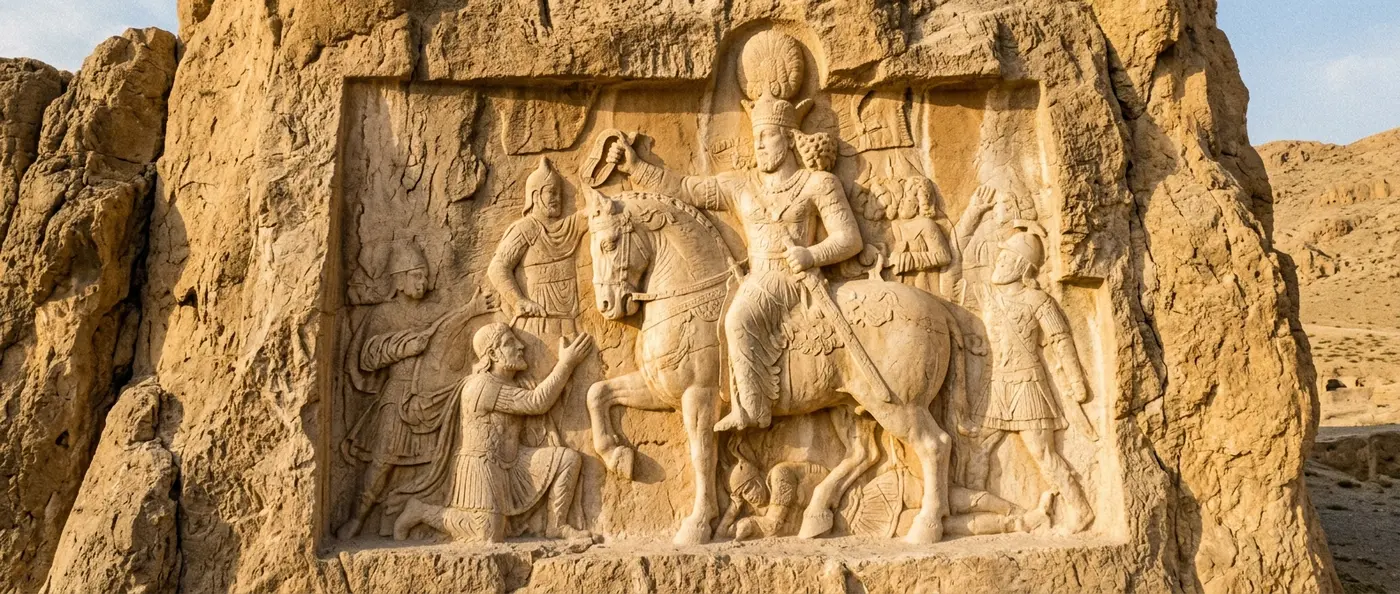
In 260 CE, Shapur I achieved something no other enemy of Rome had managed: he captured a Roman emperor, Valerian, at the Battle of Edessa. This victory was immortalized in rock reliefs showing the Roman emperor kneeling before the Persian king.
The conflicts peaked in the 6th and 7th centuries. Khosrow II captured Jerusalem in 614 CE and took the True Cross as booty. For a moment, it seemed the Sassanids would conquer the entire Byzantine Empire. But Heraclius counterattacked and invaded deep into Persian territory, forcing the Sassanids into humiliating peace in 628 CE.
Military Organization
The Sassanids developed one of the most effective armies of their era. Their cataphract cavalry, covered head to toe in heavy armor, formed the elite core of their forces.
Economic Power
The empire controlled trade routes between East and West. Their silver drachmas circulated from Rome to China, proving their economic influence across the known world.
Architectural Innovation
The Sassanids perfected the art of the dome and arch. Their palaces at Ctesiphon and Firuzabad impressed with their size and complexity.
🎨 Art and Culture at the Sassanid Court
Sassanid art combined Persian traditions with influences from Rome, Byzantium, and Central Asia. Their silver vessels show kings hunting lions and boar, or winged creatures from Zoroastrian mythology.
Royal excavations have revealed stunning mosaics and frescoes. At Bishapur, mosaics show dancers and musicians in scenes that resemble Roman villas more than Persian palaces, proving the international nature of Sassanid art.
Textiles were another art form where they excelled. Their silk fabrics with intricate patterns were so sought after they reached Japan and Scandinavia. Many survived in European church treasuries, where they were used to wrap sacred relics.
💡 Did You Know?
Chess, as we know it today, likely took its modern form at the Sassanid court. The Persian "shatranj" evolved from the Indian "chaturanga" and from there spread to the Arab world and Europe.
📜 Administration and Social Organization
Sassanid society was strictly hierarchical. At the top stood the Shahanshah (King of Kings), followed by great nobles, priests, warriors, and farmers. Each class had specific rights and obligations.
The administrative system required an army of scribes and record-keepers. The empire was divided into four great regions, each under the control of a spahbed (military governor). There was also an extensive bureaucratic system with detailed records for taxes, military service, and legal cases.
Education was a privilege of the upper classes, but the Sassanids maintained and developed the ancient Persian tradition of writing and literature. The Avesta, the sacred book of Zoroastrianism, was codified in written form during their reign.
After centuries of wars with Byzantium, both empires were exhausted. No one expected the storm coming from southern Arabia. In 633 CE, Arab forces under the early caliphs invaded Mesopotamia.
The Battle of Qadisiyyah in 636 CE marked the beginning of the end. Despite heroic resistance, the Sassanids couldn't stop the Arab advance. The last Sassanid king, Yazdegerd III, was murdered in 651 CE near Merv, marking the definitive end of the empire.
The collapse was rapid but not total. Many Persian nobles and military officers entered the service of the Caliphate, bringing with them centuries of administrative experience and cultural tradition. The Persian language and civilization not only survived but flourished under their new rulers.
⚔️ Comparison with Previous Persian Empires
🏛️ The Sassanid Legacy
Sassanid influence extends far beyond the chronological limits of their empire. Their administrative system was adopted and adapted by the Islamic Caliphate. Their art and architecture influenced Islamic art for centuries.
In modern Persian consciousness, the Sassanids hold a special place. They were the last independent Persian monarchs before the Arab conquest. Iran's national epic, Ferdowsi's Shahnameh, devotes large portions to the legendary and historical kings of the dynasty.
Even today, archaeological discoveries continue to reveal new aspects of this remarkable civilization. From inscriptions near Persepolis to coins found along the Silk Road, each find adds a piece to the puzzle of the last great Persian world.