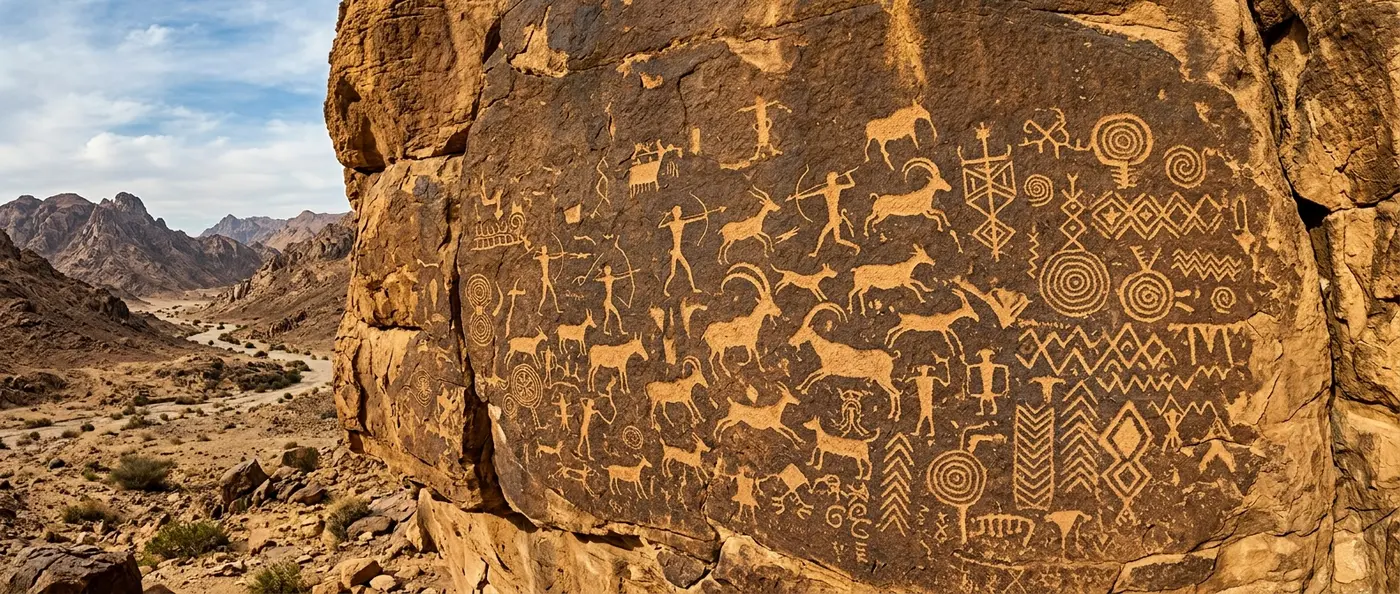
A hunter draws his bow. His dogs crouch beside him, muscles tense. The scene plays out on a rock wall in the Sinai desert, carved by hands that turned to dust 10,000 years ago. This ancient art opens humanity's longest-running gallery show, where Egyptian pharaohs, Nabataean traders, and medieval pilgrims all left their mark on the same stone canvas across 100 centuries.
📖 Read more: Saudi Arabia's Rock Art: The First Inhabitants
🗿 The Discovery That Rewrote Desert History
Mustafa Nour El-Din thought he'd seen everything during his decades with Egypt's Ministry of Tourism and Antiquities. Then in 2025, deep in southern Sinai's Umm Arak plateau, he crawled into a 100-meter-long rock shelter that made him question everything he knew about the region's past.
Sheikh Rabie Barakat, whose family had wandered these desert paths for generations, led them to the breakthrough. The shelter — 3 meters deep with a ceiling barely 1.5 meters high — had served as humanity's rest stop for millennia. Inside, Nour El-Din found a visual diary spanning 100 centuries.
The oldest images date to between 10,000 and 5,500 BCE. The newest reach into medieval times. Picture an Instagram feed that starts with Stone Age hunters and ends with Arabic inscriptions. That's what archaeologists discovered carved into these desert walls.
🏹 The First Desert Artists
Near the shelter's entrance, the oldest petroglyphs tell hunting stories with stunning detail. A bowman stands ready, flanked by at least two hunting dogs. The technique is so advanced you can read the tension in the archer's stance, the alertness in the dogs' posture. These weren't crude scratches — they were masterpieces.
The images show how Sinai's prehistoric inhabitants lived. They were nomadic hunter-gatherers who followed animal migration routes across the peninsula. The fact that they had domesticated dogs suggests a level of social organization that might surprise us. They were thriving, organized enough to train animals and sophisticated enough to document their world in stone.
The shelter's location was strategic. It sits near ancient copper and turquoise mines, suggesting the artists might have been miners who left their mark during extraction campaigns. The Sinai wasn't empty desert — it was a resource-rich frontier that drew people from across the ancient world.
⚔️ Egypt's Violent Conquest Carved in Stone
Five thousand years later, Egyptian artists used the same rocks to document something darker. Rock art from around 3000 BCE depicts the Egyptian conquest of Sinai with brutal clarity. According to archaeologists Ludwig Morenz and Mustafa Nour El-Din, these images "show in a terrifying way how the Egyptians colonized the Sinai and subjugated the inhabitants."
The central scene is harsh but revealing. One man raises his arms in triumph while another kneels with an arrow through his chest, hands bound behind his back. Nearby, a boat appears alongside an inscription naming the god Min as "ruler of the copper region."
That boat isn't decorative. In ancient Egypt, ships symbolized pharaonic power and divine authority. Its presence here signals that this conquest came with royal backing — part of an organized expansion plan, not random violence. The Egyptians weren't just raiding. They were claiming territory.
💡 The Mystery of the Erased Name
Something strange appears in the conquest scene. Next to the boat image, there was once an inscription that likely named the Egyptian ruler, but it's been deliberately erased. Who scratched it out and why remains a mystery. Egyptian history is full of cases where a pharaoh's name was erased after death by his successor — a form of ancient cancel culture that tried to erase someone from history entirely.
🌍 Geometric Patterns and Mystical Visions
Beyond realistic scenes, the Umm Arak shelter overflows with geometric shapes that baffle researchers. Thousands of X's, squares, ovals, crescents, and more complex designs cover the walls. These patterns echo similar works found worldwide and connect to ritual practices that transcend cultures.
José Miguel Pérez-Gómez, who has studied similar rock art in Venezuela extensively, argues that repetitive geometric motifs might have been created during altered states of consciousness. The artists possibly depicted optical phenomena they experienced during ceremonies, perhaps under the influence of psychotropic substances.
Many designs resemble entoptic phenomena — visual effects generated within the eye that intensify during trance states. The rocks might have functioned as sacred spaces where people communicated with the spiritual world, leaving visual records of their journeys into altered consciousness.
Geometric Motifs
Thousands of shapes like X's, squares, and spirals cover the rocks, possibly resulting from mystical experiences and trance states.
Riders and Warriors
Later depictions show people on horseback with weapons, documenting the evolution of technology and warfare tactics.
Nabataean Inscriptions
Texts in the language of the Nabataeans, the people who built Petra, were found scattered among the images.
📖 Read more: Ancient Egypt's Bread and Beer: Sacred Food of the Pharaohs
🏺 Sinai as a Cultural Crossroads
The variety of rock art reveals that Sinai wasn't just barren desert but a living crossroads of civilizations for millennia. From prehistoric hunters to Egyptian conquerors, from Nabataean traders to medieval pilgrims, everyone left their mark on the rocks.
John Darnell, professor of Egyptology at Yale who has conducted extensive research in Sinai, emphasizes the region's significance: "The Sinai was an important region for ancient Egypt, a source of mineral wealth and symbolically important area, the home of the goddess Hathor, the 'Lady of Turquoise.'"
The area's copper and turquoise mines attracted people from far away. Miners and traders who spent months in the desert used rocky shelters as rest points and worship sites. There they left their narratives, their prayers, even their fears carved in stone. The rocks became bulletin boards for the ancient world.
📜 The Nabataeans and the Language of Stone
Among the thousands of images, archaeologists discovered inscriptions in the Nabataean language. The Nabataeans, the people who built the legendary city of Petra in Jordan, flourished between 400 BCE and 200 CE. They were traders who controlled caravan routes and had developed a sophisticated writing system.
The presence of Nabataean inscriptions in Sinai shows the region was part of their extensive trade network. The inscriptions are still under study, but likely contain traveler names, prayers, or even commercial agreements. These desert rocks served as ancient LinkedIn profiles and business cards.
The tradition continued unbroken. For 10,000 years, people from different cultures and eras chose the same rocks for expression. It's as if the stones had a magnetic pull that transcends time and culture — a universal human need to leave a mark, to say "I was here."
🗺️ Timeline of Rock Art Evolution
🔬 Modern Technology Reveals Ancient Secrets
Many petroglyphs are nearly invisible to the naked eye due to time's erosion. Researchers now use DStretch technology, a digital tool that enhances colors and reveals details that would otherwise remain hidden. The technology works like X-ray vision for ancient art.
This technique has revolutionized rock art studies globally. Images that appeared as simple stains reveal themselves as complex compositions with multiple layers of meaning. In Sinai, DStretch revealed that many images had been painted one over another in different eras, creating palimpsests of millennia.
Archaeologists now plan to use dating techniques to precisely determine each layer's age. This will allow them to create a detailed timeline of human activity in the region — a frame-by-frame reconstruction of 10,000 years of desert life.
🌟 The Legacy of Stone Galleries
Sinai's rock art forms a living archive of human history — testimony to our need to communicate, create, and leave our mark on the world. From the first hunters depicting their prey to medieval pilgrims leaving their prayers, all participated in a timeless dialogue carved in stone.
Today, as modern technology allows us to read these ancient messages in new ways, we discover our ancestors were far more complex and creative than we believed. Sinai's rock art reminds us that art isn't luxury but fundamental human need that has existed since civilization's dawn.
As research continues, more secrets await discovery. Each new finding adds a piece to the puzzle of human history in the Middle East. The rocks of Sinai, silent witnesses to ten millennia, still have many stories to tell. They're not just stones — they're time machines, waiting for us to decode their messages from the deep past.