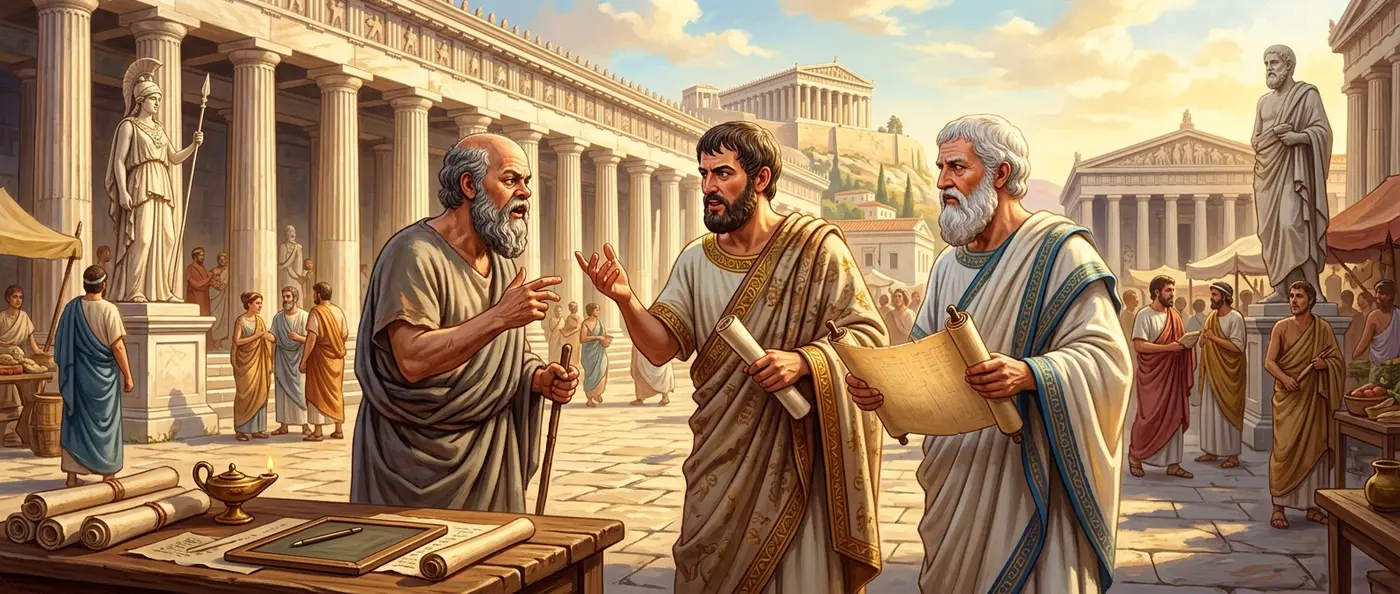
Italian researchers just used AI to crack open a 2,000-year-old mystery. They deciphered a charred papyrus scroll from Pompeii, revealing where Plato was buried — in the Academy's garden near the shrine to the Muses. The discovery pinpoints where one of history's most influential minds lies buried. Socrates, Plato, and Aristotle didn't just philosophize. They rewrote how humans think.
📖 Read more: Stoicism: The Philosophy That Conquered Time
🏛️ Athens, 5th Century BC: Where Everything Changed
Athens wasn't just another city-state. It was ground zero for an intellectual revolution that would echo through millennia. In the Agora's bustling markets, in gymnasiums where bodies and minds trained together, in symposiums where wine loosened tongues and sharpened wit — here, reason replaced tradition as the path to truth.
The city had already produced groundbreaking thinkers. Thales of Miletus earned the title "first Greek philosopher" by explaining the world's origins through natural forces, not mythological stories. Anaximander and Anaximenes built on this tradition, using observation and logic to decode nature's mysteries.
Three men would forge the intellectual tools we still use today. Socrates. Plato. Aristotle. Each built on his predecessor's work, creating an intellectual chain that stretches from the 5th century BC to your smartphone screen right now.
⚔️ Socrates: The Man Who Wrote Nothing, Changed Everything
Socrates never wrote a word. His questions changed how humans think forever. Born in 469 BC, he spent his life wandering Athens' streets, cornering anyone willing to engage. His weapon? Questions.
The "Socratic method" wasn't about providing answers — it was about exposing ignorance. Socrates believed true wisdom began with admitting you know nothing. His famous declaration: "I know that I know nothing." Through dialogues that often left conversation partners frustrated and confused, he guided them toward self-knowledge.
In 399 BC, at age 70, Athens condemned him to death. The charges: corrupting youth and introducing new gods. His trial and execution became symbols of the eternal conflict between free thought and established power. When offered escape, he refused. He'd rather die than live as a lawbreaker in his beloved city.
Plato, born in 428 BC to an aristocratic family, studied under Socrates for eight years. His teacher's death marked him deeply, driving him to preserve and expand the Socratic legacy. But Plato wasn't just a recorder — he was an original thinker who created a comprehensive philosophical system.
In 387 BC, he founded the Academy, the Western world's first organized educational institution. According to the recent AI-deciphered papyrus by Philodemus of Gadara, Plato was buried in the Academy's garden near the shrine to the Muses. We knew he'd been buried somewhere in the Academy, but the exact location remained a mystery until now.
Plato's philosophy centers on the Theory of Forms. He believed our material world is just an imperfect reflection of a perfect realm of Ideas. Every beautiful thing we see is beautiful because it participates in the Form of Beauty. This theory profoundly influenced Western thought, from Christian theology to modern science.
📖 Read more: Piraeus: Ancient World's Greatest Naval Superpower
Theory of Forms
Plato argued for a perfect world of Ideas beyond the material world. Forms are eternal, unchanging, and serve as templates for all things we experience.
The Republic
In his masterwork, Plato describes the ideal state where philosopher-kings rule with wisdom and justice, creating a perfectly ordered society.
The Academy
The West's first university operated for nearly 900 years until Emperor Justinian closed it in 529 AD, ending an era of continuous philosophical education.
🔬 Aristotle: The Father of Science
Aristotle was born in 384 BC in Stagira, Macedonia. At 17, he traveled to Athens to study at Plato's Academy, staying for 20 years. Despite his admiration for his teacher, Aristotle developed a radically different philosophical approach.
While Plato gazed toward a transcendent world of Forms, Aristotle focused on the empirical world. He believed knowledge comes from observing and analyzing concrete things. He became the first systematic scientist, cataloging dolphins' breathing patterns, mapping star movements, and dissecting the mechanics of tragedy.
In 335 BC, he founded the Lyceum, his own school in Athens. There, walking with students through covered walkways (hence "Peripatetic School"), he developed an encyclopedic system of knowledge covering nearly every field of human inquiry. His logic, formulated in the "Organon," remained the foundation of scientific method for over 2,000 years.
💡 The Legacy of Three Giants
Socrates taught us to question, Plato to envision the ideal, and Aristotle to observe and analyze the world around us. Together, they created the foundations of Western philosophy, science, and education.
🏺 Differences That Complete Each Other
Despite their teacher-student relationships, the three philosophers had fundamental differences in approach. Socrates focused on ethics and self-knowledge, refusing to engage with natural philosophy. Plato created a metaphysical system that placed true reality beyond the material world. Aristotle returned to the empirical world, insisting that form and matter are inseparable.
📖 Read more: Demosthenes: Athens' Voice Against Philip of Macedon
These clashing approaches created a complete toolkit for human inquiry. Each philosopher asked different questions and developed different methods to answer them. Socrates asked "What is right?" Plato asked "What is true?" Aristotle asked "How does the world work?" Together, they covered the entire spectrum of human curiosity.
Their influence extends far beyond ancient Greece. Their ideas shaped Roman thought, profoundly influenced Christianity and Islam, and formed the foundation of the Renaissance. The Socratic method is still used in teaching and legal education. The Platonic tradition survives in mathematics and theoretical physics. Aristotelian logic and empirical method form the core of modern science.
In the Hellenistic world, their ideas evolved into new philosophical schools. Stoicism and Epicureanism, though different from each other, both had roots in the Socratic search for happiness. Plotinus's Neoplatonism further developed Plato's metaphysical ideas, deeply influencing Christian theology.
📊 Comparing the Three Philosophers
🔱 Why They Still Matter
Today, nearly 2,500 years later, these three giants remain startlingly relevant. As artificial intelligence raises new questions about consciousness and knowledge, Platonic and Aristotelian approaches offer different frameworks for understanding. Socratic emphasis on self-knowledge and ethics is more crucial than ever in a world facing unprecedented moral challenges.
Recent discoveries, like the AI-deciphered papyrus revealing Plato's exact burial site, remind us that studying ancient philosophy isn't just academic exercise. It's a living dialogue with the past that continues to illuminate the present and shape the future.
Socrates, Plato, and Aristotle weren't just philosophers. They were the architects of Western thought, the first to dare ask the big questions and seek answers through reason and systematic inquiry. Their legacy isn't just the ideas they left behind, but the way of thinking they taught us — a method that continues to guide humanity's search for knowledge and wisdom.