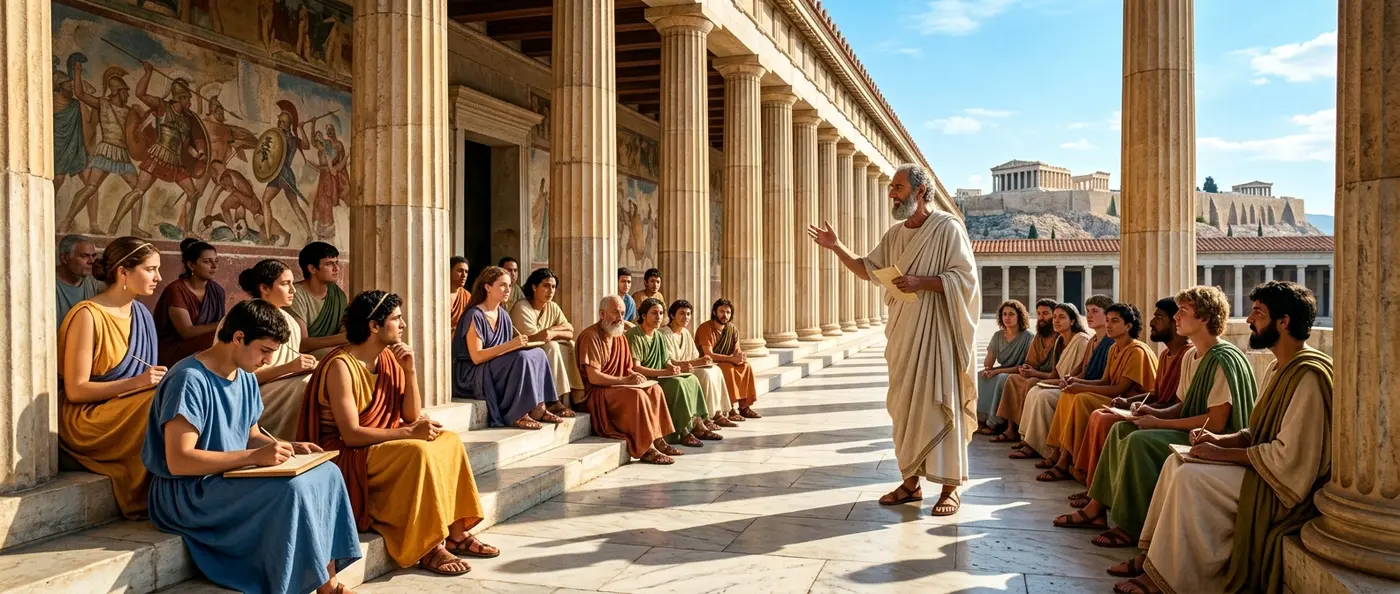
In the corridors of ancient Athens' Agora, a group of people engage in heated debate about what it means to live a good life. They're not politicians or merchants — they're philosophers following a revolutionary school of thought that would survive for millennia: Stoicism.
📖 Read more: Socrates, Plato & Aristotle: The Giants of Western Thought
Stoicism, born in Athens around 300 BCE, transformed how millions approach life's challenges. From ancient Greeks and Romans to modern psychologists and entrepreneurs, Stoic principles continue to guide millions in their search for meaningful and balanced lives.
🏛️ Birth in the Painted Porch
Zeno of Citium arrived in Athens as a merchant around 312 BCE. After a shipwreck cost him his fortune, he found refuge in philosophy. He attended lectures by various philosophers and eventually developed his own system of thought.
He began teaching at the Stoa Poikile, a public hall in the Athenian Agora decorated with painted murals. From this space, the new philosophical school took its name. Unlike other philosophers who taught in private gardens or gymnasiums, Zeno chose an open public space, making his philosophy accessible to all.
Core Principles
Virtue is the only true good. Wealth, health, fame — all are "indifferent" to happiness.
Life According to Nature
Live in accordance with nature and reason, accepting what you cannot control.
Apatheia
Not lack of emotion, but freedom from destructive passions through wisdom.
📖 Read more: Ancient Greek Education: Schools and Gymnasiums
⚔️ From Greece to Rome
Stoicism didn't remain confined to Athens. As Rome expanded and dominated the Mediterranean, Stoic philosophy found new ground. Panaetius of Rhodes, who lived in the 2nd century BCE, adapted Stoic teaching to the needs of Roman aristocracy.
The philosophy that once addressed Greek intellectuals now spoke to Roman generals and politicians. Posidonius of Apamea, in the 1st century BCE, taught that the wise man stands above the rest of humanity, observing their struggles like a spectator.
Cato the Younger embodied Roman Stoicism. When Julius Caesar won the civil war in 46 BCE, Cato chose suicide rather than live under tyranny. His act became a symbol of Stoic integrity and resistance.
🔱 The Three Pillars of Stoic Wisdom
Chrysippus, the third head of the Stoa after Zeno and Cleanthes, systematized Stoic philosophy into three parts: Logic, Physics, and Ethics. Each part was essential for understanding the world and living correctly.
Logic wasn't merely formal exercise. Chrysippus developed a new kind of logic, "propositional logic," only recently recognized as equally important as Aristotelian logic. For Stoics, clear thinking was the foundation of virtue.
Physics explained how the world works. Stoics believed in a cosmos governed by divine Reason — a rational order permeating everything. Humans can resist this order, but only to their detriment.
📖 Read more: Pythagoras: How Numbers Rewrote Philosophy
📜 The Revolutionary Ethics of the Stoics
The most radical element of Stoicism was its ethical teaching. While Romans chased gold and glory, Stoics dismissed both as worthless.
Only virtue has real value. Everything else — health or sickness, wealth or poverty, life or death — is "indifferent." This didn't mean they had no difference in daily life. Stoics distinguished between "preferred" (like health), "dispreferred" (like sickness), and "completely indifferent."
The distinction was subtle but crucial. A wise person would prefer health to sickness, but their happiness wouldn't depend on it. True well-being comes only from virtue — from living according to nature and reason.
💡 The Paradox of Stoic Freedom
For Stoics, the only truly free person is the wise one. Even if enslaved, they're freer than a tyrant ruled by their passions. True slavery is subjugation to our desires and fears.
🏺 Daily Practice of Stoicism
Stoics built their philosophy for daily use. They developed specific exercises for cultivating virtue. One was "premeditatio malorum" — mental preparation for potential difficulties. By imagining loss of property or health, Stoics prepared to face such situations with calm.
📖 Read more: Ancient Greek Astronomy: Mapping the Heavens
Another exercise was daily self-examination. Each evening, the Stoic would review the day's actions, examining where they acted correctly and where they didn't. This wasn't self-punishment but learning and improvement.
The "view from above" was a technique for gaining perspective. By imagining themselves viewing Earth from great height, Stoics realized how small the problems that seem enormous up close really are.
🗿 The Great Teachers and Their Legacy
After the Stoa's founders, new generations of philosophers developed and deepened the teaching. Epictetus, a former slave who became a philosopher, taught that "we're disturbed not by things but by our judgments about them." His distinction between what depends on us and what doesn't became fundamental to Stoic practice.
Marcus Aurelius, the philosopher-emperor, wrote his "Meditations" as personal notes for self-improvement. Despite enormous responsibilities as leader of the Roman Empire, he found in Stoicism a guide for ethical governance and personal integrity.
Seneca, advisor to Nero, combined Stoic philosophy with practical advice for daily life. His letters offer guidance on topics from managing anger to confronting death.
⚖️ Stoicism vs Other Philosophies
📖 Read more: Ancient Greek Pottery: Stories Written in Clay
🌅 Immortal Influence on the Modern World
Stoicism didn't die with Rome's fall. Its ideas influenced Christianity, the Renaissance, the Enlightenment. Today, cognitive-behavioral therapy uses Stoic principles to treat anxiety and depression.
In a world of uncertainty and constant change, the Stoic emphasis on controlling our reactions rather than external events remains extremely relevant. From CEOs to athletes, many find in Stoicism a practical guide for success and mental resilience.
Happiness comes from your decisions, not your bank account — a message that resonates in our material world. In an age of social media and constant comparisons, Stoic indifference to external approval is liberating.
Stoicism reminds us that while we can't control events, we can always control our response to them. This simple but profound truth is perhaps why a 2,300-year-old philosophy continues to speak to millions today.