📖 Read more: Roman Mosaics: Art That Survived 2,000 Years
🏛️ The Art of Roman Mosaics
Roman mosaics survive where paintings crumble. Craftsmen built them from thousands of tiny pieces — tesserae — cut from stone, glass, marble, or ceramic, set into layers of mortar. The technique started in Greece during the 5th century BC with simple pebble floors, evolved dramatically during the Hellenistic period, and reached its peak in Rome. Unlike paintings that fade with time, mosaics can survive centuries underground almost unchanged. That's exactly what makes them so valuable — and so vulnerable to looting.
The Roman Empire carpeted the Mediterranean with mosaics: villa floors, bath houses, temples, public buildings. From Britain to North Africa, from Syria to Spain, archaeologists uncover works that rival the finest museum pieces. North Africa — especially Libya — was one of the richest mosaic production centers. Cities like ancient Leptis Magna, Sabratha, Cyrene, and Arsinoe (modern Tocra) hosted hundreds of mosaic floors in private villas and public buildings.
The technique required precise engineering. First came a thick mortar layer over stone foundations — this prevented sinking and cracks. Two more mortar layers followed, finer ones, with marble dust and crushed tile as binding agents. In the final layer, craftsmen placed tesserae one by one, following patterns sketched directly into the mortar. The most spectacular mosaics belonged to the opus vermiculatum category — microscopic tesserae, sometimes smaller than 2 millimeters, creating details sharp enough to show individual eyelashes.
⚠️ The Looting of Ancient Heritage
Antiquities looting isn't modern — it started in antiquity itself. Romans looted Greek statues, Crusaders removed Byzantine mosaics. After World War II, art trafficking became a business. Mosaics, because of their visual impact, relative portability (once removed in sections), and massive demand in the art market, became prime targets.
Libya suffered particularly. Political instability after 2011 created a security vacuum at hundreds of archaeological sites. Illegal diggers excavated mosaics, cut out the most spectacular sections — central panels with mythological scenes, portraits, marine themes — and sold them to trafficking networks. The pieces traveled from Libya to Egypt or Tunisia, then to free trade zones, finally ending up in European galleries or private collections. Losing the mosaic was bad enough. Losing the information about where it came from was worse.
The ancient city of Arsinoe (modern Tocra in eastern Libya) was one such target. Founded as a Greek colony (Teucheira) in the 7th century BC and renamed Arsinoe during the Ptolemaic period in honor of Queen Arsinoe II, the city acquired rich villas with mosaic floors of exceptional artistry during Roman times. Many vanished after the unrest.
The typical route of an illegal mosaic follows a pattern: first the excavation — often at night, with hand tools, without any documentation. Illegal diggers cut tesserae into sections, place them on boards or fabric, transport them to safe locations. Transfer happens through borders with lax controls — ports, desert crossings, free trade zones in the UAE or Geneva. Along the route, fake provenance certificates appear — false documents claiming the object comes from an "old private collection" or was legally exported decades ago.
💡 The 1970 UNESCO Convention
The Convention on the Means of Prohibiting and Preventing the Illicit Import, Export and Transfer of Ownership of Cultural Property (1970) forms the basis of every modern repatriation effort. The convention establishes that cultural property belongs to the country of origin and that illegal export constitutes theft. 143 countries have signed — but enforcement remains a challenge.
🔍 Journey of a Stolen Mosaic
At the end of the chain sit the buyers: museums, private collectors, major auction houses. The price of a spectacular Roman mosaic can reach hundreds of thousands or millions of dollars. The illegal digger receives a fraction — perhaps a few hundred dollars. Middlemen keep most of the profit. This inequality explains why looting continues: poverty in source countries and wealth in destination countries create a self-feeding system.
Sometimes the answer lies in science. Geochemical analysis of tesserae can show the origin of the stone. Satellite photos before and after looting show holes in the ground. Old archaeological records — even 19th-century sketches — can match stolen pieces. The online Art Loss Register maintains a global database of stolen objects, enabling cross-checking during auctions.
In the US, the Manhattan District Attorney's office has emerged as a pioneer in recovering stolen antiquities. Specialized police units identify suspicious objects in galleries and auctions, cooperate with Interpol, Carabinieri (Italy), and archaeological services from source countries. When repatriation succeeds, it becomes ceremony: officials, journalists, emotion. But behind every success hide hundreds of cases that never get solved.
Recognition
Archaeologists spot stolen mosaics at auctions or museums. They compare photos, patterns, and materials with field records. The Art Loss Register database helps with cross-referencing.
Legal Action
The source country files a repatriation request. Court proceedings or diplomatic negotiations follow. Critical: proving the export was illegal after the 1970 Convention.
Return
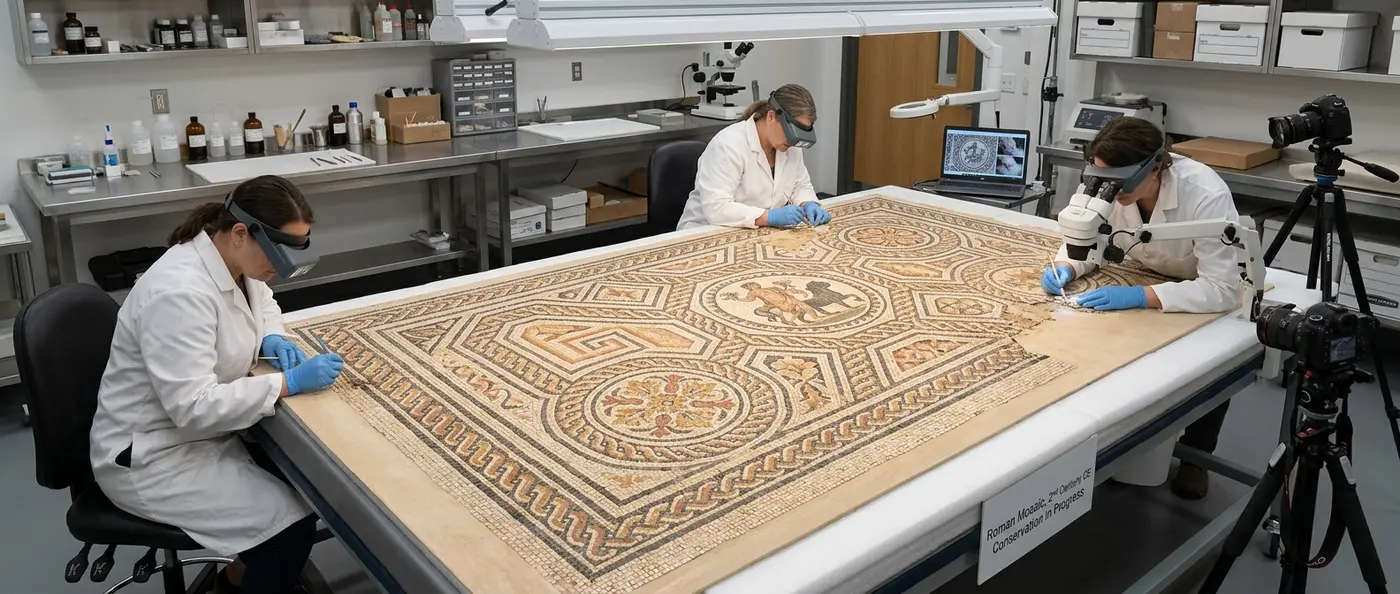
After months or years, the object is handed over. Usually requires special transport and conservation. Many mosaics arrive damaged from their removal method.
⚖️ The Battle of Repatriation
Repatriating stolen antiquities doesn't happen automatically. It requires evidence, legal action, diplomatic pressure. The source country must prove the object was illegally removed after the 1970 Convention — if looting happened before, the legal basis is weaker. The practical difficulty: how do you prove a mosaic comes from a specific floor, in a specific villa, in a specific city — without photos or excavation records?
Recent years have seen significant victories for the international community. Italy recovered dozens of antiquities from American museums after prosecuting trafficker Giacomo Medici, who moved thousands of ancient artifacts through Swiss warehouses. The "Medici dossier" revealed photos of objects dirty with soil — snapshots immediately after illegal excavation — and the same objects cleaned up, making the connection undeniable.
Greece won repatriation of antiquities from the Getty Museum, New York, Germany. Turkey pressured the Metropolitan Museum over the "Lydian Hoard" and the British Museum over archaeological finds. Libya, after years of negotiations, managed to recover Roman mosaics and statues stolen during the instability — some found in warehouses in Italy, France, or Britain.
Most stolen pieces never come home. For every object returned, hundreds remain in private collections, invisible to the public. UNESCO estimates the illegal antiquities market is worth billions of dollars annually — an industry thriving in darkness. Online markets make control even harder: objects sell anonymously, with fake provenance, without possibility of verification.
⚖️ Legal Excavation vs Illegal Digging
🌍 Why Context Matters More Than the Object
Losing the mosaic hurts. Losing its story hurts more. A mosaic inside an ancient villa isn't just decoration. Its position shows the room's use (dining room, reception, bath). The patterns declare the owner's interests, wealth, religious beliefs. The technique can identify workshops, trade networks, dating. The relationship with surrounding objects — coins, vessels, inscriptions — gives a rich historical narrative.
When the illegal digger cuts the mosaic from the floor, all this information is lost irretrievably. Even if the mosaic is repatriated, it can never be "repositioned" in its original context. We no longer know which room it was in, what other mosaics existed nearby, what burial goods might have been underneath. Archaeologist Colin Renfrew called this process "criminal destruction of knowledge" — looting removes a piece from a puzzle that will never be completed.
💡 Technology's Role in Fighting Back
High-resolution satellite images show holes at archaeological sites — undeniable signs of illegal digging. AI databases cross-reference photos of objects from auctions with records of stolen finds. Isotopic analysis of stones proves the geographical origin of tesserae. Technology can track the thieves. Politicians must choose to act.
🏛️ What a Mosaic's Return Really Means
When a stolen mosaic comes home, it sends a message: heritage has no price. That owning an ancient artwork carries moral weight — especially when removed by force, during war or chaos. Every repatriation creates precedent and strengthens the message that art trafficking doesn't pay long-term.
For Libya, Syria, Iraq, Greece — every country that suffered looting — the return of mosaics, statues, and ceramics represents dignity. But the real victory isn't in repatriation. It's in prevention — in guarding sites, funding archaeological services, legislation that punishes buyers equally with thieves. In recognizing that a mosaic on the floor of an ancient villa is worth incomparably more than a mosaic on the wall of a wealthy salon.
The craftsmen who set these stones 1,800 years ago built them to last forever in one place. Now their work gets smuggled in shipping crates, sold to the highest bidder, mounted on foreign walls. They deserved better. So do we.