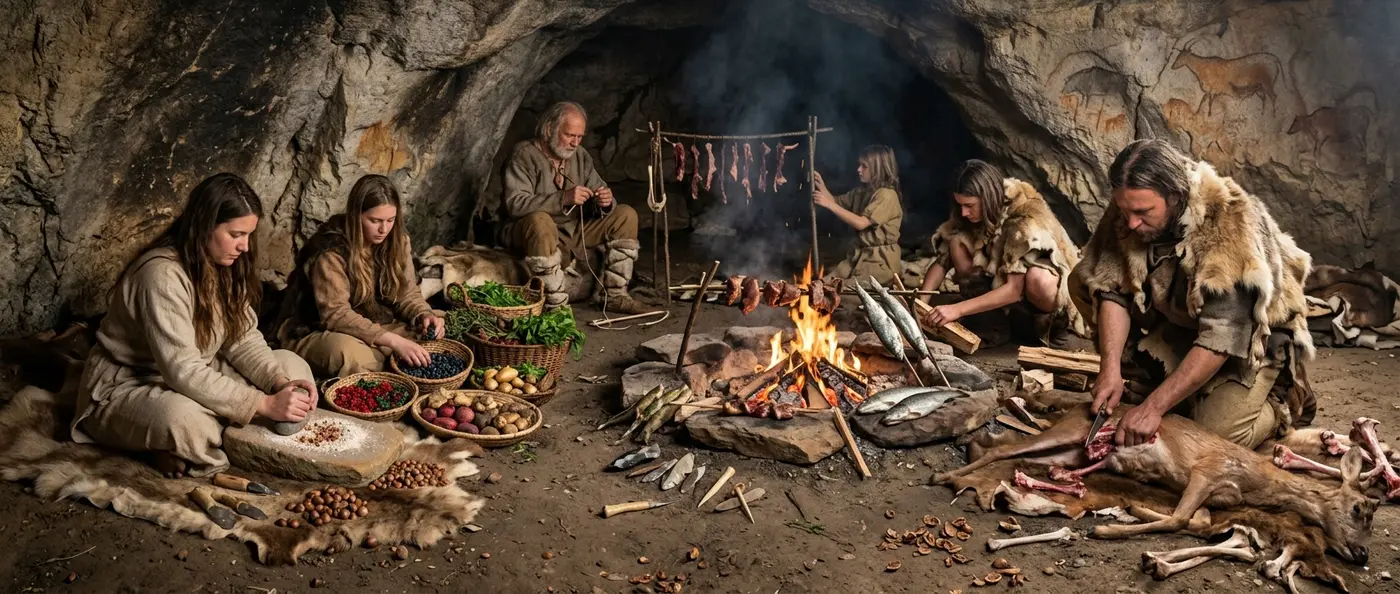
Forget everything you think you know about the "caveman diet." Fresh archaeological discoveries across Europe reveal that our prehistoric ancestors ate a far more diverse and complex menu than we ever imagined. The Paleolithic menu makes today's "paleo" diet look like a pampered millionaire's fantasy.
🍖 The Real Paleolithic Diet
The Paleolithic era kicked off roughly 2.5 million years ago when our earliest ancestors started chipping stone tools. Humans back then were lucky to live past twenty-five. They ate whatever they could find. Depending on who they were and where they lived, that meant anything from grubs and stinging nettles to armadillos and wild beasts.
The modern "paleo diet" pushed since the 1970s suggests eating only meat, fish, fruits, vegetables, eggs, and nuts. Grains, dairy, legumes, and processed foods are forbidden. Problem is, what modern paleo promotes bears almost no resemblance to what prehistoric humans actually ate.
Most of what the real "Flintstones" consumed simply doesn't exist today. Modern chickens, cows, sheep, and goats are fatter, calmer, and genetically different from their wild ancestors. Prehistoric fruits, while often smaller and more sour than modern varieties, were recognizable as fruits. Apples, grapes, figs, plums, and pears had been tempting mammals for tens, if not hundreds of thousands of years.
🥕 Vegetables You Wouldn't Recognize
Paleolithic vegetables tell a different story entirely. Ancient tomatoes were the size of berries. Potatoes weren't bigger than peanuts. Corn was a wild grass with hard seeds in clusters small as pencil erasers. Cucumbers were spiny like sea urchins. Lettuce was bitter and thorny.
Peas were so starchy and flavorless they had to be roasted like chestnuts and peeled before eating. The only available cabbage — the great-great-grandfather of today's kale, cauliflower, broccoli, and Brussels sprouts — was sea kale, a tough leafy weed that grew along temperate coastlines. Carrots were scrawny. Beans contained natural cyanide.
Today's salad bar vegetables are newcomers. They didn't really start developing until the Neolithic period, the civilized end of the Stone Age, generally said to have begun about 10,000 years ago. The Neolithic is when we abandoned the carefree, nomadic lifestyle of the hunter-gatherer and started settling down on farms and in villages.
Pottery was invented. Animals were domesticated. We began worrying about drought, weeds, and locusts, and somewhere in there, almost certainly, we invented the prehistoric words for "back pain," "blister," and "drudgery."
Stone Age Genetic Engineering
Through painstaking selection and cultivation, Neolithic farmers — the world's first and most patient genetic engineers — produced over the next centuries the fat, rich, and tasty vegetable varieties we know today.
From Wild to Wonderful
The descendants of these early crops are still on our plates today. Humans, collectively, have done many great things, but perhaps the greatest and earliest of our achievements was that of a scattering of prehistoric humans armed with stone hoes and digging sticks.
🏹 Hunter-Gatherers: A Lost Way of Life
Hunter-gatherers lived across Europe for thousands of years and were the dominant human presence in the region for most of that time. Researchers don't yet know the exact set of circumstances that led Europe's hunter-gatherers to disappear, but their decline generally coincided with the spread of agriculture in the region.
Neolithic farmers arrived in Europe about 8,000 years ago and eventually replaced the hunter-gatherers after a period of coexistence on the continent. According to Cosimo Posth, professor of archaeo- and paleogenetics at the University of Tübingen in Germany, "Farmers started to invade Europe from the Near East, bringing domesticated animals and domesticated plants, and then there is coexistence of farmers and hunter-gatherers until 5,000 years ago, when the hunter-gatherers disappear."
💡 Genetic Legacy
Modern Europeans owe about 10% to 15% of their DNA to European hunter-gatherers, most of which comes from the last wave of hunter-gatherers that spread from Italy about 14,000 years ago.
🗺️ The Transition and Conflicts
Europe's hunter-gatherers weren't a single entity but a series of different human populations and cultures that survived by hunting animals and foraging for wild food. They came to Europe in waves and began settling the continent about 45,000 years ago.
As agriculture spread across Europe, hunter-gatherers lost ground. "The last hunter-gatherers moved to the periphery of Europe, to areas where they were not in direct competition with farmers," Posth explains.
There's still much unknown about how the two groups interacted with each other. Some hunter-gatherers ended up living within or around farming communities. For example, the burial of a roughly 5,800-year-old hunter-gatherer in what is now Denmark, known as Dragsholm Man, shows he was buried with hunter-gatherer objects but had a diet that matched that of early European farmers.
A 2024 study published in the journal PLOS One found that a farming community in Denmark violently sacrificed a male hunter-gatherer from Norway or Sweden about 5,200 years ago. The ritual sacrifice wasn't necessarily punishment for the hunter-gatherer, and he may have been a migrant or trader who gained equal social status among the farmers, or he may have been a captive or slave.
Some hunter-gatherer communities likely suffered violent deaths at the hands of farmers and received new pathogens from their animals. For instance, hunter-gatherers in Denmark disappeared quickly just a few generations after farmers arrived about 5,900 years ago.
🏛️ Hunter-Gatherers vs Farmers
🦴 Archaeological Evidence of Diet
Archaeologists have discovered rare fossils that reveal details about prehistoric humans' diets. One striking example is the fossilized remains of a prehistoric sea cow discovered in northern Venezuela. The skeleton, dating to the Early to Middle Miocene epoch (23 million to 11.6 million years ago), shows the animal was likely killed by an ancient crocodile and then devoured by a tiger shark.
The food chain today works much like it did millions of years ago — dead animals feed other animals. As Aldo Benites-Palomino from the University of Zurich notes: "Today, often when we observe a predator in nature, we find the prey's carcass that proves its function as a food source for other animals as well. But the fossil record of this is rarer."
🌿 The Legacy of Prehistoric Diet
Switching from hunting and gathering to farming changed human history. Thanks to Neolithic farmers and their patient work over centuries, nobody needs to eat a Paleolithic diet anymore.
And that's good. Because the real prehistoric diet wasn't romantic or healthy like modern "paleo-diet" advocates present it. It was a daily battle for survival, with limited choices, high risk of starvation, and a lifespan that rarely exceeded 25 years.