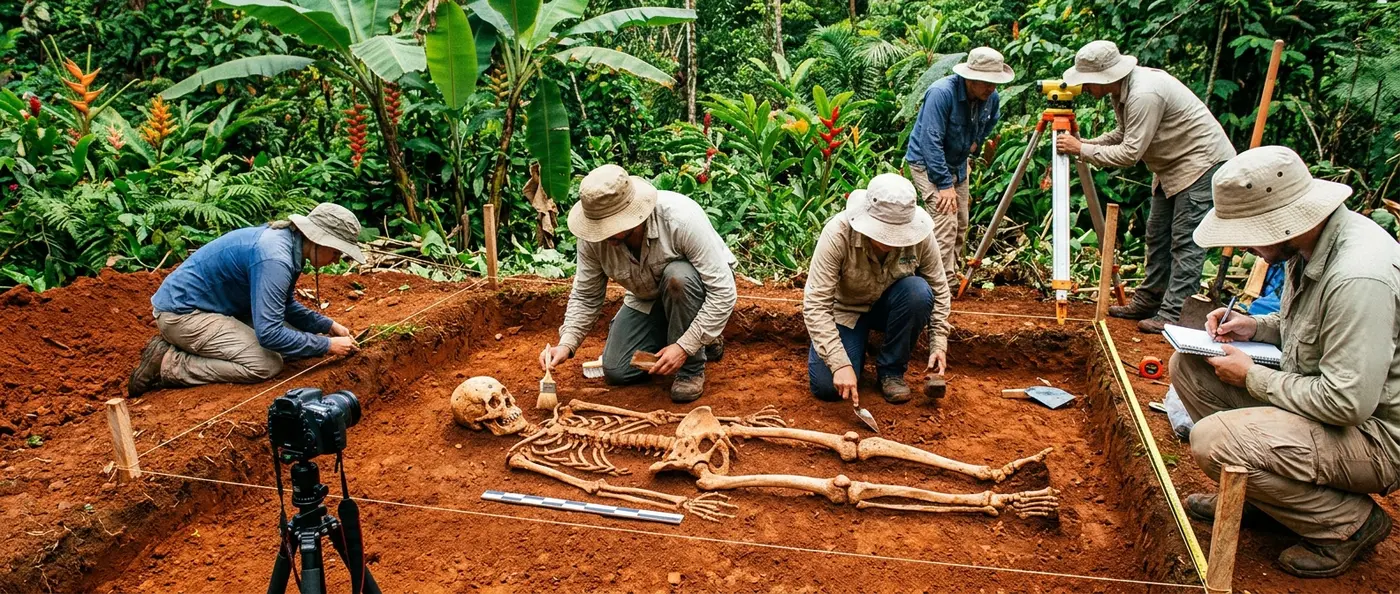
Bones don't lie. When researchers pulled 600-year-old skeletons from burial sites across Central and South America, they found something that rewrites medical history. Telltale lesions on skulls and long bones proved syphilis was already ravaging populations in the New World centuries before Columbus set foot in the Caribbean. The discovery demolishes the long-held belief that European sailors brought the disease back from the Americas.
📖 Read more: Ancient Egyptian Medicine: Surgeons 4,000 Years Ago
🦠 When Two Worlds Collided
The Columbian Exchange — historian Alfred W. Crosby's term for the biological upheaval after 1492 — was the largest reshuffling of life on Earth since the continents split apart. When European ships bridged the Atlantic, they didn't just carry gold and spices. They carried death.
Native Americans had been isolated from the disease pool that had been brewing in Europe, Asia, and Africa for millennia. Smallpox. Measles. Influenza. Mumps. Typhus. Whooping cough. In Europe, these had evolved into childhood killers that claimed one-quarter to half of all children before age six. Survivors carried lifelong immunity.
The Americas had no such preparation. When these diseases hit, entire civilizations crumbled. In the Caribbean, native populations dropped by over 99% by 1600. Across the Americas, 50% to 95% of indigenous people died by 1650. It wasn't conquest that emptied the New World — it was microbes.
💉 The Syphilis Mystery
For decades, syphilis seemed like the Americas' revenge. The story went like this: Columbus's sailors contracted the disease in the Caribbean and carried it back to Europe, where it exploded across the continent in the 1490s. Europe gave the New World smallpox and measles. The New World gave Europe syphilis. Biological tit for tat.
The timeline seemed perfect. The first recorded syphilis outbreak in Europe erupted in Naples in 1495, just three years after Columbus returned. The disease spread like wildfire, causing panic and thousands of deaths. European physicians described a horrifying new plague that created festering sores and grotesque deformities.
But perfect timelines can deceive. New archaeological evidence is tearing apart this neat narrative, bone by bone.
🔬 Bones Tell a Different Story
Archaeologists and paleopathologists have been digging deeper — literally. Skeletal remains from Peru, Mexico, and Chile tell a story that predates European contact by centuries. The evidence is unmistakable: crater-like lesions on skulls, thickened and deformed long bones, characteristic changes to nasal passages and palates.
Radiocarbon dating places these infected skeletons between 1000 and 1400 CE — at least a century before Europeans arrived. The disease wasn't imported from the Old World. It was already endemic in the New World, evolving and adapting to local populations for generations.
🗿 Why This Matters
The timing explains syphilis's devastating impact on Europe — populations there had zero immunity to a disease that had been evolving in the Americas for centuries. The New World wasn't giving Europe a new disease. It was unleashing a perfected killer.
🌎 The Great Biological Remix
Disease was just one part of the Columbian Exchange. The biological revolution transformed ecosystems on both sides of the Atlantic. Horses, pigs, cattle, goats, and sheep thrived in American environments. Horses revolutionized life for Plains tribes. The Navajo became master sheep herders. Cattle and horses multiplied explosively across the Pampas and Great Plains.
📖 Read more: Did Preeclampsia Kill Off the Neanderthals?
Plants crossed oceans too. Potatoes from the Andes fed European populations and enabled demographic explosions. Corn from Mexico became a staple crop in Africa. Tomatoes from South America transformed Italian cuisine. Sugar from the Old World created plantation economies that reshaped the New World's social structure.
Horses
Transformed transportation and warfare. Plains tribes became master riders and buffalo hunters within generations.
Plants
Potatoes, corn, and tomatoes from America. Wheat, sugar, and coffee from Europe and Africa reshaped global diets.
Microbes
Smallpox, measles, and flu devastated America. Syphilis and possibly tuberculosis struck back at Europe.
🏺 Reading Disease in Ancient Bones
Identifying syphilis in ancient skeletons requires specialized expertise and advanced techniques. Paleopathologists hunt for specific lesions characteristic of tertiary syphilis: crater-like holes in skulls, thickening and deformation of long bones, distinctive changes to nasal structures and palates.
Modern technology sharpens the analysis. CT scans and MRI can reveal details invisible to the naked eye. DNA analysis from ancient bones could theoretically detect traces of Treponema pallidum, the bacterium that causes syphilis — though genetic material degrades rapidly over centuries.
Researchers examined dozens of skeletons from multiple archaeological sites. Each case was documented with photographs, X-rays, and microscopic analysis. The consistency of findings across different locations strengthens the hypothesis that syphilis was endemic in pre-Columbian America.
⚔️ Disease and Ancient Civilizations
Syphilis in pre-Columbian America had a different impact than its later devastation of Europe. Unlike its devastating effect on 16th-century Europe, American populations seemed to have developed some degree of immunity or at least learned to live with the disease.
This doesn't mean syphilis was harmless. Skeletal evidence shows many people suffered severe complications. But society didn't collapse the way it did with diseases introduced after 1492. The difference was time — centuries to adapt versus sudden exposure.
🦠 Disease Impact: Americas vs Europe
📜 Written Records and Silent Bones
The first written accounts of syphilis in Europe appear suddenly in the late 15th century. Italian physicians described a new and terrifying disease causing hideous sores and deformities. The speed of spread and severity of symptoms suggest something completely novel to European populations.
Pre-Columbian sources from the Americas are limited. Most civilizations lacked written language in the European sense. However, Maya and Aztec codices contain illustrations that some researchers interpret as references to diseases with syphilis-like symptoms.
📖 Read more: Pre-Inca Parrot Feathers: Death's Rainbow Ornaments
The scarcity of written sources makes archaeological evidence even more valuable. Bones don't lie — the pathological changes caused by syphilis are distinctive and recognizable even after centuries.
🔍 Modern Research and Future Directions
Research into syphilis origins continues with undiminished intensity. New technologies like paleogenomics promise even more definitive answers. If scientists can extract and analyze bacterial DNA from ancient bones, they could map the evolutionary history of the disease with unprecedented precision.
Meanwhile, reexamination of museum collections with modern methods continues revealing new evidence. Skeletons collected decades ago and never carefully examined for signs of syphilis now yield valuable information.
Interdisciplinary collaboration is key. Archaeologists, anthropologists, paleopathologists, microbiologists, and historians work together to assemble a more complete puzzle. Each new finding clarifies the origins and spread of human diseases.
🌍 The Exchange's Lasting Legacy
Five centuries later, the Columbian Exchange continues shaping our world. The foods we eat, the animals we raise, even the diseases we face — all have roots in this great biological mixing.
The story of syphilis reminds us that diseases know no borders. In a connected world, a microbe can travel from one end of the planet to the other in days or weeks. The COVID-19 pandemic is just the latest example of this eternal truth.
As globalization accelerates the movement of humans, animals, and products, the Columbian Exchange provides crucial historical context for modern disease emergence.
🔬 Future Challenges
Climate change and ecosystem destruction create new opportunities for diseases to jump from animals to humans. The history of the Columbian Exchange teaches us that such transitions can have catastrophic consequences for populations without immunity.
Ultimately, the story of syphilis and the Columbian Exchange is a story about human interconnectedness. It shows how events in one corner of the world can have unpredictable and long-lasting effects everywhere. It's a reminder that history isn't just a series of isolated events, but a complex web of interactions that continues weaving itself today.