📖 Read more: 10 Hidden Secrets of the Athenian Acropolis You Never Knew
🏛️ The Sacred Promontory at Attica's Edge
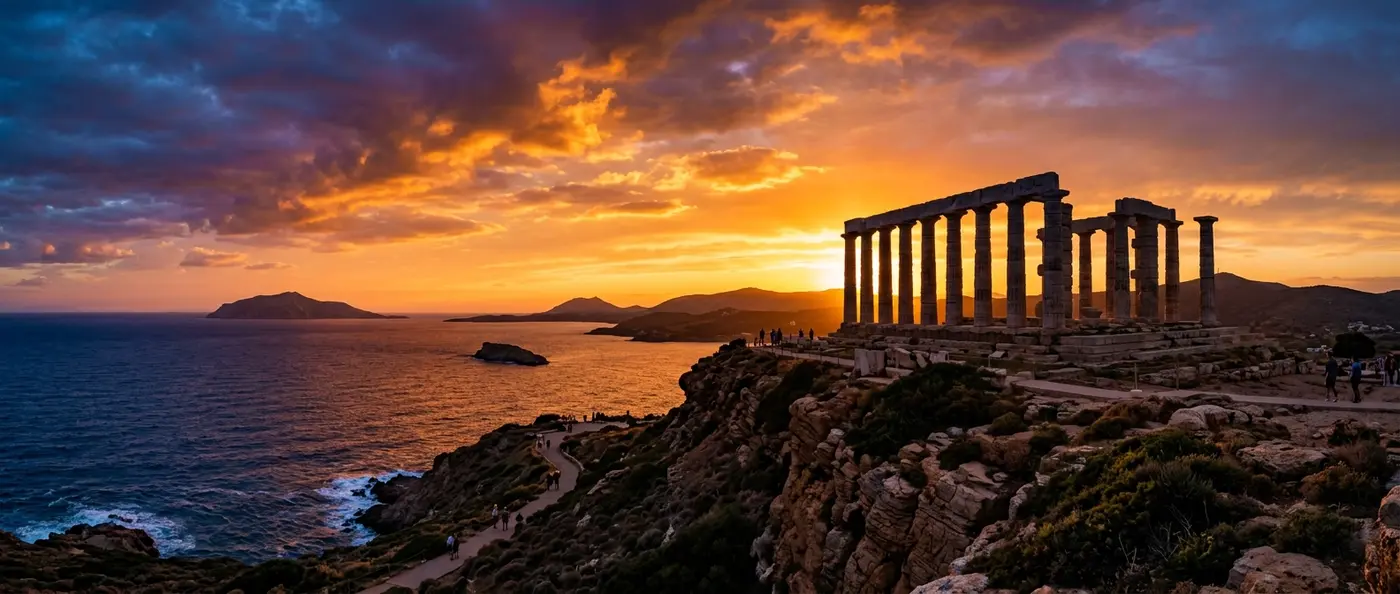
Cape Sounion juts from the southernmost tip of Attica, roughly 70 kilometers southeast of Athens. Its strategic position at the entrance to the Saronic Gulf made it the perfect spot for a sanctuary dedicated to the god of the sea. Ancient sailors entering or leaving the gulf could spot the temple from miles away — a landmark visible to sailors navigating the treacherous entrance.
People lived here since Mycenaean times, but the first shrine dates to the 7th century BC. The temple we see today rose during Athens' golden age under Pericles, built between 444-440 BC. Its construction coincided with Athenian naval supremacy and the urgent need to honor their maritime protector.
Sounion wasn't just a religious center. It doubled as a fortress guarding the grain ships that carried wheat from the Black Sea to Athens. The walls surrounding the sanctuary and harbor went up during the Peloponnesian War, turning the sacred cape into a fortified base during Athens' desperate war.
⚓ Architecture That Defies Time
The Temple of Poseidon follows the Doric order and bears striking similarities to the Temple of Hephaestus in Athens' Ancient Agora. Many scholars believe the same architect designed both. Originally, 34 columns of local Agrileza marble surrounded the temple. Today, 15 survive the centuries.
Each column stands roughly 6 meters tall with a base diameter of 1 meter. What sets Sounion's columns apart is their 16 flutes instead of the standard 20 found in Doric temples. This modification helped the marble resist the salt spray that corrodes stone along this exposed coastline.
The temple's inner chamber, the cella, once housed Poseidon's cult statue. Unfortunately, no depiction or description of this statue survives. A colonnade once surrounded the temple to shelter worshippers from the elements, but only its foundations remain visible today.
📖 Read more: Trojan War: What Archaeology Really Reveals
🔱 Worship and Sacred Rituals
Poseidon, brother to Zeus and Hades, ruled the seas in Greek mythology. For ancient Athenians who depended on maritime trade for survival, earning Poseidon's favor was literally a matter of life and death. At Sounion, regular sacrifices and offerings ensured safe voyages across treacherous waters.
Sailors passing the cape routinely threw offerings into the sea or left votive gifts at the sanctuary. Every four years, a grand festival honored Poseidon with games and sacrifices. Young men from Athens arrived by ship to participate in the ceremonies where Athens displayed its wealth and naval power.
Poseidon wasn't the only deity worshipped here. Athena also received honors at Sounion. Just north of Poseidon's temple lie the ruins of a smaller shrine dedicated to Athena Sounias. Both gods received worship here because Sounion served as sanctuary and fortress.
Maritime Offerings
Sailors left votive gifts like miniature ships, anchors, and oars to thank the god for safe returns or request protection for upcoming voyages across dangerous seas.
Sacred Sacrifices
Bulls and other animals were sacrificed at the altar before the temple. The meat was shared among worshippers in communal feasts that strengthened social bonds.
Athletic Contests
During the Souneia, Poseidon's great festival, naval races and foot races drew young competitors from across Attica to demonstrate their prowess.
🗺️ Strategic Position and Fortifications
Sounion's geography made it a crucial chokepoint for controlling Aegean shipping. From here, observers could monitor vessels heading to or from Piraeus. During the Peloponnesian War (431-404 BC), Athens fortified the cape with massive walls that still partially stand today.
📖 Read more: Knossos: Did the Minotaur's Labyrinth Really Exist?
These walls enclosed not just the sanctuary but also a small harbor on the cape's northern side. Warships anchored there to protect merchant vessels from pirates who prowled the shipping lanes. The fortress included towers, gates, and storerooms for supplies during extended sieges.
After Athens' defeat in the Peloponnesian War, Sounion's military importance gradually faded. But the sanctuary continued operating for centuries. During Roman times, Sounion became a popular destination for wealthy Romans eager to admire monuments from Greece's glorious past.
💡 Did You Know?
The famous English poet Lord Byron visited Sounion in 1810 and carved his name into one of the temple's columns. His signature remains visible today, though such an act would be considered vandalism by modern standards!
🌅 Sounion in Mythology and Literature
Cape Sounion connects to one of Greek mythology's most tragic tales. According to legend, King Aegeus stood daily on the promontory waiting for his son Theseus to return from Crete. When he saw the ship with black sails — Theseus had forgotten to change them to white as agreed to signal his success — he believed his son was dead and threw himself into the sea. The sea has been called the Aegean ever since.
Homer mentions "sacred Sounion" in the Odyssey when describing Menelaus's journey from Troy. Centuries later, the temple inspired countless poets and writers. Byron wrote about Sounion in "The Isles of Greece," praising the landscape's beauty and the melancholy of its ruins.
In modern times, Sounion remains a symbol of ancient Greek civilization. Thousands of visitors arrive yearly to watch the sunset from the temple — an experience that combines natural beauty with historical memory. The ruins have served as backdrops in films and advertisements, spreading the temple's image worldwide.
📖 Read more: Minoan Bull-Leaping: Death-Defying Ritual
🔬 Modern Research and Conservation
Archaeological investigations at Sounion began systematically in the 19th century. Early excavations revealed the temple's foundations, sections of the precinct wall, and numerous votive offerings. Significant finds include inscriptions, kouros statues, and pottery spanning from the Archaic to Roman periods.
Recent years have seen intensified conservation efforts by the Greek Archaeological Service. The columns have been reinforced using specialized techniques to withstand earthquakes and erosion. Work has also improved visitor access while protecting the site from damage caused by mass tourism.
Archaeologists now use 3D scanning to map every crack and weathering pattern in the marble. Through virtual reality, visitors can now see how the temple looked in its original form, complete with sculptures, colors, and decorative elements that time has erased.
⚔️ Comparison with Other Poseidon Temples
🏺 Sounion's Enduring Legacy
The Temple of Poseidon at Sounion represents more than an archaeological monument. It's a place where history, mythology, and nature converge in unique harmony. For ancient Greeks, it was sacred ground for communicating with the gods and a symbol of their naval power.
Today, the marble columns that defy time remind us of human creativity's power and civilization's endurance. Each sunset that paints the ancient marble in golden hues creates a bridge connecting past and present, ancient sailors with modern visitors.
Sounion lives on in collective memory not just as an archaeological site but as a symbol of humanity's eternal relationship with the sea. As long as its columns continue standing proud above the waves, the site's story will continue inspiring and moving all who encounter it.