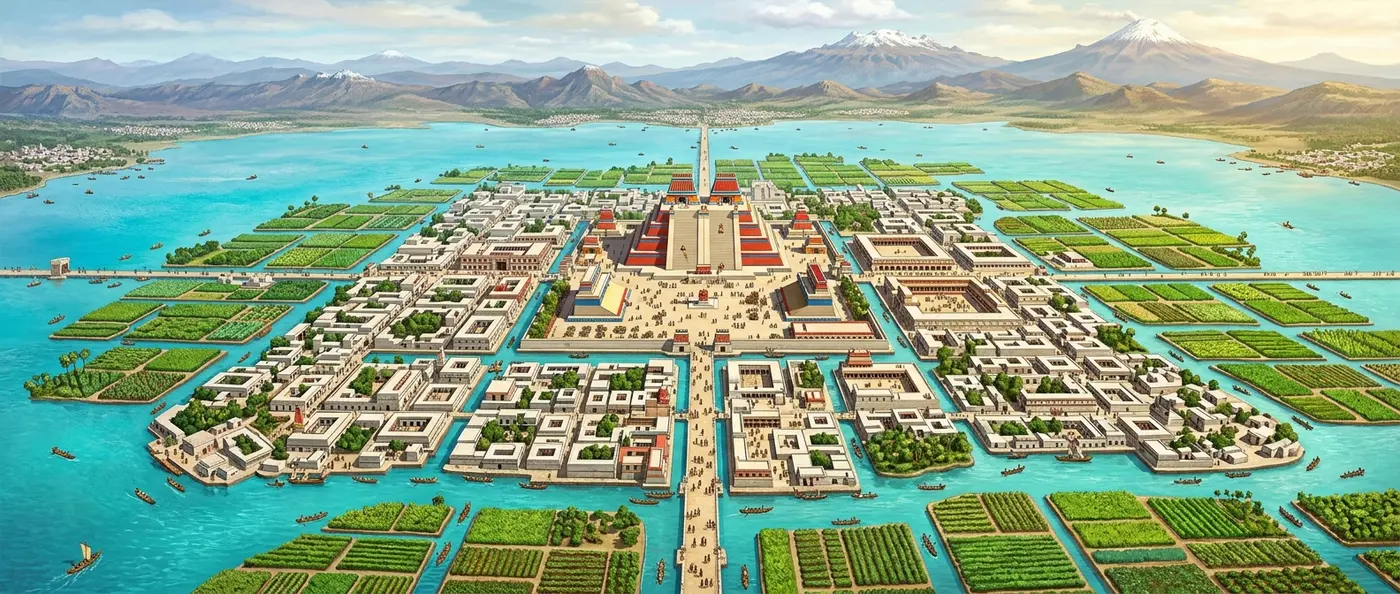
Picture a city floating on a lake. Canals instead of streets. Gardens growing on water. This wasn't fantasy — this was Tenochtitlan, the legendary Aztec capital that left Spanish conquistadors speechless when they first glimpsed it in 1519. A metropolis larger than any European city, built entirely on an island in the middle of a saltwater lake.
📖 Read more: Maya Collapse: Why an Entire Civilization Vanished
🏛️ Birth of the Floating City
The story starts in 1325 CE with a prophecy. The Mexica (as the Aztecs called themselves) had wandered for centuries, searching for their promised land. Their god Huitzilopochtli had given them a sign: they would find home where an eagle perched on a cactus, devouring a snake.
That sign appeared on a tiny island in Lake Texcoco. Terrible location for a city. No building materials. No farmland. Hostile tribes on every shore. The Mexica built anyway.
What happened next rewrote the rules of urban planning. In less than two centuries, that rocky outcrop became a 13.5-square-kilometer metropolis. Aztec engineers expanded the island using chinampas — artificial islands created with reed mats filled with lake-bottom mud. They didn't just adapt to the water. They made it work for them.
🌊 Engineering Marvel on Water
Tenochtitlan wasn't built near water — it was built with water. Three massive causeways connected the island to the mainland. A complex network of canals let thousands of canoes ferry people and goods throughout the city. Venice had nothing on this.
The water supply system was genius. Lake Texcoco was salty and undrinkable, so the Aztecs built a dual aqueduct system stretching 5 kilometers from the Chapultepec springs. Two parallel channels meant one could be cleaned while the other kept flowing. No interruptions to the water supply.
Flood control came via a massive 16-kilometer dike that separated fresh water from salt. This barrier, known as Nezahualcoyotl's dike, kept the city safe from floods for nearly a century. When it worked, it worked perfectly.
🏺 Heart of an Empire
The Sacred Precinct dominated downtown Tenochtitlan — 4 hectares of temples and ceremonial buildings. The centerpiece was Templo Mayor, a 60-meter-tall double pyramid dedicated to the gods Tlaloc and Huitzilopochtli. Seventy-eight other temples surrounded it.
Moctezuma II's palace was an architectural wonder spanning hundreds of rooms. Council chambers, workshops, storerooms, and even a zoo. Spanish conquistadors described gardens filled with rare plants from across the empire. The palace alone covered more ground than most European cities.
The city was organized into four major districts (campan), each with its own temple and market. These subdivided into smaller neighborhoods (calpulli) that functioned as autonomous communities. Schools, temples, administrative centers — each neighborhood was a city within the city.
Templo Mayor
The 60-meter double pyramid at the city's heart, where the empire's most important religious ceremonies took place.
Moctezuma's Palace
Massive complex with hundreds of rooms, gardens, a zoo, and art collections from across Mesoamerica.
Tlatelolco Market
The largest market in the Americas, where thousands of merchants sold goods from throughout the empire.
🌾 Floating Gardens Feed a Metropolis
The chinampa system was revolutionary agriculture. These "floating gardens" (actually anchored to the lake bottom) produced corn, beans, squash, tomatoes, and chili peppers. Seven harvests per year. The productivity was insane.
Canals between chinampas allowed canoe traffic and provided irrigation water. Trees planted along the edges stabilized the soil with their roots. The system was so efficient that Tenochtitlan fed its massive population without importing food.
The lake provided more than just farmland. Fish, ducks, frogs, and algae supplemented the diet. Spirulina, a protein-rich algae, was harvested from the lake surface and eaten as cakes. Nothing went to waste.
⚔️ Military and Commercial Powerhouse
Tenochtitlan was the nerve center of a vast empire. Military campaigns launched from here extended Aztec control from the Atlantic to the Pacific. The city collected tribute from hundreds of subject cities.
The Tlatelolco market was the largest in the Americas. Spanish observers counted 60,000 daily visitors. You could find everything: gold and precious stones, quetzal feathers, cacao, cotton, slaves. Trade operated through a complex barter system using cacao beans as currency.
The pochteca — professional merchants — traveled throughout Mesoamerica bringing exotic goods. They also served as spies, gathering intelligence on potential conquest targets. Tenochtitlan's economic power rested on both trade and tribute from conquered peoples.
💡 Did You Know?
Tenochtitlan had one of the world's first public sanitation systems. Thousands of workers cleaned the streets and canals daily, while waste was collected and used as fertilizer for the chinampas.
🏰 Social Structure and Daily Life
Aztec society was strictly hierarchical but allowed social mobility. At the top sat the huey tlatoani (great speaker), the absolute ruler. Below came nobles (pipiltin), priests, warriors, merchants, artisans, and farmers. Slaves occupied the bottom rung, though slavery wasn't hereditary.
Education was mandatory for all children. Noble boys attended the calmecac where they learned writing, astronomy, religion, and military arts. Commoner children went to the telpochcalli for basic training in warfare and crafts. Girls learned domestic arts, weaving, and religious duties.
Daily life began before sunrise. Most residents lived in single-story adobe houses with interior courtyards. Breakfast typically consisted of atole (corn gruel), while the main meal came at midday. The diet included corn, beans, squash, chili, tomatoes, and occasional meat from turkey, duck, or dog.
🎭 Art, Science, and Religion
The Aztecs were master artists and craftsmen. Their stone sculptures, particularly monumental depictions of gods and rulers, still impress today. Their featherwork — creating intricate mosaics from tropical bird feathers — was considered more valuable than gold.
In astronomy and mathematics, their achievements were remarkable. Their calendar was more accurate than the Julian calendar used by Europeans. They operated two calendrical cycles: the 260-day ritual calendar (tonalpohualli) and the 365-day solar calendar (xiuhpohualli), combined in a 52-year cycle.
Religion permeated every aspect of life. The Aztecs believed they lived in the Fifth Sun, the final age of the world, and that only continuous sacrifice could prevent cosmic destruction. This belief drove the human sacrifices that shocked Europeans but were integral to Aztec cosmology.
📊 Tenochtitlan by the Numbers
💀 Fall of a Legend
When Hernán Cortés and his men first saw Tenochtitlan on November 8, 1519, they stood speechless. Bernal Díaz del Castillo wrote that the sight resembled "the enchanted things we read about in the book of Amadis." A city larger than any in Spain, with palaces that surpassed European grandeur.
Conquest wasn't easy. After the initial reception and Moctezuma's capture, the Spanish were forced to flee the city during the "Noche Triste" (Sad Night) of 1520, losing hundreds of men. They returned with allies from anti-Aztec tribes and besieged the city for 75 days.
Hunger, thirst, and especially smallpox brought by Europeans decimated the population. On August 13, 1521, the last tlatoani, Cuauhtémoc, surrendered. The Spanish systematically destroyed the city, using the rubble to build the new capital of New Spain. The canals were filled, the lake gradually drained, and Mexico City rose on Tenochtitlan's foundations.
🔬 The Legacy Lives On
Despite the destruction, Tenochtitlan wasn't completely lost. Archaeological excavations in Mexico City's historic center continue revealing treasures. In 1978, the accidental discovery of a massive disk depicting the goddess Coyolxauhqui led to the excavation of Templo Mayor.
Today, the Templo Mayor Museum houses thousands of artifacts testifying to the lost city's grandeur. Every new infrastructure project in downtown Mexico City reveals more: palace sections, canals, sculptures. The ghost city keeps speaking through the finds.
Tenochtitlan's influence extends beyond archaeology. The chinampa system is still used in Xochimilco, where floating gardens attract millions of tourists. Nahuatl, the Aztec language, is spoken by 1.5 million people today. Words like tomato, chocolate, coyote, and avocado passed from Nahuatl into European languages.
But perhaps Tenochtitlan's greatest legacy is its example: a city that showed how human ingenuity can transform even the most hostile environment into a thriving metropolis. In an age facing climate change and rising sea levels, lessons from the Aztecs' floating city are more relevant than ever.