📖 Read more: Spartan Education: How Ancient Greece Forged Warriors
🗿 Rise of the Toltecs in Mesoamerica
The Toltecs burst onto the historical stage around 900 CE, filling the power vacuum left by the collapse of mighty Teotihuacan. Their capital, Tula (Tollan in the Nahuatl language), sat 50 miles north of modern Mexico City. This wasn't just another city. Here, the Toltecs would forge a culture that would define Mesoamerica for centuries.
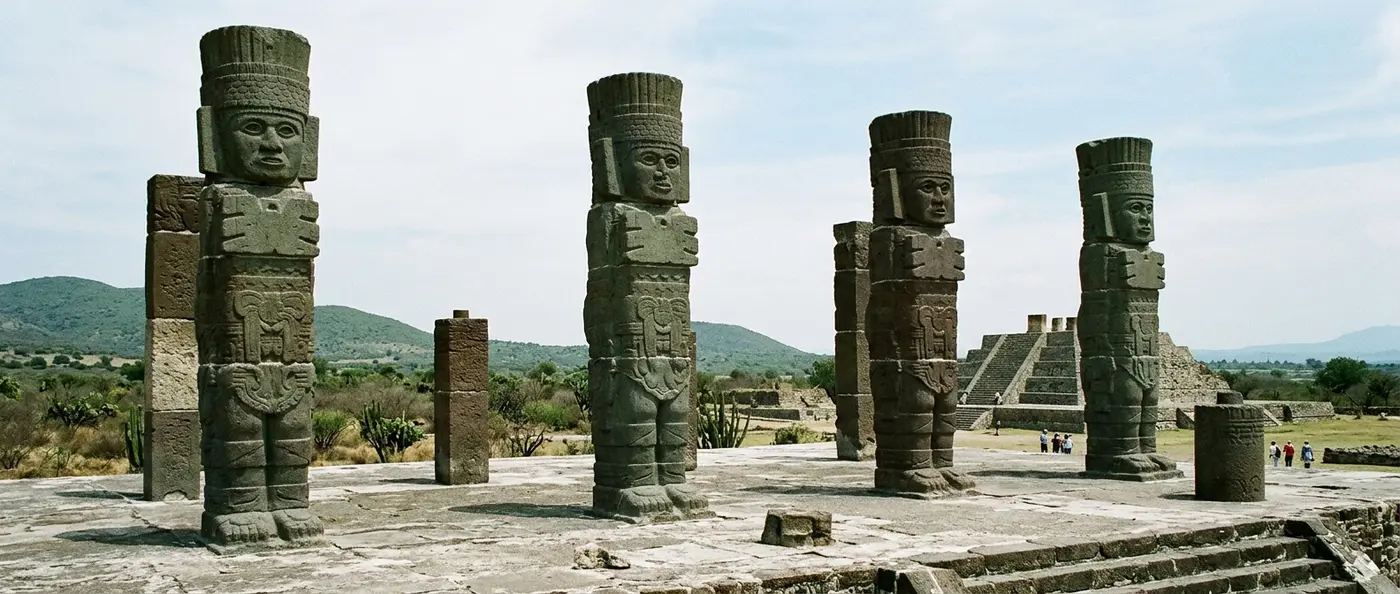
Tula showcased organization and technical mastery that left rivals scrambling to catch up. The famous Atlantean columns — massive 15-foot-tall stone warriors — still stand guard, their carved faces announcing the military power that once ruled from here. These colossal figures weren't just art. They were propaganda carved in basalt.
Toltec influence stretched far beyond Tula's borders. Archaeological evidence shows they maintained trade and cultural contacts with regions as distant as the Yucatan Peninsula to the east and Pacific coasts to the west. Their expansion relied not just on military conquest but on spreading their religious beliefs and artistic traditions. They were cultural imperialists as much as territorial ones.
⚔️ Military Culture and Organization
The Toltecs lived for war. Their society revolved around military orders and warrior virtues. Elite fighters known as Jaguars and Eagles formed the core of their army and later became the template for corresponding Aztec orders. Warfare and nobility merged into one class.
On the battlefield, they wielded weapons their enemies couldn't match. The atlatl, a spear-thrower that dramatically increased range and power, gave them battlefield advantages rivals couldn't match. Their obsidian-edged swords, called macuahuitl, cut so cleanly they could slice through hardwood. Cotton armor reinforced with salt provided surprising protection against contemporary weapons.
But Toltec power extended beyond battlefields. They developed a complex governance system blending religious and secular authority. Their ruler was considered a living embodiment of Quetzalcoatl, the Feathered Serpent god, granting him absolute power and divine legitimacy. Politics and theology merged into an unbreakable chain of command.
🏛️ Architecture and Art of the Master Craftsmen
"Toltec" in Nahuatl means "master craftsmen" or "artists," and their stonework proves the name fits. Their architecture combined monumental scale with refined decoration, creating buildings that impressed through both mass and detail. Every structure told a story of power.
Pyramid B at Tula, known as the Pyramid of Quetzalcoatl, stands as their most iconic architectural achievement. The famous Atlantean columns crown its summit — colossal warrior statues carved from basalt. Each statue consists of four perfectly fitted sections, proving Toltec mastery of stone working. These weren't just monuments. They were engineering marvels.
Building walls featured reliefs depicting jaguars, eagles, coyotes, and serpents — symbols of their military and religious ideology. Characteristic of their art were the tzompantli, walls decorated with skull reliefs symbolizing the connection between life and death, war and sacrifice. Beauty and brutality intertwined in stone.
Colossal Sculptures
The 15-foot Atlantean columns at Tula represent fully armed warriors and rank among the most impressive sculptures in pre-Columbian America.
Murals
Polychrome murals with mythological and warfare themes decorated temples and palaces, using natural pigments that still retain their vibrancy.
Plumbate Ceramics
They developed unique ceramic techniques creating metallic-finish pottery that was exported throughout Mesoamerica as luxury goods.
🔱 Religion and Mythology: The Quetzalcoatl Legacy
Quetzalcoatl, the Feathered Serpent, dominated Toltec religious life. This deity combined sky characteristics (quetzal feathers) with earth elements (serpent), representing wisdom, fertility, and wind. The Toltecs transformed Quetzalcoatl from a local deity into a pan-Mesoamerican god whose influence would outlast their civilization.
According to legends, Quetzalcoatl was also a historical figure — a priest-king of Tula who ruled with wisdom and justice. The story of his downfall, caused by conflict with followers of the war-loving god Tezcatlipoca, became a central myth that profoundly influenced later civilizations, including the Aztecs. Religion and politics fused into state mythology.
Toltec religious practices included human sacrifice, though on a smaller scale than the later Aztecs. They believed warrior blood — from those who died in battle or were sacrificed — nourished the sun on its celestial journey. This cosmology of war and sacrifice became fundamental to all subsequent Mesoamerican civilizations.
💡 The Return Prophecy
When Quetzalcoatl left Tula, he promised to return from the east. This myth played a crucial role in the Spanish conquest of Mexico, as Moctezuma initially believed Cortés was the returning god.
📖 Read more: Ancient Samnites: Italy's Forgotten Mountain Warriors
🌅 The Fall and Diaspora of the Toltecs
Around 1150 CE, Tula was abandoned and destroyed. The reasons remain hotly debated among archaeologists. Internal conflicts, climate changes causing drought, and pressure from northern nomadic populations likely all contributed to the collapse. Great civilizations rarely fall from single causes.
Tula's destruction didn't end Toltec influence. Groups of Toltecs migrated to various Mesoamerican regions, carrying their knowledge and traditions with them. At Chichen Itza in the Yucatan Peninsula, architecture and art show strong influence from Tula, indicating either Toltec migration or intensive cultural contact. Their ideas traveled even when their empire didn't.
The Aztecs, emerging centuries later, considered themselves the cultural heirs of the Toltecs. They claimed descent from Tula's royal lineage to legitimize their power. In their language, "toltec" became synonymous with high-quality artist and craftsman. The conquered became the cultural conquerors.
🏺 Daily Life in the Toltec Empire
Beyond glorious warriors and magnificent temples, Toltec society included thousands of ordinary people engaged in farming, trade, and crafts. Their economy rested on cultivating corn, beans, and squash — the sacred triad of Mesoamerican agriculture. These crops fed an empire.
The Toltecs were also long-distance traders. Their networks stretched from turquoise mines in present-day New Mexico to cacao-producing regions in Guatemala. They exchanged obsidian, ceramics, and textiles for precious feathers, jade, and other exotic goods. This trade network helped spread their culture throughout Mesoamerica.
Education mattered to the Toltecs, especially for elites. Noble children were educated in calmecac schools, where they learned writing, astronomy, religious rituals, and martial arts. Knowledge of the calendar and celestial movements was essential for priests and rulers. Information was power, literally.
📊 Toltecs vs Teotihuacan
🔬 Modern Archaeological Discoveries
Excavations at Tula continue revealing new aspects of Toltec civilization. Recent research using LiDAR technology has uncovered the city's true extent, which was much larger than previously believed. Beneath visible ruins, archaeologists have mapped an extensive network of residences, workshops, and agricultural facilities. The city was a sprawling metropolis.
Analysis of skeletal remains from Tula has provided valuable information about population diet and health. Many individuals' teeth show modification signs — filing and jade or pyrite inlays — indicating high social status. Isotopic analyses confirm their diet was primarily corn-based, but elites had access to greater food variety, including deer and turkey meat.
Studies of Toltec trade relationships prove particularly fascinating. Chemical analysis of ceramics and obsidian from various Mesoamerican sites has confirmed an extensive exchange network centered on Tula. This network wasn't limited to material goods but included the exchange of ideas, technologies, and religious practices. Commerce drove cultural diffusion.
🌟 The Eternal Influence of the Toltecs
The Toltec legacy far exceeds their civilization's temporal duration. They established foundations for many cultural traditions that would characterize Mesoamerica until Spanish arrival. The concept of the warrior-priest, the connection between war and religion, and the idea of divine ruler descent are elements the Toltecs developed and transmitted to their successors.
In modern times, the Toltecs continue to exert fascination. Their philosophy, as interpreted by contemporary authors and spiritual teachers, has found new audiences. Of course, many of these interpretations bear little resemblance to the historical Toltec civilization and more reflect contemporary spiritual searches.
For archaeologists and historians, the Toltecs remain a captivating puzzle. Each new discovery adds a piece to the picture of a civilization that bridged Mesoamerica's Classic and Postclassic periods. Studying them helps us understand not only the past but also the processes of cultural transmission and transformation that shape human societies.