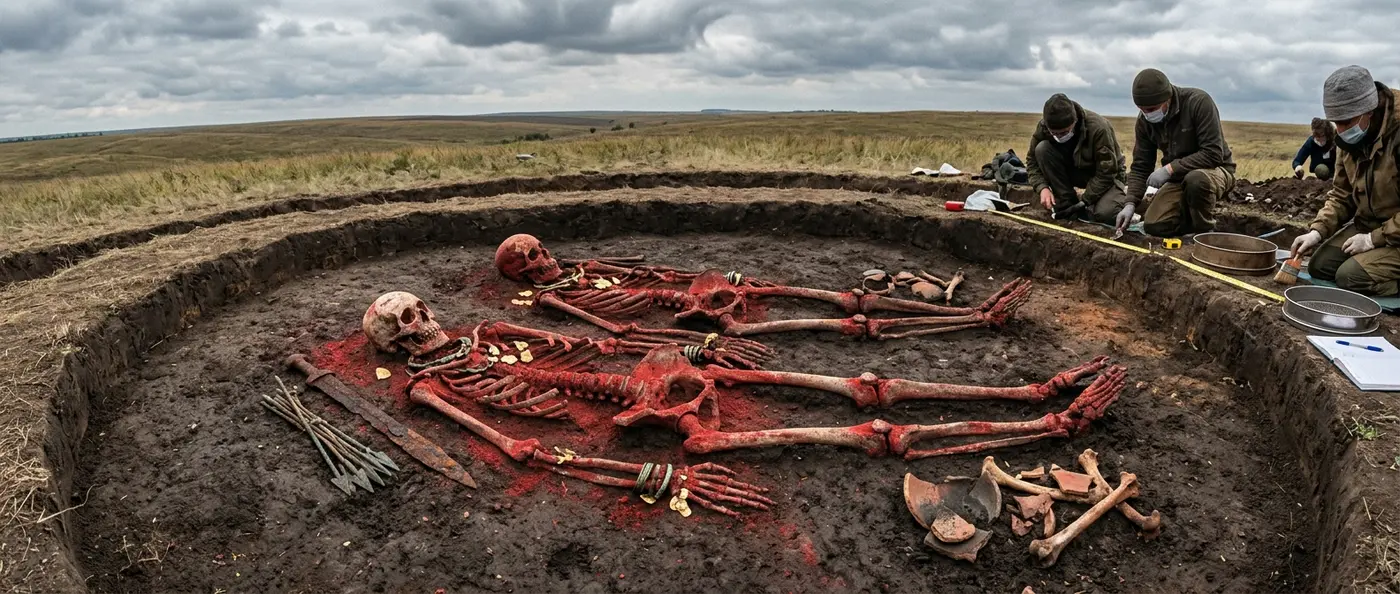
Death was red for the Scythians. Across the vast Ukrainian steppes where these nomadic warriors once ruled, archaeologists have uncovered crimson-stained burial chambers from the earth. The blood-colored mineral coating these 2,500-year-old tombs wasn't decoration. It was poison — mercury sulfide that could kill you just by breathing it. Yet the Scythians deliberately painted their dead with it, turning every royal burial into a toxic shrine that still glows scarlet today.
📖 Read more: Viking Mass Grave: Giant Warrior's Brain Surgery
🏹 Masters of the Steppes
The Scythians owned half the known world. From the 8th to 3rd centuries BCE, their empire stretched from modern Ukraine to China's borders — a territory so massive it took months to cross on horseback. They didn't build cities. They didn't need to. The steppes were their highways, and they moved across them like lightning.
Every Scythian warrior was born in the saddle. They shot arrows at full gallop with accuracy that terrified the Greeks and made the Persians think twice about invasion. Herodotus visited them in the 5th century BCE and came back with stories that sounded like myths: warriors who drank the blood of their first kill, who scalped enemies and used the skulls as drinking cups.
But beneath the barbarian reputation lay sophisticated traders. They controlled the Silk Road's northern routes, moving Chinese silk west and Greek wine east. Their tombs overflow with gold from the Urals, amber from the Baltic, and ivory from Africa. These weren't simple nomads — they were the CEOs of ancient Eurasia.
Mounted Warfare
The Scythians perfected mounted archery, creating the first truly mobile army. They could strike anywhere, anytime, then vanish into the steppes before enemies could respond.
Trade Empire
They controlled critical trade routes connecting East and West, dealing in gold, furs, honey, and slaves — accumulating wealth that rivaled Greek city-states.
Animal Art Style
Scythian goldsmiths created intricate animal-themed jewelry and weapons, developing a distinctive artistic style that influenced cultures from Siberia to the Black Sea.
🗿 Royal Burial Mounds
Ukraine's landscape is punctured with artificial hills called kurgans. Some rise 60 feet high. Underneath each one lies a Scythian tomb, and the biggest belonged to kings who commanded armies and controlled trade routes worth billions in today's money.
Building a royal kurgan took years. Workers dug deep shafts into the earth, lined them with timber, then constructed elaborate underground chambers. The king's body went in the center, surrounded by everything he'd need in the afterlife: weapons, gold jewelry, wine vessels, and sacrificed horses. Sometimes sacrificed servants too.
The Chertomlyk kurgan near Nikopol held 4 kilograms of gold artifacts. The most famous piece — a golden pectoral showing Scythian daily life in microscopic detail — now sits in Kiev's Museum of Historical Treasures. Every scene was hammered by hand: warriors milking mares, craftsmen making clothes, lions attacking deer.
📖 Read more: Alexandria's Great Library: The Ancient World's Google
💎 The Crimson Mystery
The mystery deepens in the burial chambers. Archaeologists keep finding the same thing in Scythian tombs: everything covered in brilliant red powder. Walls. Floors. Sometimes the corpses themselves, painted head to toe in crimson that still blazes after 25 centuries underground.
Chemical analysis reveals the truth. Cinnabar — mercury sulfide. One of the most toxic substances the ancient world knew. A few grams can cause tremors, memory loss, kidney failure. Prolonged exposure kills. The Scythians knew this. Chinese alchemists had been mining cinnabar for centuries, and trade routes carried both the mineral and knowledge of its dangers west.
Yet they used it anyway. Not just in royal tombs — simple graves too. Poor herders got the same red treatment as kings. Whatever this ritual meant, it transcended social class. Death made everyone equal under the crimson shroud.
⚗️ Deadly Beauty
Cinnabar's toxicity may have been the point. Ancient cultures often believed poison could protect the dead from evil spirits or grave robbers. The red mineral created a chemical barrier around the corpse — beautiful, sacred, and lethal to anyone who disturbed it.
🔬 Modern Archaeological Methods
Today's archaeologists approach Scythian sites like crime scenes. Ground-penetrating radar maps underground chambers before anyone picks up a shovel. Spectrometers identify minerals without disturbing them. 3D scanners capture every detail before artifacts leave the ground.
DNA analysis reveals family relationships between buried individuals. Isotope studies track their movements during life — what they ate, where they traveled, how far they ranged across the steppes. Some Scythian nobles journeyed thousands of miles, their bones carrying chemical signatures from distant mountains and valleys.
The red mineral poses special challenges. Mercury vapor can escape from disturbed cinnabar, forcing archaeologists to work in protective gear. Every sample gets sealed immediately. Labs analyze tiny fragments under controlled conditions, piecing together the mineral's source and composition.
🌍 Global Death Rituals
Red ochre in burials isn't unique to Scythians. Neanderthals did it 60,000 years ago. Australian Aborigines still do it today. The color connects blood, life, and rebirth across cultures that never met. But the Scythians took it further — they used industrial-grade poison instead of harmless iron oxide.
Their trade connections may explain the choice. Cinnabar came from Spain, China, and the Balkans. Scythian merchants encountered it in markets from Crimea to Central Asia. They saw how other cultures used it for medicine, magic, and mummification. Then they adapted the practice to their own beliefs about death and the afterlife.
The Sarmatians who replaced the Scythians continued the red burial tradition. So did later steppe peoples. The practice spread north into Siberia and south into the Caucasus. What started as a Scythian ritual became a signature of nomadic culture across Eurasia.
📖 Read more: Ancient Indian Graffiti Found in Egyptian Royal Tombs
🔱 Beliefs About Death
Each Scythian tomb was stocked like a survival kit for eternity. Weapons meant the dead would keep fighting. Horses meant they'd keep riding. Food and wine meant they'd keep feasting. The red mineral may have been the most crucial element — a chemical bridge between life and death.
Herodotus described Scythian funeral rites in gruesome detail. Royal bodies were embalmed, stuffed with herbs, and sewn shut. Servants and horses were strangled and arranged around the tomb. The whole burial mound became a miniature kingdom where the dead king could rule forever.
The red coating may have served multiple purposes. Protection from decay. Defense against grave robbers. Symbolic rebirth in the color of blood. Or perhaps something deeper — a belief that mercury's toxic properties could transform the dead into something more than human, something divine.
📊 Ancient Burial Practices
🏺 Legacy of the Red Tombs
Every Scythian tomb tells a story. Not just of individual lives, but of a civilization that bridged continents and connected cultures. The red mineral remains their most enigmatic signature — beautiful, deadly, and deeply meaningful in ways we're still trying to understand.
Modern Ukraine claims these ancient warriors as ancestors, and for good reason. The Scythians were the first people to unite the Ukrainian steppes under a single culture. Their artistic traditions influenced Slavic metalwork. Their trade routes became medieval highways. Their burial mounds dot the landscape like monuments to a forgotten empire.
New discoveries happen every year. Ground-penetrating radar has located thousands of unexcavated kurgans. Each one potentially holds new clues about Scythian life, death, and the mysterious red ritual that defined their passage to the afterlife. As analytical techniques improve, we may finally decode the full meaning of their crimson legacy.
The toxic red mineral that once protected Scythian kings now protects their memory. Every grain of cinnabar is a message from the past — a reminder that death, for these ancient nomads, was not an ending but a transformation. They painted themselves red to be reborn, and in a way, they succeeded. Twenty-five centuries later, we're still talking about them.