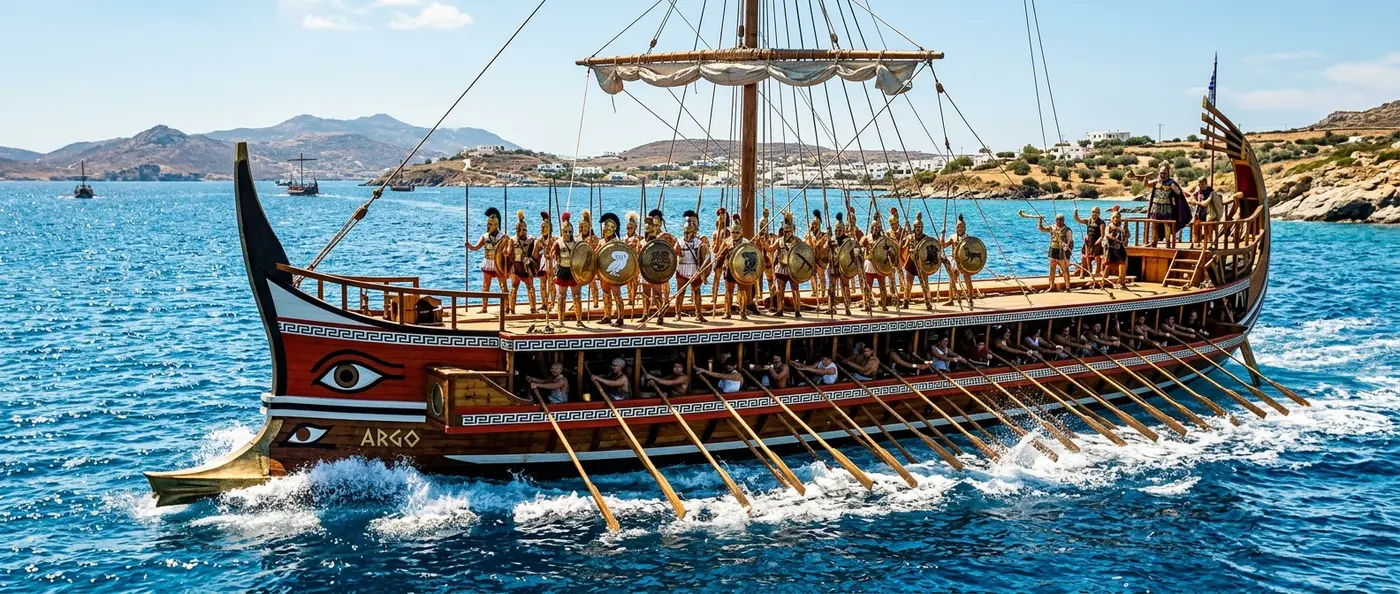
In the shipyards of ancient Athens, hundreds of craftsmen worked feverishly to complete the new warship that would forever change naval history. With three rows of oarsmen, a bronze ram at the prow, and breathtaking speed, the trireme wasn't just a ship — it was the ultimate weapon of maritime dominance that gave the Greeks victory at Salamis and shaped the course of Western civilization.
📖 Read more: 2026 Excavation Unveils 6th-Century Poseidon Temple
⚓ The Birth of the Trireme
The evolution from simple single-row ships to complex triremes didn't happen overnight. According to historical sources, the first triremes appeared around the 7th century BC, likely as an evolution of the biremes adopted by the Phoenicians. The Greeks' innovation was adding a third row of oarsmen, positioned in such a way as to maximize power without excessively increasing the ship's size.
The Athenians were the ones who perfected the trireme design, transforming it into the era's premier warship. Building a trireme required specialized craftsmen and high-quality timber — primarily pine for the frame and oak for the keel. Each ship needed about 6 months to complete and its cost was enormous, comparable to the modern value of a fighter aircraft.
The secret of the trireme's success lay in its revolutionary design. At approximately 38 meters long and just 6 meters wide, it was extremely slender and lightweight. This gave it incredible agility and speed, allowing it to execute rapid maneuvers impossible for the heavier ships of its opponents.
🏛️ Structure and Mechanism of the Trireme
The trireme's architecture was an engineering marvel for its time. The three rows of oarsmen — thranites, zygites, and thalamites — sat at slightly different levels, with small lateral and longitudinal displacement. This arrangement allowed 170 oarsmen (85 on each side) to row simultaneously without interfering with each other.
The most impressive feature was the bronze ram at the prow. Weighing about 440 pounds, the ram was designed to pierce enemy ship hulls below the waterline. The impact force was enhanced by the heavy keel that gave the ship the necessary momentum to cause catastrophic damage.
The oarsmen weren't slaves, as many believe, but free citizens who received wages for their service. They sat on leather cushions tied around their waists and used their entire bodies — not just their arms — to move the heavy oars. This technique allowed them to develop tremendous power for extended periods.
Ancient Greek naval tactics with triremes were as sophisticated as the ships themselves. The main tactics included the diekplous and periplous. In the diekplous, triremes sailed between enemy lines, striking their opponents' oars with their rams and rendering their ships unmanageable. In the periplous, the fleet moved around the enemy to strike from the flanks or rear.
The Battle of Salamis in 480 BC stands as the brightest example of Greek trireme effectiveness. Despite the Persian fleet's numerical superiority, the Greeks managed to win thanks to their superior tactics and ship agility. Themistocles lured the Persians into the straits of Salamis, where their large, slow ships couldn't maneuver effectively.
Besides ramming, triremes carried a small number of hoplites — the epibatai — who were responsible for boarding enemy ships when necessary. Usually 10-20 heavily armed soldiers who could fight on deck or attack enemy crews.
Diekplous
Penetration tactic between enemy lines to destroy oars and immobilize ships.
Periplous
Circular movement around the enemy fleet for attacks from vulnerable positions.
Ramming
Direct attack with the bronze ram into the enemy ship's hull below the waterline.
🌊 Life Aboard a Trireme
Daily life on a trireme was harsh and demanding. The 200-man crew included 170 oarsmen, 20 sailors for sails and maneuvers, and 10 marines. Space was so limited that there was no possibility for sleeping or cooking aboard. Triremes had to dock every night for resupply and crew rest.
Oarsmen worked in shifts, with rhythm provided by a flautist who played rhythmic melodies. Under normal conditions, they could maintain 4-5 knots for hours. In battle, however, they could reach 7 knots for short periods — an impressive speed for a ship powered solely by human strength.
The crew's diet was simple but nutritious. Barley biscuits, olives, figs, cheese, and diluted wine formed the basic food. Water was precious and stored in amphorae in the hold. Limited space meant supplies were restricted, making frequent stops necessary.
💡 Did You Know?
Ancient Greek athletes who won at the Panathenaic Games received amphorae filled with sacred oil from Athena's trees as prizes. This oil was so valuable it could finance the construction of equipment for an entire trireme!
🔱 The Legacy of Greek Naval Power
Trireme crews didn't just win battles — they transformed Athenian politics. The naval supremacy it secured allowed Athens to create and maintain the Delian League, a network of city-states that brought unprecedented prosperity and cultural flowering. Revenue from trade and allied tribute funded the construction of the Parthenon and other monuments we admire today.
Roman shipwrights copied the bronze ram design, adding their own decorative helmets to the deadly points. Even when larger ships with more rows of oars appeared — quadriremes, quinqueremes, even Ptolemy's gigantic tessarakonteres with 4,000 oarsmen — the basic principle of ramming and agility remained central to naval strategy.
The Romans, though initially inferior at sea, adopted and adapted Greek shipbuilding technology. Recent finds, like the bronze ram discovered off Sicily from the Battle of the Aegates Islands (241 BC), show how Romans had perfected ramming technique, adding decorative reliefs depicting Roman Montefortino-type helmets.
The trireme's significance is strongly reflected in ancient Greek art. Amphorae from the Panathenaic Games often depict naval scenes, while reliefs on temples and public buildings celebrate naval victories. Particularly impressive is a black-figure representation from 530 BC showing five nude runners — athletes competed naked believing their bodies would intimidate opponents, just as triremes impressed with their speed and agility.
In literature, from Aeschylus to Thucydides, references to triremes and naval battles are frequent. Aeschylus, who fought at Salamis, dramatically describes the Persian fleet's destruction in "The Persians." These descriptions give us valuable information about ship construction and operation.
The trireme also became a symbol of democratic Athens. The oarsmen, drawn from the lower citizen classes, gained political power thanks to their crucial role in the city's defense. This led to a more participatory form of democracy, where even the poorest citizens had a voice in public affairs.
⚔️ Ancient Warship Comparison
🔬 Modern Research and Reconstructions
Interest in ancient triremes remains vibrant in modern times. In 1987, a team of archaeologists and shipbuilders completed construction of "Olympias," a full trireme reconstruction based on archaeological finds and ancient sources. Olympias trials confirmed many theories about ancient ship performance and limitations.
Recent underwater research has brought new evidence about ancient maritime technology to light. Bronze rams discovered at 260-foot depths in the Mediterranean still preserve their decorative elements, revealing details about their construction and use. These finds show that ramming technology continued evolving for centuries after the classical period.
Trireme studies continue offering valuable insights not only into naval history but also social organization, economics, and ancient world technology. Each new discovery adds a piece to the puzzle of understanding these remarkable ships that changed history's course.