📖 Read more: Trojan War: What Archaeology Really Reveals
🏛️ The Story We Think We Know
Homer's Iliad, composed around the 8th century BCE, tells the epic tale of a ten-year siege. Paris, prince of Troy, steals Helen from Sparta's king Menelaus. This triggers a coalition of Greek city-states led by Agamemnon to launch a thousand ships against Troy's walls. The poem gives us Achilles' rage, Odysseus' cunning, Hector's nobility, and old king Priam's grief.
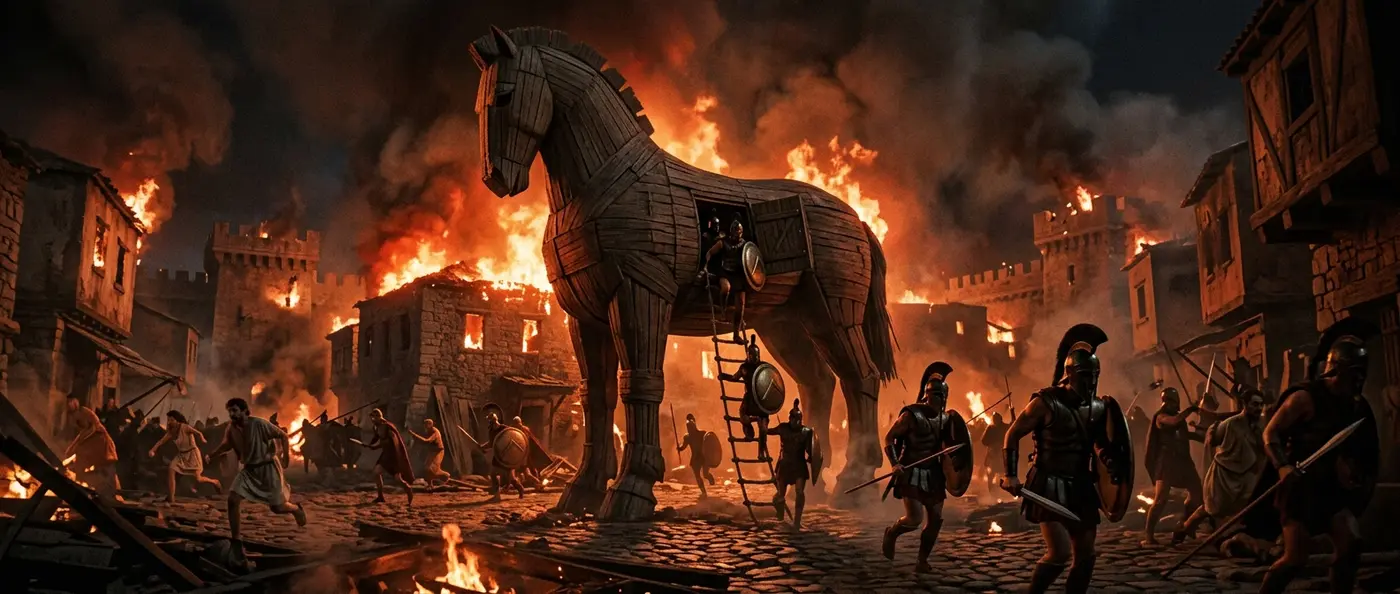
The war ends with the famous Trojan Horse stratagem—Greek warriors hidden inside a wooden offering that the Trojans drag into their city. That night, the Greeks emerge and burn Troy to the ground. The ancient Greeks never doubted this happened. Herodotus, the "father of history," calculated Troy's fall at 1250 BCE. For classical Greeks, the Trojan War wasn't mythology—it was the founding event of their civilization.
They treated it like Americans treat the Revolutionary War. Real. Documented. The starting point of everything that mattered. When Greek colonists sailed across the Mediterranean, they claimed descent from Trojan War heroes. When Alexander conquered Asia, he stopped at Troy to honor Achilles. The question that haunted scholars for centuries was simple: were the Greeks right, or spectacularly wrong?
💡 Did You Know?
Ancient historians placed Troy's destruction around 1184 BCE using genealogical calculations and mythic traditions. This date became so accepted that it served as a reference point for dating other ancient events—like using "AD" or "BCE" today. The precision was impressive for a supposedly fictional event.
🗿 The Hunt for Historical Troy
The search for the real Troy began in 1870 when Heinrich Schliemann, a German businessman turned amateur archaeologist, started digging at Hisarlik hill in northwest Turkey. He was convinced this was Homer's Troy. What he found stunned the world.
Schliemann uncovered nine distinct layers of settlement, dating from 3000 BCE to Roman times. Each layer represented a different city built on the ruins of its predecessor. Troy VI and Troy VIIa, dating to the Late Bronze Age (1700-1180 BCE), emerged as the prime candidates for Homeric Troy.
The evidence grows murky. Troy VI was destroyed around 1300 BCE, probably by earthquake. Troy VIIa that followed was smaller and poorer, but shows clear evidence of violent destruction by fire around 1180 BCE—a date that matches traditional estimates for the Trojan War. The timing was perfect. The scale? Less impressive.
⚔️ Archaeological Evidence of War
The archaeological evidence for warfare is stark. In Troy VIIa, the evidence is stark. Arrowheads embedded in walls and scattered in streets. Human bones in unnatural positions suggesting violent death. Extensive fire damage that consumed much of the city.
The architecture tells a story of siege preparation. Large storage jars were buried in house floors—emergency food supplies. Houses were crammed together inside the walls, suggesting the rural population had fled to the city for protection. The lower town, once sprawling beyond the citadel, was abandoned. Everyone had retreated behind the massive stone walls.
📜 Written Records from the Bronze Age
Beyond archaeology, there are written sources from the Bronze Age that might reference Troy. In 13th century BCE Hittite archives, there's mention of a city called "Wilusa" in northwest Anatolia—a name many scholars identify with Homer's "Ilion" (another name for Troy).
The Hittite texts describe conflicts in the region and mention a king of Wilusa named Alaksandu—strikingly similar to Alexander, Paris's other name in Greek mythology. They also reference the "Ahhiyawa," likely Homer's Achaeans.
One particularly intriguing reference appears in a letter from the last Hittite king, written around 1200 BCE. It mentions an earlier dispute over Wilusa, suggesting the region was contested for an extended period. The Hittites, it seems, knew about trouble in Troy long before Homer was born.
🏺 The Mycenaean Connection
From the Greek side, archaeology confirms that the Mycenaeans of the Late Bronze Age had the power and organization to conduct major military campaigns. The Mycenaean citadels with their Cyclopean walls, tholos tombs filled with gold grave goods, and palaces with Linear B archives reveal a warrior culture with powerful kings.
Linear B tablets from Pylos and Knossos record warriors, chariots, weapons, and ships, confirming Mycenaean military organization. One tablet from Pylos mentions coastal guards, suggesting fear of seaborne raids. These weren't peaceful traders—they were Bronze Age superpowers with the means to project force across the Aegean.
📖 Read more: Minoan Bull-Leaping: Death-Defying Ritual
🔬 Modern Scientific Approaches
Contemporary archaeologists use advanced technologies to shed new light on the mystery. Geophysical surveys have revealed the extent of Troy's lower city, which was much larger than previously believed. Using magnetometers and ground-penetrating radar, scientists discovered an extensive network of ditches and fortifications protecting an area of 300,000 square meters.
DNA analysis of human bones from the period reveals a cosmopolitan population with genetic influences from Anatolia, the Balkans, and the Aegean. Isotopic analysis of teeth shows that many inhabitants of Troy VIIa weren't born there, suggesting population movements—perhaps refugees from the countryside.
Ceramic Analysis
Chemical analysis of pottery reveals trade relationships throughout the Aegean, confirming Troy's strategic importance in maritime commerce.
Genetic Studies
Ancient DNA shows genetic diversity, with influences from Anatolia and Europe, suggesting a hub of cultural exchanges.
Satellite Imaging
Modern technology reveals ancient roads, harbors, and settlements around Troy, showing an entire network of fortified positions.
🗺️ The Geopolitical Context
To understand whether the Trojan War was real, we need to examine the broader geopolitical context. Troy sat at a strategic chokepoint, controlling passage from the Aegean to the Black Sea through the Dardanelles. This made it a hub of maritime trade and a likely target for anyone wanting to control these commercial routes.
In the 13th century BCE, the eastern Mediterranean was a complex stage of competing powers: the Hittite empire in Anatolia, Pharaonic Egypt, Assyria in Mesopotamia, and the Mycenaeans in Greece. All these powers had interests in the Aegean and Anatolia.
Around 1200 BCE, this entire region plunged into chaos. The Bronze Age collapse, caused by a combination of climate change, internal conflicts, population movements, and the mysterious "Sea Peoples," led to the destruction of many cities and civilizations. Troy wasn't the only one destroyed during this period—it was part of a broader catastrophe that ended the Bronze Age world.
💭 Myth and Historical Memory
How should we interpret the relationship between Homer's epic and archaeological findings? Most modern scholars agree that the Iliad isn't historical narrative in the modern sense. It's an epic that weaves together memories, legends, and myths from different periods.
Homer, writing 400-500 years after the events, didn't have access to historical records. What he had was an oral tradition that preserved some memories from the Bronze Age: names of great cities and kings, recollections of wars and destructions, elements of material culture like battle chariots and bronze weapons.
But Homer also projects elements from his own era into the past and adds mythological elements: gods intervening in battle, heroes with superhuman abilities, the Trojan Horse stratagem. The result is a complex work that combines historical memory with poetic imagination.
📊 Homeric Myth vs Archaeological Data
🔍 Conclusions and Open Questions
What can we say with certainty today? Archaeology confirms there was a significant fortified city at Troy's location during the Late Bronze Age. This city was violently destroyed around 1180 BCE, during a period of widespread conflicts and destructions in the eastern Mediterranean. The Mycenaeans had the capability to organize such expeditions and had contacts with northwest Anatolia.
On the other hand, there's no evidence for a ten-year war, for Homer's specific heroes, or for the Trojan Horse. The actual conflict, if it occurred, was probably smaller in scale and duration than Homer's version. The reasons were likely economic and strategic rather than romantic.
The myth of the Trojan War preserved for centuries the memory of a real place and a real destruction. When Homer described the "windy Ilion" and the "well-greaved Achaeans," he was referring to a world that had been lost but not entirely forgotten. Poetry became the vehicle that carried this memory to later centuries, transforming it into one of the foundational myths of Western civilization.
Today, as new technologies and discoveries continue to illuminate the past, the distinction between myth and history becomes more complex but also more captivating. The Trojan War remains one of archaeology's great mysteries—not simply as a question of "what really happened," but as an example of how human memory, imagination, and history interweave to create narratives that transcend time.