👑 The Transition Pharaoh
Nine years old. That's when Tutankhamun inherited the most powerful throne on Earth, around 1333 BCE. His father Akhenaten had just finished wrecking 3,000 years of religious tradition, shutting down temples and forcing Egypt to worship a single god — the Aten. The empire was falling apart.
Egyptologist Salima Ikram from the American University in Cairo calls Tutankhamun "the transition king." With help from two powerful advisors — the elderly official Ay and general Horemheb — the boy pharaoh reversed his father's revolution. He reopened the temples of Amun-Ra. Restored the priests' privileges. Moved the capital back to Memphis.
Even his name changed from Tutankhaten ("living image of the Aten") to Tutankhamun ("living image of Amun"), marking the return to old ways. He married Ankhesenamun, Akhenaten's daughter, symbolically uniting the old order with the new. For ten years, this teenager held Egypt together while his body fell apart.
💀 Death Comes for the Boy King
Tutankhamun's death at 19 stumped scientists for decades. The broken leg theory dominated — maybe he fell from his chariot, got infected, died. Then 2010 DNA analysis rewrote the story.
Malaria parasites. Found in the boy king's mummy. Combined with degenerative bone disease also detected in his remains, malaria likely killed him. He died suddenly, without naming an heir — proof his death caught everyone off guard.
But darker theories persist. General Horemheb, who eventually became pharaoh after Ay, systematically erased Tutankhamun's name from monuments. Did he have reasons to want the young king dead? Archaeologists found no murder evidence, but the circumstances remain suspicious.
The timing was catastrophic. Egypt needed stability after Akhenaten's chaos. Instead, they got another succession crisis when their teenage pharaoh collapsed without warning.
🏺 The Botched Burial
Everything about Tutankhamun's burial screams "emergency." First, they stuffed him into an unusually small tomb for a pharaoh — probably one meant for someone else, hastily converted when the boy king died unexpectedly.
Second, his mummy was slathered in thick black resin — extremely rare for royal burials. Salima Ikram explains this "black mud" might symbolize rebirth and connection to Osiris, god of the dead. But why the desperate symbolism?
Most disturbing: his heart was missing. In Egyptian tradition, the heart stayed in the body during mummification because it was essential for the afterlife journey. Without it, Tutankhamun couldn't pass the Judgment of the Dead, where hearts were weighed against a feather. Why would priests bury him without the most important organ for eternal life?
🔍 The Missing Heart Mystery
Ancient Egyptians believed the heart was weighed against a feather in the Hall of Judgment. Too heavy with sin, and you were devoured by Ammit. No heart meant no judgment — and no afterlife. Why would priests condemn their pharaoh to eternal oblivion?
🗿 The Tomb That Time Forgot
Irony saved Tutankhamun. His insignificance in life became his salvation in death. The small tomb got buried under debris from larger tombs built later. Erasing his name from monuments meant tomb robbers forgot about him.
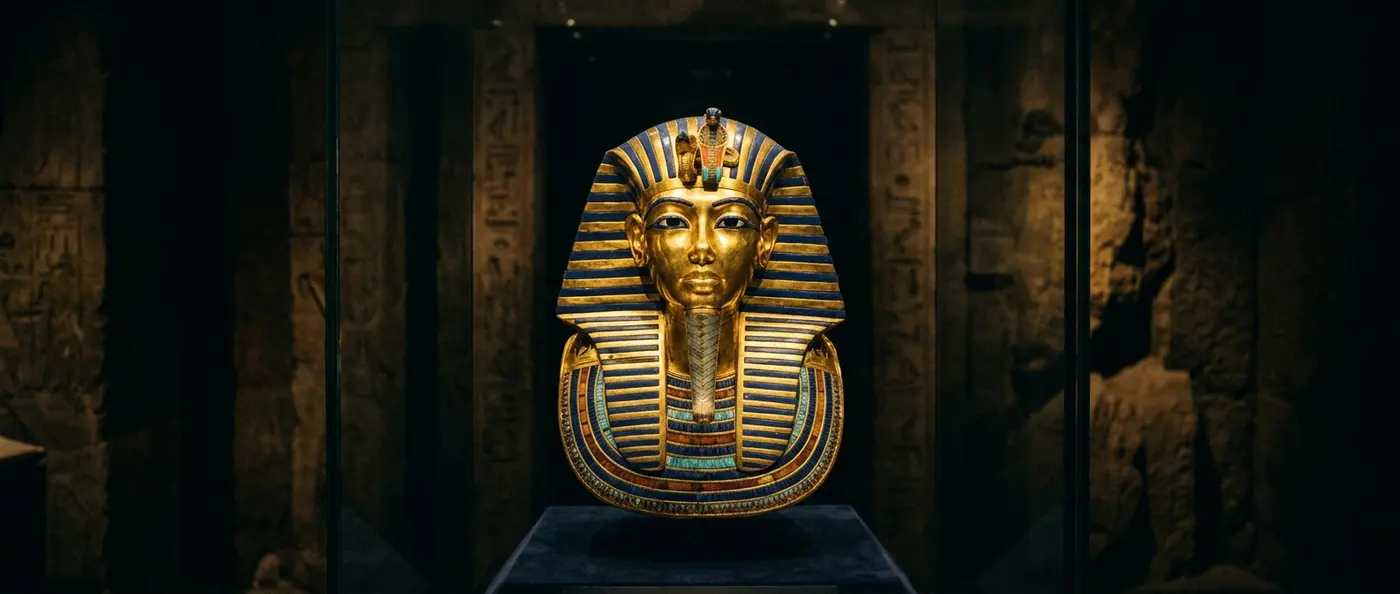
When Howard Carter peered through that hole in 1922, he saw what no archaeologist had ever seen — an intact pharaoh's burial. Over 5,000 objects crammed into four small rooms. Gold statues, jewelry, chariots, weapons, even sandals. The famous golden mask with lapis lazuli eyes became the most recognizable symbol of ancient Egypt.
Carter needed 10 years to catalog and remove everything. Each object revealed more about the life and death of the boy pharaoh who ruled during chaos. The tomb wasn't just a burial — it was a time capsule of royal life 3,300 years ago.
The Golden Mask
22 pounds of solid gold decorated with precious stones. Eyes of lapis lazuli and quartz stare into eternity with haunting beauty.
Three Nested Coffins
The mummy lay inside three coffins, one inside the other. The innermost was solid gold weighing 243 pounds — worth millions today.
Canopic Jars
Four miniature golden coffins held the pharaoh's internal organs, protected by the four sons of Horus in the afterlife journey.
⚔️ Legacy of the Forgotten King
The pharaoh erased from history became the most famous of all time. Not for his achievements — limited by his youth — but for the treasure he left behind. Tutankhamun's tomb revolutionized our understanding of ancient Egypt.
For the first time, archaeologists could see exactly how ancient Egyptians equipped a king for the afterlife journey. The objects revealed details about art, technology, religious beliefs, and daily life that no textbook could teach. Every golden amulet, every piece of furniture, every weapon told part of the story.
A century after discovery, new technologies keep revealing secrets. Radar scans suggest hidden chambers behind the tomb walls. Could Nefertiti's tomb be hidden there? The investigation continues, with each scan potentially rewriting Egyptian history again.
🔬 What Modern Science Reveals
CT scans turned Tutankhamun's mummy into an open book. The boy pharaoh had a cleft palate and clubfoot — likely results of inbreeding in the royal family. DNA confirmed his parents were siblings, explaining the genetic disorders that plagued him.
The scans revealed multiple diseases. Besides malaria, he suffered from Köhler disease, which causes bone death in the foot. Archaeologists found 130 walking sticks in his tomb — evidence he had trouble walking. This wasn't the mighty warrior pharaoh depicted in tomb paintings, but a sick child struggling against fate.
These discoveries paint a picture of a fragile young man trying to rule an empire in crisis. He wasn't the powerful warrior pharaoh shown in art, but a disabled teenager fighting multiple diseases while holding Egypt together. His death at 19 becomes even more tragic knowing how much he suffered.
📊 Tutankhamun by the Numbers
🌟 The Eternal Mystery
Tutankhamun remains a paradox wrapped in gold leaf. An insignificant pharaoh who became the most famous. A young man who died mysteriously and was buried strangely. A king erased from history only to rise again 3,000 years later.
Every new discovery brings more questions. Why was his burial so rushed? Who decided to bury him without a heart? Are there hidden chambers waiting to be discovered? The boy king keeps his secrets, even as technology strips away the bandages of time.
Maybe we'll never know all the answers. But that's what makes Tutankhamun so compelling. In a world where everything seems explainable, the boy pharaoh reminds us that the past still holds its mysteries. And perhaps that's his greatest legacy — not the gold he left behind, but the questions that continue to haunt us.